

Last Updated on 4 July 2026
Introduction
What is demat account? If you’ve ever wondered how investors safely own shares without handling piles of paper certificates, you’re asking one of the most important questions for anyone new to the stock market. Imagine buying shares of your favorite company and receiving a stack of paper certificates every time you invest. Losing just one certificate could mean losing proof of your ownership.
That was exactly how investing worked in India before the late 1990s.
Today, investing is much simpler and more secure. Whether you purchase shares, ETFs, bonds, or other securities, everything is stored electronically in a secure digital account known as a Demat Account.
If you’re just beginning your investment journey, you may be wondering, what is demat account, how does it work, and why is it necessary? Understanding this concept is essential before investing in the stock market because a demat account forms the foundation of modern investing in India.
Having invested in Indian equities and mutual funds for several years, I’ve noticed that many beginners confuse a demat account with a trading account or even a bank account. While these three accounts work together, each serves a different purpose. Once you understand the role of a demat account, the entire investing process becomes much easier to understand.
In this guide, we’ll explain about demat account, how it works, its key benefits, and why every stock market investor should understand it before making their first investment.
In this guide, you’ll learn:
- What is a demat account?
- Why is it important?
- How does it work?
- What are its benefits?
- Who needs one?
- How is it different from a trading account?
Let’s start with the basics.
What Is Demat Account?
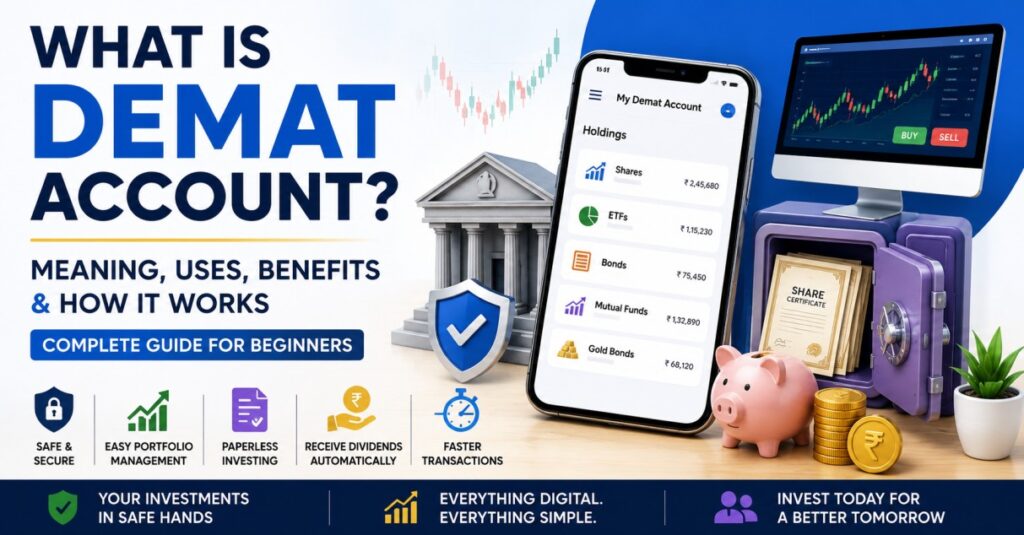
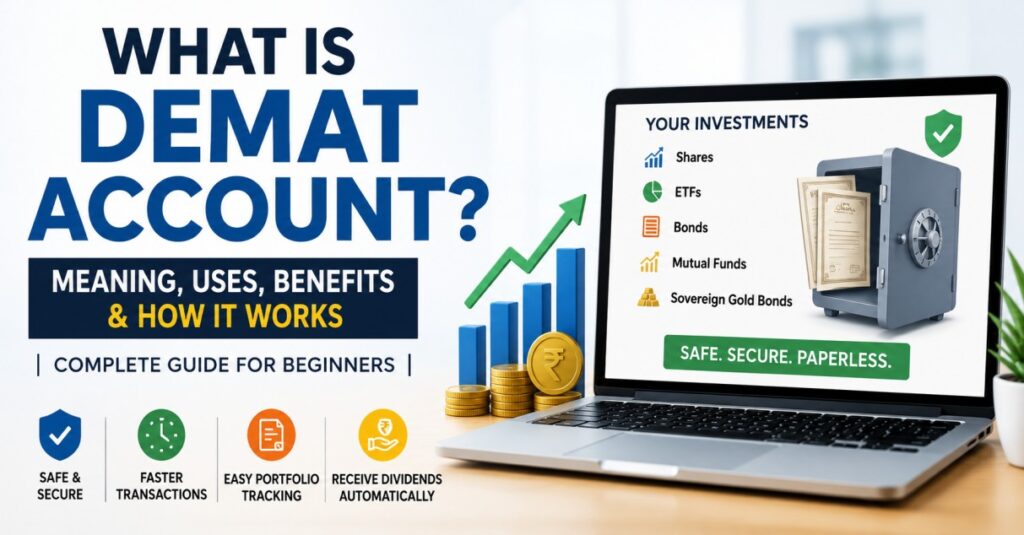
A Demat Account (short for Dematerialized Account) is an electronic account that stores your financial securities in digital form.
Instead of receiving physical share certificates, all your investments are safely held electronically.
Think of it like this:
- A bank account stores your money.
- A demat account stores your investments.
Your demat account can hold:
- Shares
- Exchange Traded Funds (ETFs)
- Government securities
- Corporate bonds
- Sovereign Gold Bonds
- REITs
- InvITs
- Mutual fund units (if purchased through supported platforms)
Whenever you buy securities, they are credited to your demat account. When you sell them, they are debited automatically.
This digital system makes investing safer, faster, and more convenient.
Why Was the Demat Account Introduced?
Before electronic investing, investors received paper share certificates.
This created several problems:
- Certificates could be lost.
- Documents could be damaged.
- Fake certificates were common.
- Ownership transfer often took weeks or months.
- Selling shares involved extensive paperwork.
To solve these issues, India introduced the dematerialization system, replacing physical certificates with electronic records.
Today, almost all stock market investments in India happen through demat accounts, making the process efficient and secure.
How Does it Work?
A demat account acts like a secure digital locker for your investments.
Here’s a simple example.
Suppose you buy 10 shares of a listed company.
The process looks like this:
- You place a buy order using your trading account.
- The stock exchange matches your order with a seller.
- The transaction is settled.
- The purchased shares are transferred electronically to your demat account.
Now those shares remain safely stored until you decide to sell them.
When you sell:
- The shares are automatically removed from your demat account.
- The sale proceeds are credited to your linked bank account after settlement.
The entire process usually happens electronically without any paperwork.
How Does it Fit Into the Investment Process?
Many beginners assume they only need one account for investing.
In reality, three different accounts work together.
| Account | Purpose |
|---|---|
| Bank Account | Holds your money |
| Trading Account | Places buy and sell orders |
| Demat Account | Stores your investments |
Think of it like online shopping.
- Your bank account is your wallet.
- The trading account is the shopping cart.
- The demat account is your cupboard where purchased items are stored.
Each account has a unique role.
Demat Account vs Trading Account
One of the biggest misconceptions among new investors is assuming both accounts are the same.
They are not.
| Feature | Demat Account | Trading Account |
|---|---|---|
| Purpose | Stores securities | Buys and sells securities |
| Holds Shares | Yes | No |
| Required for Stock Delivery | Yes | Yes |
| Executes Trades | No | Yes |
| Similar To | Bank Locker | Shopping Counter |
A simple way to remember this:
Trading Account = Transaction
Demat Account = Storage
You generally need both accounts if you want to buy and sell stocks in India.
Who Maintains Your account?
Your investments aren’t stored by your broker directly.
Instead, they are held securely through India’s two official depositories:
- National Securities Depository Limited (NSDL) – Primarily associated with the National Stock Exchange (NSE).
- Central Depository Services (India) Limited (CDSL) – Widely used across brokers and linked with the Bombay Stock Exchange (BSE).
Your broker acts as a Depository Participant (DP), giving you access to your demat account while the securities remain with the depository.
This structure provides an additional layer of safety because your investments are kept separately from your broker’s own assets.
My Experience: Why Understanding Matters
When I started investing, I mistakenly believed that opening a trading account was enough.
Only after making my first stock purchase did I understand that the shares themselves had to be stored somewhere—and that’s exactly what a demat account does.
Once I understood the difference between a bank account, trading account, and demat account, investing became much less confusing.
This is why I always recommend that beginners spend a little time understanding the basics before making their first investment. A clear understanding of these concepts can prevent many common mistakes later.
Why Do You Need?
If you’re planning to invest in the Indian stock market, a demat account is more than just a convenience—it’s an essential tool. For most equity investments on Indian stock exchanges, holding shares in electronic form is mandatory.
Whether you’re a first-time investor or someone building long-term wealth, a demat account simplifies the entire investment journey.
Here are some of the key reasons why investors use one:
- It securely stores your investments in digital form.
- It eliminates the risks associated with physical share certificates.
- It enables quick buying and selling of securities.
- It makes tracking your investment portfolio easier.
- It allows you to receive corporate benefits like dividends and bonus shares directly.
In short, a demat account acts as the foundation of your stock market investments.
What Is the Use of a Account?
Many beginners think a demat account is only for buying shares. In reality, it can hold a variety of investment products.
Here are its primary uses:
1. Store Shares Electronically
The most common use of a demat account is storing equity shares securely in digital form.
Unlike physical certificates, digital holdings cannot be lost, stolen, or damaged.
2. Invest in ETFs
Exchange Traded Funds (ETFs) are bought and sold on stock exchanges just like shares.
Every ETF you purchase is credited directly to your account.
3. Hold Government Securities
Investors can also keep government securities and treasury instruments in account.
These investments are popular among conservative investors seeking lower risk.
4. Store Corporate Bonds
Many companies issue bonds that can be held electronically through a account.
This makes fixed-income investing more organized and transparent.
5. Invest in Sovereign Gold Bonds (SGBs)
Instead of buying physical gold, investors can purchase Sovereign Gold Bonds and store them safely in their account.
This eliminates storage concerns while providing exposure to gold.
6. Hold REITs and InvITs
Real Estate Investment Trusts (REITs) and Infrastructure Investment Trusts (InvITs) are listed on stock exchanges.
These investments are also stored electronically in your account.
7. Simplify Portfolio Management
A demat account allows you to view all your eligible investments in one place.
Instead of managing multiple physical documents, you can monitor your portfolio through your broker’s app or website.
Benefits of a Demat Account
The popularity of demat accounts isn’t just because they’re mandatory for most stock investments—they also offer significant practical advantages.
1. Safe and Secure
Physical share certificates could easily be misplaced, stolen, or damaged.
With a demat account, your securities are stored electronically under regulated depositories, greatly reducing these risks.
2. Faster Transactions
Buying and selling securities takes place electronically, making the process much quicker than the old paper-based system.
Settlement cycles have become significantly faster, improving liquidity for investors.
3. Easy Portfolio Tracking
Instead of maintaining files of paper certificates, you can log into your broker’s platform and instantly see:
- Current holdings
- Purchase price
- Market value
- Overall profit or loss
This convenience is especially valuable for long-term investors.
4. Automatic Corporate Benefits
When a company announces:
- Dividends
- Bonus shares
- Stock splits
- Rights issues
eligible benefits are processed electronically, reducing paperwork and administrative delays.
5. Reduced Risk of Fraud
Since ownership records are maintained electronically through regulated depositories, the chances of fake or duplicate share certificates are virtually eliminated.
6. Easy Transfer of Securities
Transferring securities between demat accounts is straightforward compared to the lengthy paperwork involved with physical certificates.
7. Environment Friendly
By replacing paper certificates with digital records, the demat system also contributes to reducing paper usage.
Who Should Open a Demat Account?
A common misconception is that demat accounts are only for active stock traders.
In reality, they’re useful for a wide range of investors.
You should consider opening a account if you:
- Want to invest in stocks.
- Plan to buy ETFs.
- Intend to invest in Sovereign Gold Bonds.
- Wish to invest in REITs or InvITs.
- Want to build a long-term investment portfolio.
- Prefer managing investments digitally.
Even if you invest only occasionally, having a account gives you the flexibility to participate in various investment opportunities.
Documents Required to Open a Demat Account
Opening a demat account has become a simple online process.
Typically, you’ll need:
| Document | Purpose |
|---|---|
| PAN Card | Mandatory identity for financial transactions |
| Aadhaar Card | Identity and address verification |
| Mobile Number | OTP verification |
| Email Address | Account communication |
| Bank Account Details | Linking for fund transfers |
| Passport-size Photograph | Identity verification |
| Signature | Digital verification |
Some brokers may request additional documents depending on regulatory requirements.
How to Open a Account (Step-by-Step)
The online process usually takes only a few minutes.
Step 1
Choose a registered broker that suits your investment needs.
Step 2
Complete the online application form.
Step 3
Upload the required KYC documents.
Step 4
Complete Aadhaar-based OTP or video KYC verification.
Step 5
Link your bank account.
Step 6
Digitally sign the application.
Step 7
After successful verification, your demat account is activated.
You can then start investing in eligible securities.
Charges Explained
Many beginners believe demat accounts are completely free.
While some brokers offer free account opening, certain charges may still apply.
| Charge | Description |
|---|---|
| Account Opening Fee | Some brokers charge this, while many waive it |
| Annual Maintenance Charge (AMC) | Yearly fee for maintaining the account |
| DP Charges | Charged when selling securities from the demat account |
| Pledge Charges | Applicable if securities are pledged |
| Off-market Transfer Charges | For transferring securities outside exchange transactions |
Before choosing a broker, always compare the complete fee structure rather than focusing only on account opening charges.
Choosing the Right Broker: What Matters Most?
When selecting a broker, don’t base your decision solely on advertisements or promotional offers.
Consider factors such as:
- Regulatory compliance
- Transparent pricing
- User-friendly mobile app
- Quality of customer support
- Research tools (if you need them)
- Ease of account opening
- Reliability and reputation
A broker with slightly higher fees but excellent service can often provide a better overall investing experience than one offering “free” accounts with limited support.
Detailed information about ₹1,000 Monthly SIP in Nifty 50 Index Fund for 20 Years
Common Myths About Demat Accounts
Many new investors hesitate to open a demat account because of misinformation. Let’s clear up some of the most common myths.
Myth 1: A Demat Account Is Only for Stock Traders
Reality:
This is one of the biggest misconceptions. While traders use demat accounts daily, long-term investors also need them to hold shares, ETFs, REITs, InvITs, and many other securities electronically.
If your goal is long-term wealth creation rather than frequent trading, a account is still an essential tool.
Myth 2: Opening a Demat Account Means You Must Trade Every Day
Reality:
Opening a demat account doesn’t obligate you to trade regularly. You can buy quality investments and hold them for years without making frequent transactions.
In fact, many successful investors believe that patience often delivers better results than constant buying and selling.
Myth 3: Demat Accounts Are Expensive
Reality:
Today, many brokers offer free account opening and competitive annual maintenance charges (AMCs). However, it’s important to compare the complete fee structure, including DP charges and brokerage, rather than focusing only on promotional offers.
Myth 4: My Investments Belong to My Broker
Reality:
Your securities are held with regulated depositories through your broker, not owned by the broker itself. This structure provides an additional layer of safety for investors.
Common Mistakes Beginners Should Avoid
Starting your investment journey with the right habits can save you time, money, and unnecessary stress.
Here are some mistakes to watch out for:
Choosing a Broker Based Only on Low Fees
A broker with poor customer support or unreliable technology can create problems later. Consider service quality, platform stability, and transparency—not just pricing.
Ignoring Annual Charges
Many investors focus only on free account opening and overlook recurring charges. Always review the complete pricing schedule before opening an account.
Not Updating KYC Details
Ensure your mobile number, email address, and bank account information remain up to date. This helps avoid delays in receiving important communications and corporate benefits.
Sharing Login Credentials
Never share your trading or demat account password or OTP with anyone. Enable two-factor authentication whenever available to enhance account security.
Investing Without Understanding the Product
A demat account makes investing easy, but it doesn’t guarantee profits. Always research the securities you’re buying and ensure they align with your financial goals and risk tolerance.
To know more about ₹500 Monthly SIP in Nifty 50 Index Fund Returns
Frequently Asked Questions (FAQs)
1. What is a demat account in simple words?
A demat account is an electronic account that stores your investments—such as shares, ETFs, bonds, and other eligible securities—in digital form. It works much like a bank account, but instead of money, it holds your investments.
2. Is a demat account mandatory for investing?
For most equity investments listed on Indian stock exchanges, yes. If you want to buy and hold listed shares electronically, you’ll generally need a demat account.
3. Can I have more than one demat account?
Yes. You can open multiple demat accounts with different brokers, provided you comply with applicable regulations and complete the required KYC process.
4. Is a trading account the same as a demat account?
No.
A trading account is used to place buy and sell orders, while a demat account stores the securities you own.
5. Can I invest in mutual funds without a demat account?
Yes. Many mutual funds can be purchased directly through Asset Management Companies (AMCs) or other investment platforms without a demat account. However, some platforms also allow you to hold mutual fund units in demat form.
6. Can I close my demat account later?
Yes. If you no longer need your demat account, you can request its closure after following your broker’s prescribed process and ensuring there are no remaining holdings or pending obligations.
7. Is my money kept in a demat account?
No.
Your money remains in your linked bank account. A demat account stores only your eligible securities, not cash.
For detailed information about Best Share Market Investment Tips for Long Term
Key Takeaways
Here’s a quick summary of what we’ve covered:
| Topic | Key Point |
|---|---|
| What is a Demat Account? | A digital account that stores eligible securities electronically |
| Why Is It Needed? | Enables secure and paperless investing |
| Main Uses | Holding shares, ETFs, bonds, REITs, InvITs, and more |
| Who Needs It? | Anyone planning to invest in listed securities |
| Trading vs Demat | Trading account executes transactions; demat account stores investments |
| Major Benefits | Safety, convenience, faster settlements, and easier portfolio management |
Final Thoughts
If you’re serious about building wealth through the stock market, understanding what is demat account is one of the first and most important steps.
Think of it as the digital foundation of your investment journey. Just as a savings account helps you manage your money, a demat account helps you securely own and manage your investments.
Technology has transformed investing from a paper-heavy process into a seamless digital experience. Today, opening a demat account takes only a short time, and it provides access to a wide range of investment opportunities.
However, remember that a demat account is simply a tool. Long-term success depends on making informed investment decisions, staying disciplined, diversifying appropriately, and remaining invested for the long run.
Whether you’re investing your first ₹1,000 or building a diversified portfolio over many years, understanding the basics today can help you make smarter financial decisions tomorrow.
Disclaimer: The content provided is for educational and informational purposes only and should not be considered financial, investment, insurance, or legal advice.