


Last Updated on 14 July 2026
Introduction
SBI Mutual Fund is one of the largest and most trusted mutual fund houses in India. Backed by the reputation of State Bank of India, the fund house offers a wide range of investment options across equity funds, debt funds, hybrid funds, and index funds. For investors looking to understand long-term performance, exploring the top performing SBI mutual funds in India last 10 years can provide useful insights into how different SBI schemes have performed across various market cycles.
Over the last decade, mutual fund investing has become increasingly popular among Indian investors. Many people who earlier preferred fixed deposits and traditional savings products have started exploring mutual funds to build long-term wealth.
However, choosing the right mutual fund can be challenging. Investors often compare different SBI schemes to identify the top SBI mutual funds in India based on factors such as historical performance, investment strategy, risk level, and suitability for their financial goals.
While past performance does not guarantee future returns, analysing a fund’s long-term track record can help investors understand its consistency, investment approach, risk profile, and potential suitability.
In this article, we will explore some of the top-performing SBI mutual funds over the last 10 years, their features, benefits, risks, and important factors investors should consider before investing.
Note: Mutual fund returns, expense ratios, assets under management (AUM), fund managers, and other details may change over time. Investors should verify the latest information from the official SBI Mutual Fund website and scheme documents before making investment decisions.
Understanding SBI Mutual Fund
What is SBI Mutual Fund?
SBI Mutual Fund is an asset management company that manages investment schemes pooled from thousands of investors.
When investors invest in a mutual fund, their money is collected and invested in assets such as:
- Stocks
- Bonds
- Government securities
- Money market instruments
A professional fund manager manages these investments according to the objective of the scheme.
For example:
- An equity fund invests mainly in company shares.
- A debt fund invests in fixed-income securities.
- A hybrid fund combines equity and debt investments.
The return generated depends on the performance of the underlying investments.
For detailed information about Top Performing Nippon India Mutual Funds List (2026)
Why Investors Look at 10-Year Mutual Fund Performance
A 10-year period is considered meaningful because it includes different market cycles.
During the last decade, Indian equity markets experienced:
- Economic growth periods
- Market corrections
- Global uncertainties
- The COVID-19 market crash
- Strong market recoveries
A fund that performs consistently across different market conditions may indicate a disciplined investment approach.
However, investors should remember:
A fund that performed well in the past may not necessarily remain the best performer in the future.
Investment decisions should consider multiple factors including:
- Fund objective
- Risk level
- Portfolio quality
- Expense ratio
- Investment horizon
- Personal financial goals
For detailed information about Best Arbitrage Mutual Funds in India 2026
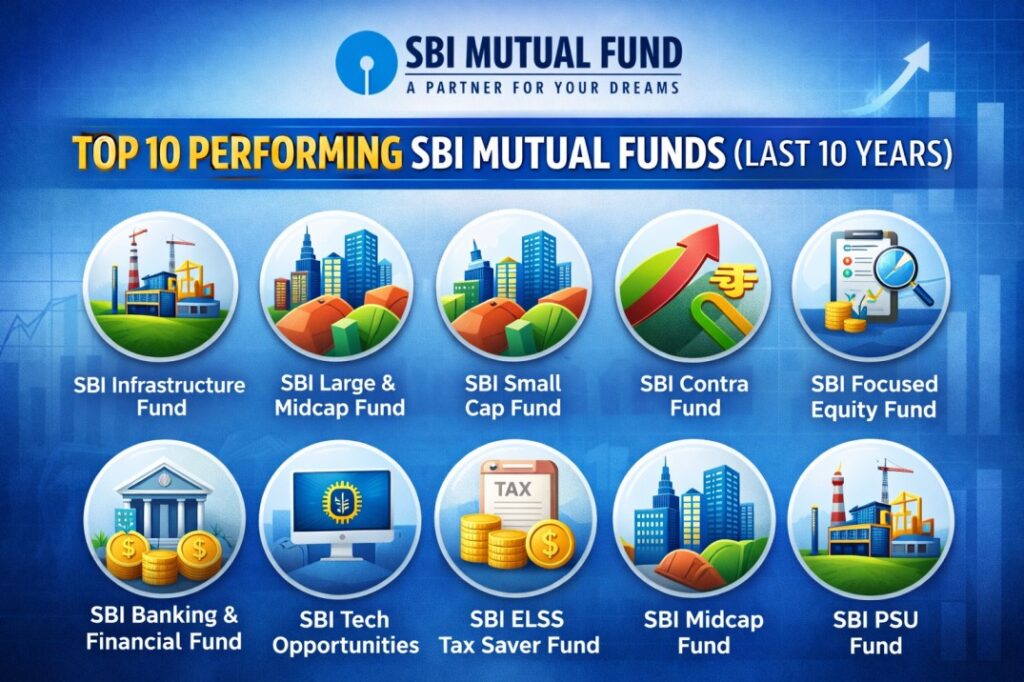
Top Performing SBI Mutual Funds in India Last 10 Years
The following SBI mutual fund schemes have been among the notable performers over the long term based on their category performance and historical track records.
(Returns mentioned in mutual fund discussions change regularly. Investors should check the latest performance data from official sources before investing.)
1. SBI Small Cap Fund
Fund Category:
Small Cap Equity Fund
SBI Small Cap Fund has attracted significant investor attention because small-cap companies have the potential to grow faster compared to larger established companies.
The fund primarily invests in small-cap companies with long-term growth opportunities.
Why Investors Consider SBI Small Cap Fund
- Exposure to emerging companies
- Long-term wealth creation potential
- Diversified small-cap portfolio
- Suitable for investors with higher risk tolerance
Risks
Small-cap funds can experience large price fluctuations because smaller companies are generally more sensitive to:
- Economic changes
- Business risks
- Market sentiment
Investors should have a long investment horizon before considering small-cap funds.
Suitable For:
- Investors with 7–10+ year horizons
- Investors comfortable with high volatility
- Long-term wealth creation goals
Not Suitable For:
- Short-term investors
- Investors looking for guaranteed returns
- People uncomfortable with market fluctuations
2. SBI Focused Equity Fund
Fund Category:
Focused Equity Fund
SBI Focused Equity Fund follows a focused investment approach, meaning it invests in a limited number of companies compared to diversified equity funds.
The objective is to invest in companies that the fund manager believes have strong growth potential.
Key Features
- Concentrated portfolio approach
- Investment across market capitalisations
- Long-term equity investment strategy
Benefits
- Potential for higher returns if selected companies perform well
- Professional fund management
- Exposure to quality businesses
Risks
Because the portfolio contains fewer companies, poor performance of some holdings can have a bigger impact.
3. SBI Large & Midcap Fund
Fund Category:
Large & Mid Cap Equity Fund
This fund combines investments in large companies and mid-sized companies.
Large companies generally provide stability, while mid-cap companies can offer higher growth potential.
Why Investors Prefer Large & Midcap Funds
| Feature | Benefit |
|---|---|
| Large-cap exposure | More stability |
| Mid-cap exposure | Growth opportunities |
| Diversification | Balanced approach |
Suitable For:
Investors who want a combination of stability and growth through equity investing.
4. SBI Contra Fund
Fund Category:
Contra Equity Fund
SBI Contra Fund follows a contrarian investment strategy.
This means the fund may invest in companies that are currently undervalued but may have potential for improvement in the future.
Example:
A company may temporarily face challenges due to market conditions, but if the business fundamentals remain strong, a contrarian investor may see future opportunity.
Advantages
- Opportunity to invest in undervalued businesses
- Different investment approach compared to traditional funds
Risks
- Recovery of undervalued companies may take time
- Strategy may underperform during certain market cycles
Comparison of Top SBI Mutual Funds in India
The following table provides a broad comparison of some popular SBI mutual fund schemes. Investors should verify current scheme details, portfolio composition, expense ratio, and performance data from official sources before investing.
| SBI Mutual Fund Scheme | Category | Investment Style | Risk Level | Suitable Investment Horizon |
|---|---|---|---|---|
| SBI Small Cap Fund | Small Cap Equity | Growth-oriented small companies | High | 7–10+ years |
| SBI Focused Equity Fund | Focused Equity | Limited number of companies | High | 5–7+ years |
| SBI Large & Midcap Fund | Large & Mid Cap Equity | Mix of large and mid-sized companies | Moderate to High | 5–7+ years |
| SBI Contra Fund | Contra Equity | Invests in undervalued opportunities | High | 5–10+ years |
| SBI Bluechip Fund | Large Cap Equity | Established large companies | Moderate | 5+ years |
5. SBI Bluechip(now Largecap) Fund
Fund Category:
Large Cap Equity Fund
SBI Bluechip Fund focuses mainly on large and established companies. Large-cap companies generally have stronger business models, experienced management teams, and a longer operating history.
For beginners entering equity mutual funds, large-cap funds are often considered easier to understand because they invest in well-established businesses.
Benefits of SBI Bluechip Fund
- Exposure to large and reputed companies
- Relatively lower volatility compared to small-cap funds
- Suitable for long-term equity investors
- Professional portfolio management
Risks
Although large-cap funds may fluctuate less compared to smaller companies, they are still affected by stock market movements.
Risks include:
- Market downturns
- Economic slowdown
- Company-specific issues
For detailed information about Best Corporate Bond Funds in India 2026
Benefits of Investing in Top SBI Mutual Funds
1. Professional Fund Management
One major advantage of mutual funds is that investors do not need to select individual stocks themselves.
A professional fund management team researches companies, analyses industries, and makes investment decisions according to the scheme objective.
For beginners, this can make equity investing easier.
2. Diversification
When investors buy a mutual fund, their money is usually invested across multiple companies.
For example:
Instead of investing ₹50,000 in one company, a mutual fund may spread the investment across dozens of companies from different sectors.
This reduces dependence on a single company’s performance.
3. Long-Term Wealth Creation Potential
Historically, equity mutual funds have provided opportunities for wealth creation over long periods.
However, returns depend on:
- Market conditions
- Fund performance
- Economic growth
- Investor behaviour
Investors should avoid expecting guaranteed returns.
4. SIP Facility for Regular Investing
Systematic Investment Plans (SIPs) allow investors to invest a fixed amount regularly.
Example:
A person investing ₹5,000 every month through SIP continues investing regardless of market ups and downs.
Benefits of SIP include:
- Developing investment discipline
- Avoiding the pressure of timing the market
- Starting with smaller amounts
However, SIPs do not eliminate market risk.
For detailed information about Top 10 ICICI Prudential Mutual Funds for Long Term Investment in India
Risks of Investing in SBI Mutual Funds
1. Market Risk
Equity mutual funds are linked to stock market performance.
During market corrections, the value of mutual fund investments can decline temporarily.
Example:
If the stock market falls sharply, equity mutual funds may also experience short-term losses.
2. No Guaranteed Returns
Unlike fixed deposits, mutual funds do not offer guaranteed returns.
Even funds with strong historical performance can underperform in future market conditions.
3. Investment Horizon Risk
Some investors invest in equity funds for short periods and expect quick profits.
This can create problems because equity investments generally require patience.
A short-term investor may have to withdraw during a market decline.
4. Fund Selection Risk
Choosing a mutual fund only because it had the highest past return can be risky.
Investors should also evaluate:
- Investment philosophy
- Portfolio quality
- Risk level
- Consistency
- Suitability
Pros and Cons of Top SBI Mutual Funds
Pros
✅ Strong brand reputation
✅ Wide range of mutual fund schemes
✅ Professional management
✅ Diversified investment options
✅ SIP investment facility
✅ Suitable options for different investor categories
Cons
❌ Returns are not guaranteed
❌ Equity funds can be volatile
❌ Past performance may not continue
❌ Some funds may require a long investment horizon
❌ Investors need to understand risk before investing
For detailed information about Best Ultra Short Term Mutual Funds in India 2026
Who Should Invest in SBI Mutual Funds?
SBI mutual funds may be suitable for investors who:
- Want professional investment management
- Have long-term financial goals
- Understand market risks
- Prefer mutual funds over selecting individual stocks
- Can remain invested during market fluctuations
Examples of financial goals:
- Retirement planning
- Child education
- Wealth creation
- Long-term savings goals
Who Should Avoid SBI Equity Mutual Funds?
Investors may want to avoid equity mutual funds if they:
- Need money within a short period
- Cannot tolerate temporary losses
- Expect guaranteed returns
- Do not understand market-linked investments
For short-term goals, investors may explore other investment options depending on their requirements and risk profile.
For detailed information about Best Liquid Funds for Beginners in India
Practical Example: How an Investor May Approach SBI Mutual Funds
Suppose Rahul is a 30-year-old salaried professional.
His goal is to create wealth for retirement after 25 years.
Instead of investing randomly in multiple funds, he first evaluates:
- His risk tolerance
- Monthly investment capacity
- Investment duration
- Financial goals
He may consider equity mutual funds because his investment horizon is long.
However, before investing, he researches:
- Fund objective
- Historical consistency
- Portfolio strategy
- Risk factors
- Latest scheme information
This approach is more practical than selecting a fund only because it generated high returns in the past.
For detailed information about Best Axis Mutual Funds for Long Term 2026
Common Mistakes Investors Make While Choosing SBI Mutual Funds
1. Selecting Funds Only Based on Highest Returns
Many investors choose the fund with the highest recent performance.
The problem is that recent winners may not always remain winners.
A better approach is analysing long-term consistency.
2. Ignoring Risk Level
A small-cap fund may provide higher growth potential but can experience larger declines.
Investors should match the fund category with their risk capacity.
3. Investing Without a Goal
Investing without knowing the purpose can lead to wrong decisions.
Every investment should have a clear objective.
Examples:
- Retirement
- Home purchase
- Education
- Long-term wealth creation
4. Frequent Buying and Selling
Many investors exit mutual funds during market falls due to fear.
Long-term investing requires patience and discipline.
5. Investing Too Many Funds
Holding too many mutual funds does not always mean better diversification.
A large number of similar funds can create unnecessary complexity.
How to Choose the Right SBI Mutual Fund?
Choosing a mutual fund should not be based only on historical returns. A good investment decision requires understanding your financial goals, risk capacity, and investment timeframe.
Here are some important factors investors can consider before selecting an SBI mutual fund.
1. Understand Your Investment Goal
Before investing, ask yourself:
Why am I investing?
Different goals require different investment approaches.
Examples:
| Goal | Possible Investment Approach |
|---|---|
| Retirement after 20 years | Long-term equity funds may be considered |
| Child education after 10 years | Goal-based diversified investments |
| Short-term requirement | Lower-risk options may be considered |
A fund suitable for retirement may not be suitable for a short-term goal.
2. Check the Fund Category
Every mutual fund category has a different risk and return profile.
Equity Funds
Invest mainly in stocks.
Suitable for:
- Long-term investors
- Wealth creation goals
Risk:
- Higher short-term volatility
Debt Funds
Invest mainly in fixed-income instruments.
Suitable for:
- Investors seeking relatively stable investments
Risk:
- Interest rate and credit risks
Hybrid Funds
Invest in a combination of equity and debt.
Suitable for:
- Investors looking for a balance between growth and stability
3. Evaluate Long-Term Consistency
A fund should not be judged only by one-year or two-year performance.
Investors can analyse:
- Performance across different market cycles
- Consistency compared with benchmark and category peers
- Downside protection during market corrections
A consistent fund may be preferable to a fund that performs extremely well only during certain periods.
4. Review Portfolio Quality
Investors should understand where their money is invested.
Important points include:
- Top holdings
- Sector allocation
- Market capitalisation exposure
- Investment style
A diversified portfolio can help manage risk.
5. Consider Costs
Mutual funds charge expenses for managing investments.
Important factors include:
- Expense ratio
- Exit load (if applicable)
- Other scheme-related charges
These details may change, so investors should check the latest information from official scheme documents.
Are Top Performing SBI Mutual Funds Good for Beginners?
For beginners, SBI mutual funds can be considered because:
- SBI is a well-known financial institution
- Multiple fund categories are available
- Investors can start through SIPs
- Professional fund management is available
However, beginners should avoid investing simply because a fund has delivered strong past returns.
A beginner should first understand:
- Basic mutual fund concepts
- Risk level
- Investment horizon
- Personal financial goals
Starting with knowledge is more important than chasing returns.
SBI Mutual Funds vs Other Investment Options
| Investment Option | Return Potential | Risk Level | Suitable For |
|---|---|---|---|
| Fixed Deposit | Lower and predictable | Low | Capital safety seekers |
| Equity Mutual Funds | Higher long-term potential | Medium to High | Long-term investors |
| Direct Stocks | High potential | High | Experienced investors |
| Gold | Depends on market conditions | Medium | Diversification |
| Government Schemes | Usually lower risk | Low to Medium | Conservative investors |
Each investment option has a different purpose. Investors should select according to their financial situation.
Frequently Asked Questions (FAQs)
1. Which is the best performing SBI mutual fund in the last 10 years?
There is no single “best” SBI mutual fund for every investor. Different SBI funds belong to different categories such as small-cap, large-cap, focused, and hybrid funds.
Investors should select funds based on their goals, risk tolerance, and investment horizon rather than only past returns.
2. Are SBI mutual funds safe?
SBI mutual funds are regulated investment products, but they are not risk-free.
Equity mutual funds are affected by stock market movements, and their value can increase or decrease.
Investors should understand risks before investing.
3. Can beginners invest in SBI mutual funds?
Yes, beginners can consider SBI mutual funds after understanding how mutual funds work.
Starting with SIPs and choosing funds according to personal goals can be a practical approach.
4. Which SBI mutual fund is suitable for long-term investment?
Long-term investors may explore equity-oriented SBI mutual funds because they provide exposure to companies with growth potential.
However, suitability depends on individual risk capacity and financial goals.
5. Does SBI mutual fund guarantee returns?
No. Mutual funds do not guarantee returns.
The performance depends on market conditions and the underlying investments.
6. Is SIP better than lump sum investment in SBI mutual funds?
Both SIP and lump sum investing have different advantages.
SIP can help investors invest regularly and avoid the challenge of market timing.
Lump sum investing may work differently depending on market conditions and investor circumstances.
7. How long should I stay invested in SBI equity mutual funds?
Equity mutual funds are generally considered more suitable for long-term goals.
Many investors prefer longer investment periods because markets can fluctuate significantly in the short term.
8. Should I choose SBI mutual funds only because of past returns?
No.
Past performance is only one factor. Investors should also consider:
- Risk level
- Fund strategy
- Portfolio quality
- Investment objective
9. How can I check the latest SBI mutual fund performance?
Investors should check updated information through:
- Official SBI Mutual Fund website
- Scheme information documents
- AMFI resources
- Fund factsheets
10. Can I invest in multiple SBI mutual funds?
Yes, investors can invest in multiple schemes, but they should avoid unnecessary duplication.
Having many funds from the same category may not provide additional diversification.
For updated information about SBI Mutual Funds
Key Takeaways
- SBI Mutual Fund is one of India’s leading asset management companies with multiple investment options.
- Long-term performance is one factor investors can consider, but it should not be the only selection criteria.
- Equity mutual funds have historically provided higher growth potential but come with market risks.
- Investors should match mutual funds with their financial goals, investment horizon, and risk capacity.
- SIP investing can help beginners invest regularly and manage market volatility.
- Past returns do not guarantee future performance.
- Always check the latest scheme details, expense ratio, portfolio changes, and risk factors before investing.
Conclusion
SBI Mutual Fund offers a wide range of investment options for Indian investors, including equity funds, debt funds, hybrid funds, and index funds.
Some SBI equity funds have delivered strong long-term performance over the last decade, attracting investors looking for wealth creation opportunities. However, historical returns should not be the only reason to select a mutual fund.
A successful investment approach requires:
- Clear financial goals
- Understanding risk
- Long-term discipline
- Regular review of investments
For beginners, learning the basics of mutual funds and investing through a disciplined approach can be more valuable than chasing the highest-performing fund.
Before investing in any SBI mutual fund, investors should carefully review the latest scheme details, risk factors, portfolio information, and their own financial objectives.
Author’s Note: I’ve been investing in mutual funds and stocks since 2018 and have practical experience in business and personal finance. While I’m not a licensed financial advisor or investment professional, I write educational content based on years of hands-on investing experience, business knowledge, extensive research, and reliable sources. My goal through TheInvestorStory.com is to simplify investing, personal finance, business, and financial concepts so readers can make more informed financial decisions.
Disclaimer: The content provided is for educational and informational purposes only and should not be considered financial, investment, insurance, or legal advice.




Pingback: Top 10 Tata Mutual Funds with Highest Returns in Last 10 Years
Pingback: Best Kotak Mutual Funds for Long Term Investment 2026 India
Pingback: best debt mutual funds to invest in 2026