


Last Updated on 30 June 2026
Introduction
Can a ₹1000 Monthly SIP in Nifty 50 Index Fund really make a meaningful difference to your financial future? At first glance, investing just ₹1,000 every month may not seem enough to build significant wealth. However, when combined with consistency, patience, and the power of compounding, even a small monthly investment can grow into a substantial corpus over the long term.
Many people believe that wealth creation requires investing thousands or even lakhs of rupees every month. This misconception prevents countless beginners, students, and young professionals from taking their first step into investing. The reality, however, is quite different. Successful investing isn’t about starting with a large amount—it’s about staying consistent for a long time.
A ₹1,000 Monthly SIP in Nifty 50 Index Fund may seem like a small investment today. In fact, it’s less than what many people spend on eating out or online subscriptions in a month. But when this small amount is invested regularly for 20 years, it has the potential to grow into a substantial corpus, thanks to the power of compounding and the long-term growth of India’s stock market.
Having invested in the Indian stock market and mutual funds since 2018, one lesson has stood out above all others: consistency beats perfection. I’ve seen investors delay investing because they were searching for the “best” mutual fund or waiting for the “perfect” market correction. Ironically, many of them lost valuable years of compounding while waiting. Meanwhile, investors who simply started with affordable SIPs and remained disciplined often achieved better long-term outcomes.
This is why index investing has become increasingly popular. Instead of trying to predict which fund manager will outperform the market, you simply invest in India’s largest and most established companies through a low-cost index fund. Over decades, this straightforward strategy has helped millions of investors around the world participate in economic growth without constantly monitoring the stock market.
In this detailed guide, we’ll explore:
- How much wealth a ₹1,000 monthly SIP can potentially create in 20 years
- How Nifty 50 Index Funds work
- Estimated returns under different scenarios
- Benefits and risks of index investing
- Whether this strategy is suitable for beginners
- Tips to maximize long-term returns
By the end of this article, you’ll have a realistic understanding of what a ₹1,000 monthly SIP can achieve and whether it fits into your financial journey.
What Is a Nifty 50 Index Fund?
Before discussing returns, let’s understand what you’re actually investing in.
A Nifty 50 Index Fund is a type of mutual fund that aims to replicate the performance of the Nifty 50 Index, India’s benchmark stock market index. Rather than trying to outperform the market by actively selecting stocks, the fund simply invests in the same companies that make up the Nifty 50, in nearly the same proportion.
The Nifty 50 represents 50 of the largest and most financially strong companies listed on the National Stock Exchange (NSE). These businesses are leaders in sectors such as:
- Banking and Financial Services
- Information Technology
- FMCG
- Oil & Gas
- Telecommunications
- Pharmaceuticals
- Automobiles
- Consumer Goods
- Infrastructure
When you invest in a Nifty 50 Index Fund, you’re essentially becoming a part-owner of some of India’s biggest companies through a single investment.
This makes index funds one of the simplest ways to build a diversified equity portfolio without researching individual stocks.
Why Are Index Funds Becoming So Popular?
Over the last decade, passive investing has gained tremendous popularity across the world, including India. One of the primary reasons is that many actively managed funds struggle to consistently outperform benchmark indices after accounting for fees and expenses.
Instead of trying to predict market winners, index funds simply follow the market.
This approach offers several advantages:
1. Lower Expense Ratio
Since index funds don’t require a large research team or frequent buying and selling of stocks, their costs are usually much lower than actively managed mutual funds.
Even a small difference in annual expenses can significantly impact your final wealth over 20 years.
2. Diversification
With one investment, you gain exposure to companies across multiple sectors of the Indian economy.
If one sector underperforms temporarily, strong performance in others can help balance your portfolio.
3. Transparency
Because the fund mirrors the Nifty 50 Index, investors always know which companies they own.
There are no surprises regarding portfolio composition.
4. Simplicity
You don’t need to spend hours researching stocks or monitoring fund manager changes.
Your investment automatically follows India’s leading businesses.
Understanding SIP (Systematic Investment Plan)
A Systematic Investment Plan (SIP) allows you to invest a fixed amount at regular intervals, usually every month.
Instead of investing a large lump sum at one time, SIP enables you to invest gradually.
For example:
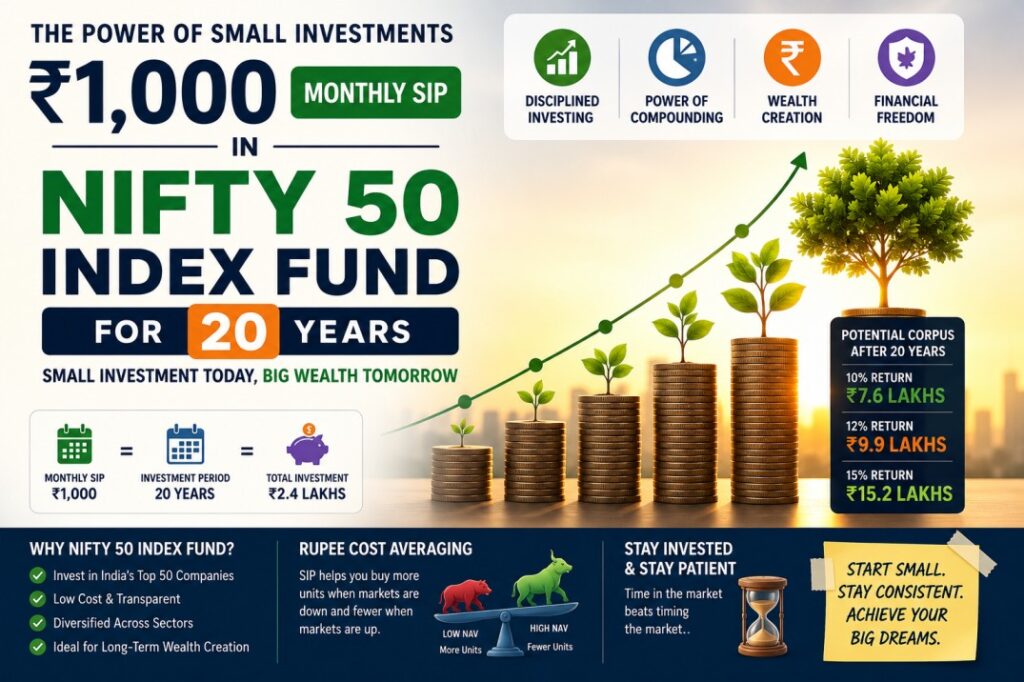
- Monthly SIP: ₹1,000
- Investment Period: 20 Years
- Total Number of Investments: 240
Every month, your money purchases units of the mutual fund.
When markets fall, your SIP buys more units.
When markets rise, it buys fewer units.
This process is known as Rupee Cost Averaging, and it helps reduce the impact of market volatility over the long term.
One of the biggest advantages of SIP investing is that you don’t need to worry about finding the “perfect” time to invest.
Instead, you allow time and consistency to work in your favor.
Why ₹1,000 Per Month Is a Great Starting Point
Some beginners hesitate because they believe ₹1,000 is “too little” to make a difference.
In reality, the amount you start with is far less important than developing the habit of investing regularly.
Think of your first SIP as building a financial discipline rather than chasing immediate wealth.
A ₹1,000 monthly SIP helps you:
- Develop long-term investing habits
- Understand how markets behave
- Benefit from compounding over time
- Build confidence as an investor
- Create a foundation that can be expanded later
As your salary or income increases, you can gradually increase your SIP amount. This strategy, known as a Step-Up SIP, can significantly boost your long-term wealth without putting pressure on your current finances.
Why Time Matters More Than the Amount
One of the biggest mistakes new investors make is delaying their first investment while waiting for a higher income.
Imagine two investors:
Investor A starts investing ₹1,000 per month at age 25.
Investor B waits five years and starts investing ₹2,000 per month at age 30.
Despite investing a higher monthly amount, Investor B may still end up with a smaller corpus because Investor A benefited from five additional years of compounding.
This highlights an important truth:
The best time to start investing is when you can comfortably afford it-not when you think you have “enough” money.
Now let’s answer the question most investors want to know:
How much wealth can a ₹1,000 Monthly SIP in Nifty 50 Index Fund create over 20 years?
The exact amount cannot be predicted because equity mutual funds deliver market-linked returns, not guaranteed returns. However, historical data suggests that Indian equity markets have rewarded patient investors over long investment horizons, despite periods of volatility.
To understand the potential, let’s look at three different return scenarios.
Assumptions
| Particular | Value |
|---|---|
| Monthly SIP | ₹1,000 |
| Investment Period | 20 Years |
| Total SIP Installments | 240 |
| Total Investment | ₹2,40,000 |
Estimated Returns at Different Annual Rates
The table below illustrates the approximate future value of a ₹1,000 monthly SIP under different annual return assumptions.
| Expected Annual Return | Approximate Corpus | Wealth Gain |
|---|---|---|
| 10% | ₹7.6 Lakhs | ₹5.2 Lakhs |
| 12% | ₹9.9 Lakhs | ₹7.5 Lakhs |
| 15% | ₹15.2 Lakhs | ₹12.8 Lakhs |
Note: These figures are estimates based on SIP calculations and are meant for educational purposes only. Actual returns may be higher or lower depending on market performance.
You can calculate your SIP investment by using our free SIP Calculator
Key Observation
Notice something interesting.
Even though your total investment is only ₹2.4 lakh, the potential wealth created is several times higher. This happens because your money earns returns year after year, and those returns continue generating additional returns—a process known as compounding.
Understanding the Power of Compounding
Compounding is often called the most powerful force in long-term investing.
Here’s a simple way to understand it.
Imagine planting a mango tree.
In the first few years, growth seems slow. The tree is developing its roots, and you may wonder if your efforts are paying off. But as the years pass, the tree grows larger, bears more fruit, and becomes increasingly productive.
Investing works in much the same way.
During the early years, your corpus grows mainly because you’re adding fresh investments. As time passes, however, the returns generated by your existing investments begin contributing more than your monthly SIP itself.
This is why investors who remain patient often see the most significant growth in the later years of their investment journey.
Why the Last Few Years Matter Most
Many first-time investors expect dramatic returns within three or five years. When that doesn’t happen, they become impatient and stop investing.
In reality, the last decade of a 20-year SIP often contributes more to wealth creation than the first decade because compounding accelerates as the investment grows.
The lesson is simple:
Time in the market is usually more valuable than trying to time the market.
Year-by-Year Growth Table:
The following table gives you a rough idea of how a ₹1,000 monthly SIP growing at an assumed 12% annual return may progress over time.
| Investment Period | Total Investment | Approximate Corpus |
|---|---|---|
| 5 Years | ₹60,000 | ₹82,000–₹85,000 |
| 10 Years | ₹1,20,000 | ₹2.3–₹2.4 Lakhs |
| 15 Years | ₹1,80,000 | ₹5.0–₹5.2 Lakhs |
| 20 Years | ₹2,40,000 | ₹9.9 Lakhs |
One of the biggest takeaways from this table is that wealth growth accelerates with time. The increase between Year 15 and Year 20 is much larger than during the early years, even though your monthly SIP remains the same.
What If Markets Crash During Your SIP?
This is one of the biggest concerns for new investors.
Many people assume that a market crash is the worst time to invest. Ironically, for long-term SIP investors, it can actually work in their favor.
Let’s understand why.
Suppose your ₹1,000 SIP normally buys 20 units of a fund.
If the market falls by 20–30%, the Net Asset Value (NAV) declines, and the same ₹1,000 may now purchase 25 or even 30 units.
When markets eventually recover, those extra units participate in the rebound, helping increase your long-term wealth.
This is one of the key advantages of SIP investing. Instead of worrying about buying at the perfect time, you continue investing through both bull and bear markets.
Why Staying Invested Is More Important Than Timing the Market
I’ve noticed that many beginners make the same mistake.
They wait for:
- “The next market crash”
- “A better entry point”
- “Election results”
- “Interest rate cuts”
- “Global stability”
Months or even years pass, and they still haven’t started investing.
Meanwhile, disciplined SIP investors continue building wealth one month at a time.
No one—not even professional fund managers—can consistently predict short-term market movements. Instead of trying to forecast every rise and fall, successful investors focus on what they can control:
- Investing regularly
- Staying invested
- Avoiding emotional decisions
- Reviewing their portfolio periodically rather than daily
₹1,000 SIP vs Fixed Deposit
Many conservative investors compare SIPs with Fixed Deposits (FDs). Both have their place, but they serve different financial goals.
| Feature | Nifty 50 Index Fund SIP | Fixed Deposit |
|---|---|---|
| Returns | Market-linked | Fixed |
| Wealth Creation Potential | Higher over the long term | Moderate |
| Inflation Protection | Better | Limited |
| Risk | Moderate | Low |
| Liquidity | High (subject to fund rules) | Depends on FD tenure |
| Suitable For | Long-term goals | Short-term savings and capital preservation |
A Fixed Deposit offers certainty, which can be comforting. However, after accounting for inflation and taxes, its real purchasing power may grow more slowly than that of long-term equity investments.
For goals that are 15–20 years away—such as retirement or a child’s higher education—many investors prefer equity-oriented investments like Nifty 50 Index Funds because of their higher long-term growth potential.
Inflation: The Hidden Factor Investors Often Ignore
Imagine you save ₹10 lakh over the next 20 years.
It may sound like a large amount today.
But due to inflation, the purchasing power of ₹10 lakh in the future will likely be much lower than it is today.
That’s why your investment should aim not only to preserve your money but also to grow faster than inflation.
Historically, equity investments have offered a better chance of outpacing inflation over long periods compared to many traditional fixed-income options, although they come with higher short-term volatility.
This is another reason why long-term investors often include index funds in their portfolios.
What If You Increase Your SIP Every Year?
One of the easiest ways to build significantly more wealth is through a Step-Up SIP.
Instead of investing ₹1,000 every month forever, increase your SIP by 10% each year.
For example:
| Year | Monthly SIP |
|---|---|
| 1 | ₹1,000 |
| 2 | ₹1,100 |
| 3 | ₹1,210 |
| 4 | ₹1,331 |
| 5 | ₹1,464 |
As your salary grows, these small increases become much easier to manage. Over 20 years, a Step-Up SIP can create a substantially larger corpus than a fixed ₹1,000 SIP because you’re investing more during your higher-earning years while still benefiting from compounding.
For detailed information about ₹500 Monthly SIP in Nifty 50 Index Fund Returns
Benefits of Investing ₹1,000 Monthly in a Nifty 50 Index Fund
A ₹1,000 Monthly SIP in Nifty 50 Index Fund may seem like a modest investment, but its true strength lies in consistency, diversification, and long-term growth potential. Whether you’re a student, a salaried employee, or someone just beginning their investment journey, this strategy offers several advantages.
Let’s explore them in detail.
1. Invest in India’s Top 50 Companies
One of the biggest benefits of a Nifty 50 Index Fund is that your money is automatically invested in India’s largest and most established listed companies.
These businesses have proven track records, strong management teams, and significant market presence. As the Indian economy grows, many of these companies are well-positioned to benefit from rising consumer demand, infrastructure development, technological advancements, and increasing corporate earnings.
Instead of selecting individual stocks, you gain exposure to leading companies across sectors such as banking, information technology, FMCG, automobiles, pharmaceuticals, energy, and telecommunications—all through a single investment.
2. Low Expense Ratio Means Higher Net Returns
Unlike actively managed mutual funds, index funds don’t require fund managers to constantly buy and sell stocks in an attempt to outperform the market.
As a result, their expense ratios are generally much lower.
This may appear to be a small difference initially, but over a 20-year investment period, lower costs can translate into a noticeably larger investment corpus.
A simple rule of investing is:
The less you pay in unnecessary fees, the more money remains invested and continues compounding for you.
3. Diversification Reduces Company-Specific Risk
Imagine investing all your savings in just one company.
If that company performs poorly, your entire investment suffers.
Now imagine investing in 50 leading companies across multiple industries.
Even if one sector experiences temporary challenges, strong performance in other sectors can help balance your overall portfolio.
That’s the advantage of diversification.
It doesn’t eliminate market risk, but it significantly reduces the impact of problems faced by any single company.
4. Ideal for Busy Professionals
Many investors simply don’t have the time to:
- Analyze financial statements
- Track quarterly earnings
- Follow daily market news
- Study technical charts
- Evaluate hundreds of stocks
A Nifty 50 Index Fund removes much of this complexity.
Once your SIP is set up, you can focus on your career, business, or studies while your investments continue automatically every month.
5. Disciplined Investing Through Automation
One of the biggest enemies of successful investing is emotion.
Investors often buy when markets are soaring and panic when markets decline.
A monthly SIP helps reduce emotional decision-making because investments continue automatically regardless of market conditions.
This disciplined approach encourages long-term wealth creation rather than short-term speculation.
For detailed information about How Much Wealth Can ₹5,000 Per Month Create
Who Should Invest in a ₹1,000 Monthly SIP?
A ₹1,000 monthly investment is suitable for a wide range of investors, especially those who are just beginning.
This strategy is ideal for:
- First-time mutual fund investors
- College students starting their investment journey
- Young professionals with limited disposable income
- Salaried employees looking to build long-term wealth
- Individuals saving for retirement
- Parents investing for a child’s future
- Investors who prefer a simple, low-maintenance portfolio
One of the best aspects of SIP investing is that you can always increase your contribution later as your income grows.
Who May Want to Consider Other Options?
Although Nifty 50 Index Funds are excellent for long-term investing, they may not be suitable for everyone.
You should be cautious if:
- You need the money within the next 3-5 years.
- You are uncomfortable with temporary market declines.
- Your priority is guaranteed returns rather than market-linked growth.
- You haven’t built an emergency fund yet.
For short-term goals, safer investment options such as fixed deposits or liquid mutual funds may be more appropriate.
Risks You Should Understand
Every investment carries some level of risk, and it’s important to understand them before investing.
1. Market Volatility
The value of your investment can rise and fall due to changes in the stock market.
It’s perfectly normal for equity markets to experience temporary corrections.
Historically, however, Indian markets have recovered from major downturns over the long term.
2. No Guaranteed Returns
Unlike a bank fixed deposit, returns from a Nifty 50 Index Fund are not guaranteed.
Future performance depends on market conditions, corporate earnings, economic growth, interest rates, and various domestic and global factors.
Always invest with realistic expectations rather than expecting fixed annual returns.
3. Tracking Error
Although index funds aim to replicate the Nifty 50 Index, their returns may differ slightly due to:
- Expense ratio
- Cash holdings
- Portfolio rebalancing
- Transaction costs
This difference is known as tracking error.
Well-managed index funds generally maintain low tracking errors.
4. Emotional Investing
Ironically, the biggest risk isn’t always the market.
It’s investor behavior.
Many investors:
- Stop SIPs during market crashes.
- Redeem investments after temporary declines.
- Chase funds based on recent performance.
- Switch strategies too frequently.
These actions often reduce long-term returns more than market volatility itself.
For detailed information about best index funds for beginners
Common Mistakes New SIP Investors Make
Having observed the investing journey of many beginners, these are the most common mistakes I see.
Waiting for the “Perfect Time”
Many investors delay starting because they believe markets are too expensive.
The truth is that no one consistently predicts market tops and bottoms.
Starting early with a SIP is usually more beneficial than waiting indefinitely.
Stopping SIPs During Market Corrections
This is perhaps the biggest mistake.
When markets decline, your SIP buys more units.
Stopping your investment during a downturn means missing an opportunity to accumulate units at lower prices.
Checking Portfolio Every Day
Daily market fluctuations can create unnecessary stress.
If your investment horizon is 20 years, daily price movements are largely irrelevant.
Instead, review your portfolio once or twice a year.
Chasing Last Year’s Best Fund
A fund that performed exceptionally well last year may not remain the top performer next year.
Rather than chasing short-term rankings, focus on your long-term investment strategy.
Ignoring Asset Allocation
While equity investments are important for wealth creation, don’t invest all your money in stocks or equity mutual funds.
Maintain a balanced portfolio that aligns with your financial goals, risk tolerance, and investment horizon.
Practical Tips to Maximize Your SIP Returns
Here are some practical habits that can improve your investing experience over the long term.
Start as Early as Possible
Time is your greatest ally in investing.
Even a small SIP started early can outperform a larger SIP started much later.
Increase Your SIP Every Year
Whenever your salary increases, consider increasing your SIP by 5–10%.
This simple habit can dramatically improve your final corpus without placing significant pressure on your finances.
Stay Invested During Market Volatility
Remember that market corrections are temporary, but long-term wealth creation depends on staying invested.
Successful investors view volatility as a normal part of equity investing rather than something to fear.
Invest According to Your Goals
Instead of investing randomly, link your SIP to specific financial goals such as:
- Retirement
- Child’s education
- Home purchase
- Financial independence
- Wealth creation
Goal-based investing helps you remain disciplined during market fluctuations.
Review, Don’t React
Conduct an annual review of your investments.
Avoid making decisions based solely on market headlines or short-term performance.
Frequently Asked Questions (FAQs)
Is ₹1,000 enough to start investing?
Yes. Many mutual funds allow SIPs starting from ₹500 or ₹1,000. The important thing is to begin and remain consistent.
Can I increase my SIP later?
Absolutely.
Most Asset Management Companies (AMCs) allow you to increase your SIP amount whenever your financial situation improves.
Is a Nifty 50 Index Fund better than buying individual stocks?
For many beginners, yes.
An index fund offers instant diversification and requires significantly less research than building and managing a portfolio of individual stocks.
Can I stop my SIP anytime?
Yes.
You can pause or stop your SIP whenever required. However, stopping during temporary market declines may reduce your long-term wealth creation potential.
How often should I review my SIP?
A review once or twice a year is generally sufficient for long-term investors unless your financial goals or personal circumstances change significantly.
Is a 20-year investment horizon important?
A longer investment horizon allows your money more time to compound and helps reduce the impact of short-term market volatility.
That’s why equity investments are generally more suitable for long-term goals than short-term needs.
My Perspective After Following the Market Since 2018
After investing in mutual funds and the Indian stock market since 2018, I’ve noticed something interesting.
The investors who create meaningful wealth are rarely the ones who spend all day predicting where the market will go next.
Instead, they usually have three simple habits:
- They invest consistently.
- They stay invested during market corrections.
- They avoid making emotional decisions based on short-term news.
I’ve seen markets fall sharply during events like the COVID-19 crash and later recover to new highs. Investors who continued their SIPs during uncertain times often accumulated more units at lower prices, benefiting when markets rebounded. On the other hand, many investors who stopped investing out of fear missed that recovery.
This experience reinforced an important lesson for me:
Long-term wealth is built through discipline, not prediction.
A ₹1,000 Monthly SIP in Nifty 50 Index Fund may not seem exciting in the beginning. There are no overnight gains or dramatic headlines. But over 20 years, disciplined investing has the potential to create results that many people underestimate.
Likewise, add links from those articles back to this one to create a strong content cluster.
Key Takeaways
If you remember only a few points from this guide, let them be these:
- A ₹1,000 monthly SIP is enough to begin your investing journey.
- Starting early is generally more valuable than waiting for the “perfect” time.
- Long-term investing allows compounding to work in your favor.
- Nifty 50 Index Funds provide low-cost exposure to India’s leading companies.
- Market volatility is normal; consistency is often more important than short-term performance.
- Increasing your SIP as your income grows can significantly enhance long-term wealth creation.
Final Thoughts
A ₹1,000 Monthly SIP in Nifty 50 Index Fund may not make headlines, but it represents one of the simplest ways to participate in the long-term growth of India’s economy.
No investment can guarantee returns, and equity markets will always experience periods of volatility. However, history has shown that patient investors who stay disciplined and remain invested for long durations have often been rewarded over time.
Rather than trying to predict the next market move or searching endlessly for the “perfect” mutual fund, focus on what you can control:
- Invest regularly.
- Stay invested.
- Review your portfolio periodically.
- Increase your SIP as your income grows.
These habits may seem ordinary, but over 20 years, they can make an extraordinary difference.
Remember:
Small monthly investments, when combined with patience and discipline, can become the foundation of long-term financial security.
Conclusion
Building wealth doesn’t always require a large starting amount. What matters most is developing the habit of investing consistently and giving your money enough time to grow.
If you’re just beginning your investment journey, a ₹1,000 Monthly SIP in Nifty 50 Index Fund can be a practical first step. As your income grows, you can gradually increase your SIP and align your investments with your long-term financial goals.
The journey to financial independence isn’t about finding shortcuts—it’s about making disciplined decisions month after month.
Disclaimer: The content provided is for educational and informational purposes only and should not be considered financial, investment, insurance, or legal advice.




Pingback: Best S&P 500 Index Fund in India (2026): Top Funds to Invest USA