

Last Updated on 6 July 2026
Introduction
What Is NSE Stock Exchange? Imagine walking into a massive marketplace where millions of buyers and sellers trade products every second. Instead of fruits, clothes, or electronics, this marketplace deals in ownership of companies—shares, Exchange-Traded Funds (ETFs), bonds, Real Estate Investment Trusts (REITs), Infrastructure Investment Trusts (InvITs), and other financial securities.
This marketplace is known as a stock exchange, and in India, the National Stock Exchange (NSE) is the country’s largest and most actively traded stock exchange. It provides a secure, transparent, and technology-driven platform where investors and traders can buy and sell securities with confidence.
If you’ve ever invested through platforms like Zerodha, Groww, Upstox, Angel One, ICICI Direct, or any other broker, chances are your buy and sell orders were executed on the NSE. Yet many beginner investors don’t fully understand what happens behind the scenes when they click the “Buy” button.
So, what is NSE Stock Exchange, and why is it so important to India’s financial system?
Whether you’re planning to invest in stocks, ETFs, mutual funds, or IPOs, understanding how the NSE works will help you make more informed investment decisions. After all, successful investing isn’t just about choosing the right stocks-it’s also about understanding the marketplace where those investments are traded.
In this beginner-friendly guide, you’ll learn how the National Stock Exchange works, why it was established, its key functions, its role in India’s economy, and why every investor should understand how this financial marketplace operates before investing their hard-earned money.
In this beginner-friendly guide, you’ll learn:
- What the NSE Stock Exchange is
- Why it was established
- How it works behind the scenes
- Why millions of investors trust it
- How it differs from the BSE
- Why every long-term investor should understand its role
Let’s begin with the basics.
What Is NSE Stock Exchange?
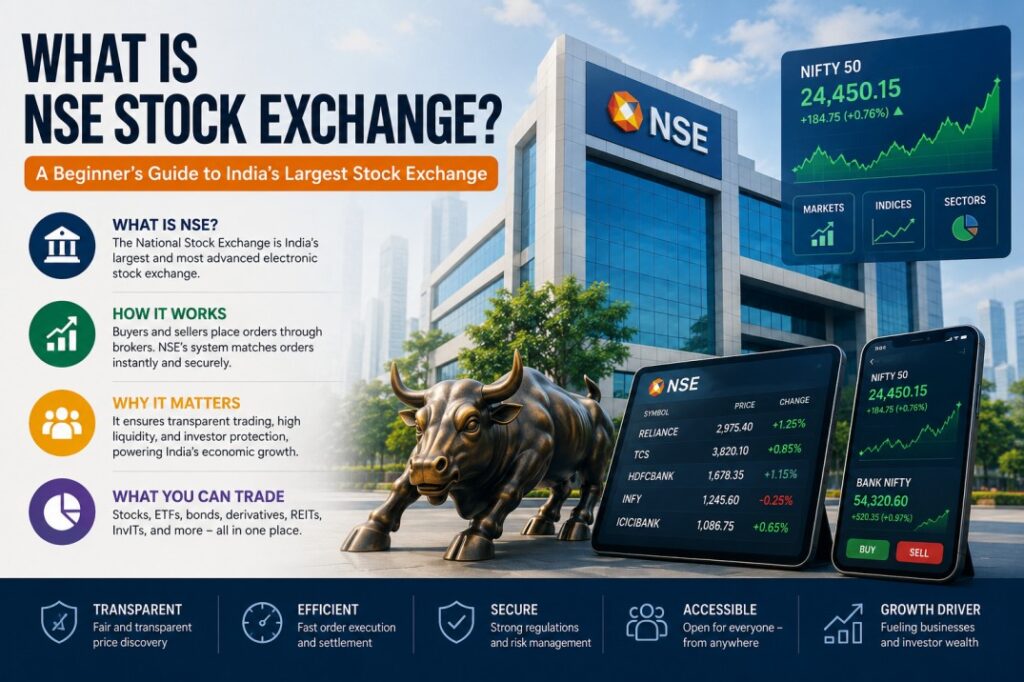
The National Stock Exchange (NSE) is India’s largest electronic stock exchange where investors buy and sell financial securities in a transparent, secure, and regulated environment.
Established in 1992, the NSE transformed India’s capital markets by introducing fully electronic, screen-based trading, replacing the old open-outcry system where traders physically gathered on trading floors to execute transactions.
Today, the NSE is one of the world’s largest stock exchanges by the number of trades executed daily and plays a central role in India’s financial ecosystem.
Simply put, the NSE acts as a bridge between buyers and sellers. It doesn’t buy or sell shares itself. Instead, it provides the technology, rules, and infrastructure that allow market participants to trade efficiently.
For example:
- You decide to buy 20 shares of a listed company.
- Another investor wants to sell exactly those shares.
- The NSE’s sophisticated trading system matches both orders within fractions of a second.
- Once matched, the trade is completed, and ownership is transferred through the depository system.
This entire process happens so quickly that most investors never notice the complex technology working in the background.
Think of the NSE Like an Online Marketplace
A simple analogy can make the concept easier to understand.
Imagine shopping on an e-commerce website.
- Buyers place orders.
- Sellers list products.
- The platform matches buyers with sellers.
- Payments and deliveries happen through a secure system.
The NSE works in a similar way.
Instead of products, investors trade financial assets such as:
- Equity shares
- Exchange Traded Funds (ETFs)
- Government securities
- Corporate bonds
- REITs
- InvITs
- Futures and Options (F&O)
The exchange itself doesn’t own these securities-it simply provides a trusted marketplace where transactions can take place efficiently and fairly.
Key Facts About the NSE
| Feature | Details |
|---|---|
| Full Name | National Stock Exchange of India Limited |
| Established | 1992 |
| Trading Started | 1994 |
| Headquarters | Mumbai, Maharashtra |
| Benchmark Index | Nifty 50 |
| Regulator | Securities and Exchange Board of India (SEBI) |
| Trading System | Fully electronic and screen-based |
| Main Products | Stocks, ETFs, Bonds, REITs, InvITs, Derivatives, Currency & Debt Instruments |
Why Was the NSE Established?
To understand why the NSE was created, it’s helpful to look at how India’s stock market operated before the 1990s.
Back then, stock trading was very different from what investors experience today.
Transactions were carried out manually on physical trading floors. Brokers shouted buy and sell orders in crowded halls, a method known as the open outcry system.
While this system had worked for decades, it came with several serious limitations.
Some of the biggest problems included:
- Lack of transparency in price discovery
- Slow execution of trades
- Heavy paperwork
- Physical share certificates
- Delays in settlement
- Higher chances of manipulation
- Limited access for investors outside major cities
For ordinary investors, participating in the stock market wasn’t easy. Investing often depended on local brokers, lengthy paperwork, and manual verification processes.
India needed a modern, technology-driven exchange that could bring greater transparency, improve efficiency, and inspire investor confidence.
That need led to the creation of the National Stock Exchange in 1992.
For detailed information about How to analyze stocks before investing
How the NSE Revolutionized India’s Stock Market
The NSE didn’t just introduce a new exchange-it fundamentally changed how India’s stock market operated.
Some of its most important innovations included:
1. Electronic Trading
Instead of physical trading floors, investors could place orders electronically through computers.
This dramatically reduced human errors and made trading faster.
2. Nationwide Access
Earlier, stock trading was concentrated in a few cities.
With the NSE’s electronic infrastructure, investors from across India gained equal access to the market.
Today, someone living in a small town can invest just as easily as someone in Mumbai or Delhi.
3. Greater Transparency
Every investor now sees the same market prices in real time.
Orders are matched using predefined rules rather than personal influence or negotiation.
This significantly increased trust in the market.
4. Faster Settlement
Earlier, completing a trade could take several days or even weeks.
Today, India’s market follows a T+1 settlement cycle, making it one of the fastest major equity settlement systems in the world.
This means investors receive shares or funds much sooner after a trade is executed.
5. Better Investor Protection
The NSE operates under strict regulations set by the Securities and Exchange Board of India (SEBI).
It uses advanced surveillance systems to detect unusual trading activity, helping reduce fraud and market manipulation.
How Does the NSE Stock Exchange Work?
Although trading appears simple on a mobile app, a sophisticated system works behind the scenes to execute every transaction accurately.
Here’s a simplified overview of what happens when you buy a stock:
Step 1: You Place a Buy Order
Using your broker’s trading platform, you enter details such as:
- Stock name
- Quantity
- Order type (Market or Limit)
- Price (if applicable)
Step 2: Your Broker Sends the Order to the NSE
Your broker forwards the order to the NSE’s electronic trading system almost instantly.
Step 3: The NSE Matches Buyers and Sellers
The exchange automatically searches for a matching sell order based on:
- Best available price
- Time priority
- Order quantity
This process takes milliseconds.
Step 4: Trade Confirmation
Once matched, the trade is executed immediately.
Both buyer and seller receive confirmation through their respective brokers.
Step 5: Clearing and Settlement
The clearing corporation verifies the transaction.
Funds move from the buyer to the seller, while shares are transferred electronically to the buyer’s Demat account through the depository system.
The entire process is designed to ensure security, accuracy, and fairness.
A Simple Real-Life Example
Suppose you decide to purchase 10 shares of Reliance Industries using your brokerage app.
You place the order at ₹1,500 per share.
At that exact moment, another investor is willing to sell 10 shares at the same price.
The NSE’s trading engine automatically matches both orders in milliseconds.
Once the trade is confirmed:
- The seller receives the sale proceeds (after settlement).
- You become the new owner of those 10 shares.
- The shares are credited to your Demat account after settlement.
From your perspective, the transaction feels almost instantaneous. Behind the scenes, however, multiple systems—including your broker, the NSE, the clearing corporation, and the depository—work together seamlessly to complete the trade.
Key Functions of the NSE Stock Exchange
The National Stock Exchange is much more than a place where investors buy and sell shares. It forms the backbone of India’s capital market by ensuring that trading is efficient, transparent, and secure.
Let’s explore its major functions.
1. Provides a Transparent Trading Platform
One of the biggest contributions of the NSE is transparency.
Before electronic trading, investors often depended on brokers for price information, making it difficult to know whether they were getting a fair deal.
Today, every investor sees the same market prices in real time.
Whether you’re investing ₹500 or ₹50 lakh, your orders are matched using the same automated system based on:
- Best available price
- Order priority
- Time of order placement
This ensures fairness and eliminates favoritism.
2. Facilitates Price Discovery
A stock’s price isn’t decided by the company or the stock exchange.
Instead, it is determined through price discovery, where thousands of buyers and sellers continuously place orders.
For example:
- If more investors want to buy a stock than sell it, the price usually rises.
- If more investors want to sell than buy, the price generally falls.
This continuous interaction helps establish a fair market value for listed securities.
3. Provides Liquidity
Liquidity refers to how easily you can buy or sell an investment without significantly affecting its price.
The NSE has millions of active participants every day, making it one of the world’s most liquid exchanges.
High liquidity offers several advantages:
- Faster order execution
- Narrow bid-ask spreads
- Reduced price manipulation
- Easier entry and exit for investors
For long-term investors, liquidity means you can sell your investments whenever needed without struggling to find a buyer.
4. Supports Capital Formation
The NSE plays an essential role in helping businesses raise money.
When companies launch an Initial Public Offering (IPO), they list their shares on a stock exchange.
The money raised can be used for:
- Business expansion
- New product development
- Debt reduction
- Infrastructure projects
- Research and innovation
At the same time, investors get an opportunity to participate in the company’s future growth.
This creates a win-win situation for businesses and investors.
5. Protects Investors
Investor confidence is the foundation of every successful stock market.
To maintain trust, the NSE works closely with SEBI and the National Securities Clearing Corporation (NSCCL) to ensure:
- Fair trading practices
- Continuous market surveillance
- Risk management systems
- Timely settlements
- Detection of suspicious trading activity
These measures help create a safer investing environment.
6. Encourages Financial Inclusion
One of the NSE’s greatest achievements is making investing accessible to millions of Indians.
Earlier, investing was largely limited to metropolitan cities.
Today, anyone with:
- A smartphone
- Internet access
- A bank account
- A Demat account (For detailed information about Demat Account)
can invest from virtually anywhere in the country.
This democratization of investing has significantly increased retail participation over the past decade.
Market Segments Available on the NSE
Many beginners think the NSE is only for buying company shares.
In reality, it offers multiple market segments catering to different investment needs.
| Market Segment | Purpose |
|---|---|
| Equity Market | Buy and sell company shares |
| Exchange-Traded Funds (ETFs) | Invest in indices, gold, and other assets |
| Mutual Fund Platform | Purchase selected mutual fund schemes electronically |
| Futures & Options (F&O) | Trade derivative contracts |
| Currency Derivatives | Hedge or trade currency movements |
| Debt Market | Invest in government and corporate bonds |
| REITs & InvITs | Invest in real estate and infrastructure assets |
This wide range of products allows investors to diversify their portfolios according to their financial goals.
Major Indices of the NSE
When people hear phrases like “the market is up today” or “Nifty crossed 25,000,” they’re referring to stock market indices.
An index measures the overall performance of a selected group of companies.
Let’s look at the most important ones.
Nifty 50
The Nifty 50 is the benchmark index of the NSE.
It consists of 50 of the largest and most liquid companies listed on the exchange across various sectors.
These companies represent a significant portion of India’s stock market capitalization.
Some well-known sectors represented include:
- Banking
- Information Technology
- FMCG
- Oil & Gas
- Pharmaceuticals
- Automobile
- Telecom
Many mutual funds and ETFs track the Nifty 50 because it reflects the performance of India’s leading businesses.
Nifty Next 50
Think of this as the “waiting list” for the Nifty 50.
It includes the next 50 large companies that could eventually become part of the Nifty 50 as they grow.
Many investors consider it a higher-growth index with slightly greater volatility.
Nifty Midcap 150
This index tracks medium-sized companies.
Mid-cap stocks often have stronger growth potential than large-cap companies but generally come with higher risk.
Nifty Smallcap 250
The Nifty Smallcap 250 includes smaller listed companies.
These businesses can generate substantial returns over the long term but may experience significant price fluctuations.
Sectoral Indices
The NSE also maintains indices for specific industries, including:
- Nifty Bank
- Nifty IT
- Nifty Pharma
- Nifty Auto
- Nifty Financial Services
- Nifty FMCG
- Nifty Metal
- Nifty Realty
These help investors analyze the performance of individual sectors.
How Companies Get Listed on the NSE
Not every company can start trading on the NSE overnight.
Listing involves a rigorous approval process designed to protect investors.
The general process includes:
Step 1: Meet Eligibility Requirements
Companies must satisfy financial, regulatory, and governance standards prescribed by SEBI and the NSE.
Step 2: File an IPO
The company issues an Initial Public Offering (IPO), allowing the public to subscribe to its shares.
Step 3: Regulatory Review
SEBI reviews the offer documents to ensure that investors receive adequate and accurate information.
Step 4: Listing Approval
After meeting all requirements, the company’s shares are officially listed on the NSE.
Step 5: Public Trading Begins
Once listed, investors can buy and sell the company’s shares through registered stockbrokers.
NSE Trading Timings
The Indian stock market operates during specific trading sessions on business days.
| Session | Time |
|---|---|
| Pre-Open Session | 9:00 AM – 9:15 AM |
| Regular Trading Session | 9:15 AM – 3:30 PM |
| Closing Session | After 3:30 PM |
The pre-open session helps determine a fair opening price and reduces excessive volatility at market open.
NSE vs BSE: What’s the Difference?
One of the most common questions beginners ask is:
Should I invest through the NSE or the BSE?
The truth is, you don’t choose one exchange over the other. Your broker can execute trades on either, depending on where the stock is listed and market conditions.
However, understanding the differences between the two exchanges is still important.
| Feature | NSE | BSE |
|---|---|---|
| Full Name | National Stock Exchange | Bombay Stock Exchange |
| Established | 1992 | 1875 |
| Trading Started | 1994 | 1875 |
| Benchmark Index | Nifty 50 | Sensex |
| Trading System | Fully electronic from inception | Transitioned from floor trading to electronic trading |
| Liquidity | Higher | Lower (for many stocks) |
| Daily Trading Volume | Higher | Lower |
| Popular Among | Retail and institutional investors | Long-established investors and listed companies |
Which Is Better: NSE or BSE?
Rather than asking which exchange is “better,” it’s more useful to understand their strengths.
Choose the NSE if you:
- Prefer high liquidity
- Want faster trade execution
- Trade frequently
- Invest in derivatives
- Invest in ETFs tracking the Nifty
Choose the BSE if you:
- Want access to certain stocks listed only on the BSE
- Prefer the Sensex as a benchmark
- Invest in companies with stronger liquidity on the BSE
For most retail investors, this distinction isn’t critical because many large companies are listed on both exchanges, and brokers automatically route orders to the appropriate market.
Why Do Most Investors Prefer the NSE?
Although both exchanges are well-regulated, the NSE handles a significantly larger share of equity trading volume.
Some reasons include:
- Higher liquidity
- Faster order execution
- Lower bid-ask spreads
- Strong derivatives market
- Widely followed Nifty indices
- Advanced trading infrastructure
This is why you’ll often hear financial news channels focus on the Nifty 50 as the primary indicator of India’s stock market performance.
Quick Takeaways
| Topic | Summary |
|---|---|
| Primary Function | Provides a secure platform for trading securities |
| Benchmark Index | Nifty 50 |
| Major Advantage | High liquidity and transparent electronic trading |
| Market Segments | Equity, ETFs, Bonds, Derivatives, REITs, InvITs, Currency |
| Popular With | Retail investors, traders, institutions, and foreign investors |
| Regulated By | SEBI |
Benefits of the NSE Stock Exchange for Investors
Whether you’re a first-time investor or someone building wealth for retirement, the National Stock Exchange offers several advantages that make investing easier, safer, and more efficient.
Here are the key benefits.
1. High Liquidity
One of the biggest strengths of the NSE is its high trading volume.
Every trading day, millions of buy and sell orders are executed across thousands of listed securities. This high level of activity makes it easier to buy or sell shares quickly without causing significant price changes.
For investors, this means:
- Faster trade execution
- Better buying and selling prices
- Easier exit during emergencies
- Reduced chances of orders remaining unfilled
2. Transparent Price Discovery
Every investor has access to the same market information.
Unlike traditional markets where prices could vary between buyers and sellers, the NSE’s automated trading system ensures that prices are determined fairly based on real-time demand and supply.
This transparency builds trust and confidence among investors.
3. Advanced Technology
The NSE was India’s first exchange to introduce a fully electronic trading system.
Today, its advanced infrastructure enables:
- Millisecond order execution
- Real-time price updates
- Secure trading
- High system reliability
- Efficient order matching
Most investors never notice this technology in action because it works seamlessly behind the scenes.
4. Strong Regulatory Oversight
The NSE operates under the supervision of the Securities and Exchange Board of India (SEBI).
Strict regulations help ensure:
- Fair trading practices
- Disclosure of important company information
- Prevention of insider trading
- Continuous market surveillance
- Protection against market manipulation
While no market is completely risk-free, India’s regulatory framework has significantly improved investor protection over the years.
5. Wide Range of Investment Options
The NSE isn’t limited to company shares.
Investors can access:
- Equity shares
- Exchange-Traded Funds (ETFs)
- Index funds
- Government securities
- Corporate bonds
- REITs
- InvITs
- Futures and Options
- Currency derivatives
This variety allows investors to build diversified portfolios based on their financial goals and risk tolerance.
6. Easy Accessibility
Years ago, investing required visiting a broker’s office and completing extensive paperwork.
Today, the process is remarkably simple.
With a smartphone, internet connection, bank account, and Demat account, you can start investing from almost anywhere in India.
This convenience has played a major role in increasing retail participation in the stock market.
The Role of SEBI in the NSE
A stock exchange cannot function effectively without strong regulation.
That’s where the Securities and Exchange Board of India (SEBI) comes in.
SEBI is the regulator responsible for overseeing India’s securities market and protecting investor interests.
Its responsibilities include:
- Regulating stock exchanges
- Monitoring listed companies
- Preventing fraudulent practices
- Enforcing disclosure requirements
- Protecting retail investors
- Promoting fair and transparent markets
Think of SEBI as the referee of India’s financial markets. While the NSE provides the trading platform, SEBI ensures that everyone follows the rules.
Are There Any Risks of Investing Through the NSE?
The NSE provides a secure marketplace, but it’s important to remember that market risk still exists.
The exchange itself doesn’t guarantee profits or protect investors from poor investment decisions.
Some common risks include:
Market Risk
Stock prices can rise or fall due to economic conditions, company performance, interest rates, or global events.
Volatility
Markets can experience sharp price movements over short periods, especially during periods of uncertainty.
Long-term investors should avoid making decisions based solely on short-term fluctuations.
Company-Specific Risk
Even fundamentally strong companies can face challenges such as:
- Declining profits
- Increased competition
- Regulatory issues
- Management changes
Diversification helps reduce this risk.
Emotional Investing
Many investors make costly mistakes because of emotions.
Common examples include:
- Buying during market euphoria
- Selling during market crashes
- Chasing “hot” stocks
- Ignoring long-term goals
Successful investing requires discipline more than prediction.
Tips for Beginners Investing Through the NSE
If you’re just starting your investment journey, these practical tips can help you avoid common mistakes.
1. Learn Before You Invest
Understanding basic concepts like stocks, ETFs, indices, and diversification can make a significant difference in your long-term results.
2. Start Small
You don’t need lakhs of rupees to begin investing.
Even small, consistent investments can grow substantially over time through the power of compounding.
3. Focus on Quality Companies
Rather than chasing speculative stocks, consider businesses with:
- Strong financial performance
- Consistent earnings
- Good corporate governance
- Sustainable competitive advantages
4. Diversify Your Portfolio
Avoid putting all your money into a single company or sector.
Diversification helps reduce overall investment risk.
5. Think Long Term
Historically, equity markets have rewarded patient investors far more than those trying to time short-term market movements.
6. Ignore Daily Market Noise
News headlines can create unnecessary panic or excitement.
Instead of reacting to every market movement, focus on your financial goals and investment strategy.
Common Myths About the NSE
Let’s clear up a few misconceptions.
| Myth | Reality |
|---|---|
| The NSE guarantees profits. | The exchange only facilitates trading. Investment returns depend on market performance. |
| Investing requires a large amount of money. | You can start investing with relatively small amounts. |
| Only experts can invest. | Anyone can invest after learning the basics. |
| The stock market is gambling. | Investing in fundamentally strong businesses is different from speculation. |
| The NSE decides share prices. | Prices are determined by market demand and supply. |
Frequently Asked Questions (FAQs)
What is the NSE Stock Exchange?
The National Stock Exchange (NSE) is India’s largest electronic stock exchange where investors buy and sell shares, ETFs, bonds, derivatives, and other financial securities.
What is the difference between the NSE and the BSE?
The NSE is known for its higher trading volume and benchmark index, the Nifty 50, while the BSE is Asia’s oldest stock exchange and is represented by the Sensex.
Can beginners invest through the NSE?
Yes. Anyone with a Demat account, trading account, and linked bank account can invest in securities listed on the NSE through a registered stockbroker.
Is the NSE safe?
The NSE operates under SEBI’s regulatory framework and uses advanced technology and surveillance systems to ensure fair and transparent trading. However, all investments carry market risk.
What is traded on the NSE?
The NSE offers trading in:
- Equity shares
- ETFs
- Government securities
- Corporate bonds
- REITs
- InvITs
- Futures and Options
- Currency derivatives
Do I buy shares directly from the NSE?
No. Investors place orders through SEBI-registered stockbrokers, who execute trades on the NSE.
Conclusion
Understanding what is NSE Stock Exchange is one of the first and most important steps toward becoming a confident investor.
The National Stock Exchange has transformed India’s financial markets by introducing transparent, technology-driven, and efficient trading. It connects millions of buyers and sellers every day, helping businesses raise capital while giving individuals opportunities to participate in the country’s economic growth.
However, it’s equally important to remember that the NSE is a marketplace-not an investment advisor. While it provides a secure platform for trading, your success depends on making informed decisions, staying disciplined, and maintaining a long-term perspective.
If you’re just beginning your investment journey, don’t feel pressured to know everything at once. Learn the fundamentals, start with quality investments, diversify your portfolio, and stay consistent. Over time, these habits can make a meaningful difference in achieving your financial goals.
Disclaimer: The content provided is for educational and informational purposes only and should not be considered financial, investment, insurance, or legal advice.




Great content! Keep up the good work!
Thanks