


Last Updated on 17 July 2026
Investing in mutual funds has become one of the most popular ways to build wealth in India. While large-cap funds offer stability and small-cap funds provide high growth potential with higher risk, mid-cap mutual funds strike a balance between the two. They invest in companies that have already established themselves but still have significant room for future growth. For investors searching for the Best Mid-Cap Mutual Funds in India 2026, understanding how these funds work, their growth potential, and the risks involved is important before making any investment decision. Mid-cap mutual funds can provide exposure to growing businesses that may become future market leaders, making them an attractive option for long-term investors who can handle market fluctuations.
This guide will help you understand the Best Mid-Cap Mutual Funds in India 2026, why mid-cap funds are popular among long-term investors, and the key factors you should consider before investing. Whether you’re a beginner starting your investment journey or an experienced investor looking to diversify your portfolio, this article explains the concept in a simple and practical way.
Important: Mutual fund performance, expense ratios, fund managers, AUM, exit loads, portfolio holdings, and tax rules can change over time. Always verify the latest information from the respective Asset Management Company’s (AMC) official website or trusted financial platforms before investing.
Why This Topic Matters
India’s economy continues to grow across sectors such as manufacturing, banking, healthcare, technology, infrastructure, and consumer businesses. Many companies that are currently classified as mid-cap businesses have the potential to become tomorrow’s large-cap leaders.
This growth potential makes mid-cap mutual funds an attractive investment option for investors who have a long investment horizon and are comfortable with moderate to high market fluctuations.
However, choosing the right fund isn’t as simple as picking the one with the highest past returns. Factors such as portfolio quality, risk management, consistency, expense ratio, and fund management play an equally important role.
This guide aims to help you understand these factors so you can make informed investment decisions rather than chasing short-term performance.
What Are Mid-Cap Mutual Funds?
According to the classification framework defined by the Securities and Exchange Board of India (SEBI), mid-cap companies are generally those ranked 101st to 250th by market capitalization.
A mid-cap mutual fund is an equity mutual fund that is required to invest at least 65% of its assets in mid-cap companies.
These companies are typically beyond the startup phase and have demonstrated a viable business model. At the same time, they still have significant opportunities to expand their market share, increase profits, and potentially become large-cap companies over time.
Because of this, mid-cap funds are often considered a “growth-oriented” investment category.
How Mid-Cap Mutual Funds Work
When you invest in a mid-cap mutual fund:
- Your money is pooled with investments from other investors.
- A professional fund manager selects a diversified portfolio of mid-cap stocks.
- The portfolio is actively monitored and adjusted based on market conditions, company fundamentals, and investment opportunities.
- Your returns depend on the overall performance of the underlying companies and the broader stock market.
Unlike investing directly in individual stocks, mutual funds provide diversification, which helps reduce company-specific risk.
Why Mid-Cap Funds Are Popular in 2026
Several factors continue to make mid-cap mutual funds attractive for long-term investors in 2026:
1. Strong Economic Growth
India remains one of the fastest-growing major economies. As businesses expand and consumer demand rises, many mid-sized companies are well-positioned to benefit from increasing revenues and profitability.
2. Higher Growth Potential
Large-cap companies are already established, so their growth may be relatively steady. Mid-cap companies, however, often have more room to expand into new markets, launch products, and improve earnings.
3. Sectoral Opportunities
Many innovative companies in sectors such as:
- Manufacturing
- Defence
- Capital Goods
- Healthcare
- Financial Services
- Renewable Energy
- Chemicals
- Consumer Businesses
fall within the mid-cap category, offering exposure to emerging growth trends.
4. Professional Fund Management
Experienced fund managers research hundreds of companies, helping investors gain diversified exposure without having to analyze individual stocks themselves.
5. Suitable for Long-Term Wealth Creation
Investors with a disciplined investment approach and a long time horizon may benefit from the growth potential offered by quality mid-cap businesses.
Mid-Cap vs Large-Cap vs Small-Cap Mutual Funds
Understanding the differences between these categories can help you choose the right investment based on your goals and risk tolerance.
| Feature | Large-Cap Funds | Mid-Cap Funds | Small-Cap Funds |
|---|---|---|---|
| Company Size | Largest companies | Medium-sized companies | Smaller companies |
| Risk Level | Lower | Moderate to High | High |
| Return Potential | Moderate | High | Very High (with higher risk) |
| Volatility | Low | Moderate | High |
| Suitable Investment Horizon | 5+ Years | 7–10+ Years | 10+ Years |
| Stability | High | Moderate | Lower |
| Growth Opportunity | Moderate | High | Very High |
Which Category Should You Choose?
The answer depends on your financial goals.
- If you prioritize stability, large-cap funds may be more suitable.
- If you seek a balance between growth and risk, mid-cap funds can be a compelling choice.
- If you can tolerate significant volatility and have a long investment horizon, small-cap funds may offer higher growth potential.
Many investors diversify by allocating investments across all three categories rather than relying on just one.
Benefits of Investing in Mid-Cap Mutual Funds
Potential for Higher Long-Term Returns
One of the primary reasons investors choose mid-cap funds is their potential for long-term capital appreciation. Companies in this segment often have established operations while still being in a phase of significant expansion.
Diversification
Instead of investing in a handful of individual stocks, a mid-cap mutual fund spreads investments across multiple companies and sectors. This diversification helps reduce the impact of poor performance from any single company.
Professional Management
Fund managers continuously evaluate businesses based on factors such as:
- Financial performance
- Valuation
- Industry outlook
- Management quality
- Corporate governance
- Future growth prospects
This professional oversight can be especially valuable for investors who do not have the time or expertise to research individual stocks.
SIP-Friendly Investment Option
Systematic Investment Plans (SIPs) allow investors to invest a fixed amount regularly, helping build discipline and reduce the impact of market volatility through rupee cost averaging.
Participation in India’s Growth Story
Many companies that become tomorrow’s industry leaders start as mid-cap businesses. Investing through mid-cap funds provides exposure to these potential growth stories without needing to identify individual winners yourself.
Risks of Mid-Cap Mutual Funds
While the growth potential is attractive, it’s equally important to understand the risks involved.
Higher Market Volatility
Mid-cap stocks can experience larger price swings compared to large-cap companies, especially during market corrections.
Economic Sensitivity
Mid-sized businesses may be more affected by economic slowdowns, rising interest rates, or reduced consumer spending than well-established large corporations.
Longer Recovery Periods
During market downturns, mid-cap funds may take longer to recover compared to large-cap funds. Investors should therefore be prepared to stay invested through market cycles.
No Guaranteed Returns
Like all equity mutual funds, mid-cap funds are market-linked investments. Past performance does not guarantee future results, and investors should avoid selecting funds based solely on historical returns.
Top Mid-Cap Mutual Funds in India 2026
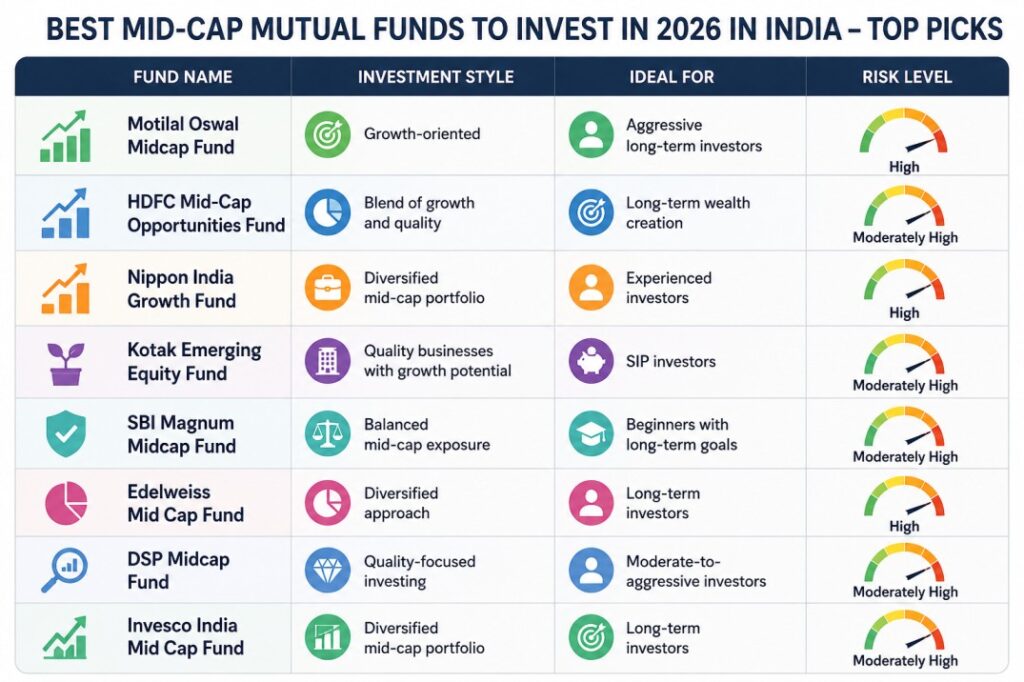
Selecting the Best Mid-Cap Mutual Funds in India 2026 requires more than simply looking at the highest historical returns. A good fund should demonstrate consistency across different market cycles, follow a disciplined investment strategy, maintain a diversified portfolio, and be managed by an experienced fund management team.
Important: The funds listed below are examples of well-known mid-cap mutual funds in India. Their expense ratio, AUM, fund manager, portfolio holdings, exit load, and historical performance may change over time. Always verify the latest information from the respective AMC’s official website before investing.
Comparison Table: Top Mid-Cap Mutual Funds 2026
| Mutual Fund | Investment Style | Suitable For | Risk Level |
|---|---|---|---|
| Motilal Oswal Midcap Fund | Growth-oriented | Aggressive long-term investors | High |
| HDFC Mid-Cap Opportunities Fund | Blend of growth and quality | Long-term wealth creation | Moderately High |
| Nippon India Growth Fund | Diversified mid-cap portfolio | Experienced investors | High |
| Kotak Emerging Equity Fund | Quality businesses with growth potential | SIP investors | Moderately High |
| SBI Magnum Midcap Fund | Balanced mid-cap exposure | Beginners with long-term goals | Moderately High |
| Edelweiss Mid Cap Fund | Diversified approach | Long-term investors | High |
| DSP Midcap Fund | Quality-focused investing | Moderate-to-aggressive investors | Moderately High |
| Invesco India Mid Cap Fund | Growth-oriented portfolio | Investors seeking diversification | High |
1. Motilal Oswal Midcap Fund
One of the most discussed mid-cap funds in recent years, this fund focuses on identifying businesses with strong earnings growth, scalable business models, and long-term wealth creation potential.
Key Features
- Focus on high-growth companies
- Long-term investment philosophy
- Concentrated yet carefully researched portfolio
- Active fund management
Suitable For
- Investors with a high risk appetite
- SIP investors investing for 10 years or more
- Young professionals building long-term wealth
Things to Consider
Since the portfolio is relatively concentrated compared to some peers, performance may fluctuate more during volatile market periods.
2. HDFC Mid-Cap Opportunities Fund
This is among India’s oldest and widely followed mid-cap mutual funds. It follows a disciplined investment approach while maintaining diversification across multiple sectors.
Key Features
- Experienced investment process
- Exposure across manufacturing, banking, industrials and consumer sectors
- Well-diversified portfolio
- Suitable for long-term investing
Why Investors Like It
Many investors appreciate its consistency across different market cycles rather than focusing only on short-term returns.
3. Nippon India Growth Fund
This fund has built a reputation over several years for investing in companies with long-term earnings potential.
Strengths
- Large and diversified portfolio
- Experienced research team
- Focus on quality businesses
- Long investment history
Best Suited For
Investors looking for long-term capital appreciation and who understand that equity markets experience temporary ups and downs.
4. Kotak Emerging Equity Fund
Kotak Emerging Equity Fund follows a disciplined stock selection process, aiming to identify businesses with sustainable growth opportunities.
Highlights
- Diversified holdings
- Strong focus on company fundamentals
- Suitable for SIP investing
- Balanced sector allocation
Investor Profile
This fund may appeal to investors seeking growth while avoiding excessive concentration in a few stocks.
5. SBI Magnum Midcap Fund
Backed by one of India’s largest fund houses, SBI Magnum Midcap Fund invests across sectors to capture opportunities in emerging businesses.
Key Advantages
- Broad diversification
- Professional research
- Suitable for disciplined long-term investing
- Managed using a structured investment framework
Good Choice For
Investors beginning their mutual fund journey who want exposure to the mid-cap segment through a reputed AMC.
6. Edelweiss Mid Cap Fund
Edelweiss follows an active investment strategy that emphasizes identifying companies with strong growth potential before they become market leaders.
Portfolio Characteristics
- Diversified sector exposure
- Focus on earnings growth
- Active portfolio management
- Long-term investment horizon
7. DSP Midcap Fund
DSP is known for its research-driven investment philosophy. This fund focuses on identifying quality businesses with sustainable competitive advantages.
Why It Stands Out
- Emphasis on corporate governance
- Disciplined risk management
- Quality-first investment philosophy
- Long-term wealth creation approach
8. Invesco India Mid Cap Fund
This fund seeks opportunities across a wide range of sectors while maintaining diversification.
Features
- Active management
- Exposure to emerging industries
- Diversified portfolio
- Long-term growth focus
How Should You Compare Mid-Cap Mutual Funds?
Instead of selecting a fund solely because it delivered impressive returns in the past year, evaluate several important factors.
1. Consistency of Performance
Markets move in cycles. A fund that performs reasonably well during both rising and falling markets may be more reliable than one that shines only during bull markets.
Look at performance across:
- 3 years
- 5 years
- 7 years
- 10 years (where available)
Remember that past performance does not guarantee future returns.
2. Portfolio Quality
Review the fund’s holdings to understand:
- Which sectors it invests in
- Level of diversification
- Concentration in individual stocks
- Exposure to cyclical industries
A diversified portfolio can help reduce company-specific risk.
3. Fund Manager’s Investment Approach
A skilled fund manager can make a significant difference over the long term. Consider:
- Investment philosophy
- Experience
- Portfolio construction
- Consistency in decision-making
Keep in mind that fund managers may change over time, so always check the latest details.
4. Expense Ratio
The expense ratio is the annual fee charged for managing the mutual fund.
Although even a small difference may seem insignificant, lower costs can have a meaningful impact on long-term returns due to the power of compounding.
Always compare expense ratios within the same category rather than across different types of funds.
5. Assets Under Management (AUM)
AUM represents the total value of assets managed by the fund.
While a larger AUM may indicate investor confidence, it should not be the only deciding factor. The quality of the portfolio and investment process are equally important.
6. Risk Measures
Several risk metrics can help evaluate a fund, including:
- Standard Deviation
- Sharpe Ratio
- Beta
- Alpha
- Sortino Ratio
Beginners don’t need to master every metric, but understanding that higher returns often come with higher risk is essential.
Benefits of Investing Through SIP
For most retail investors, a Systematic Investment Plan (SIP) can be a practical way to invest in mid-cap mutual funds.
Rupee Cost Averaging
By investing a fixed amount regularly, you buy more units when prices are low and fewer units when prices are high. This helps average out your purchase cost over time.
Investment Discipline
SIPs encourage consistent investing regardless of market conditions, helping investors avoid emotional decisions.
Power of Compounding
The earlier you start and the longer you stay invested, the greater the potential benefit of compounding.
Practical Example
Imagine two investors:
Investor A invests ₹5 lakh as a lump sum just before a market correction.
Investor B starts a ₹10,000 monthly SIP over several years.
Although short-term outcomes may differ, the SIP investor benefits from purchasing units at different market levels, potentially reducing the impact of volatility. Over the long term, disciplined investing often proves more effective than trying to time the market.
This example is for educational purposes only and should not be interpreted as a prediction of future returns.
Why Diversification Matters
Even within the mid-cap category, different funds may invest in different sectors and companies.
For example, one fund might have higher exposure to manufacturing and capital goods, while another focuses more on financial services or healthcare.
Choosing a diversified portfolio—or combining funds thoughtfully—can help reduce concentration risk. However, avoid holding too many similar mid-cap funds, as this can lead to unnecessary overlap without providing meaningful diversification.
How to Choose the Right Mid-Cap Mutual Fund in India 2026
Choosing the Best Mid-Cap Mutual Funds in India 2026 is not about finding the fund that delivered the highest return in the past. Many investors make the mistake of selecting funds based only on recent performance, but markets change and yesterday’s winners may not always remain future leaders.
A better approach is to evaluate a combination of factors such as investment strategy, consistency, risk level, portfolio quality, costs, and whether the fund matches your financial goals.
Factors to Consider Before Investing in Mid-Cap Mutual Funds
1. Understand Your Investment Goal
Before selecting any mutual fund, understand why you are investing.
Your goal could be:
- Retirement planning
- Children’s education
- Wealth creation
- Buying a house
- Long-term financial independence
Mid-cap funds are generally better suited for long-term goals because they can experience significant short-term fluctuations.
For example:
A person investing for a goal that is 10 years away may be able to tolerate market volatility, while someone needing money within the next 2–3 years may not be comfortable with the risk of equity funds.
2. Check Your Risk Tolerance
Mid-cap funds are equity investments, which means their value can rise and fall depending on market conditions.
Before investing, ask yourself:
- Can I stay invested during a 20–30% market decline?
- Will I panic and withdraw during a market correction?
- Do I have enough emergency savings?
Investors who cannot handle temporary losses may find mid-cap funds uncomfortable.
3. Evaluate Long-Term Performance
Instead of focusing on short-term returns, study performance over multiple market cycles.
Important periods to review:
- 3-year performance
- 5-year performance
- 7-year performance
- Performance during market corrections
A consistent fund that performs reasonably well across different conditions may be preferable to a fund that has occasional periods of exceptional returns.
4. Look at Portfolio Diversification
A good mid-cap fund should have a well-researched and balanced portfolio.
Check:
- Number of companies held
- Sector allocation
- Top 10 holdings concentration
- Exposure to cyclical industries
For example, a fund heavily dependent on one sector may face higher risk if that industry faces challenges.
5. Consider Expense Ratio
The expense ratio represents the annual cost charged by the mutual fund for managing your investment.
A lower expense ratio can help investors retain more of their returns over the long term.
However, investors should not select a fund only because it has the lowest expense ratio. A slightly higher-cost fund with better management and consistency may still be worth evaluating.
Always verify the latest expense ratio from the official AMC website because these charges can change.
SIP vs Lump Sum Investment in Mid-Cap Mutual Funds
Many investors wonder whether they should invest a large amount at once or start a Systematic Investment Plan (SIP).
Both methods have advantages and limitations.
| Feature | SIP | Lump Sum |
|---|---|---|
| Investment Method | Fixed amount regularly | One-time investment |
| Suitable For | Salaried investors | Investors with available capital |
| Market Timing Risk | Lower | Higher |
| Investment Discipline | High | Requires self-control |
| Benefit During Market Falls | Can buy more units at lower prices | Requires correct timing |
SIP Approach
SIP is often preferred by beginners because it creates investment discipline.
Example:
A salaried employee investing ₹5,000 every month in a mid-cap mutual fund does not need to worry about daily market movements.
The investment happens automatically, allowing the investor to focus on long-term goals.
Lump Sum Approach
A lump sum investment may work for investors who already have a large amount of money and understand market risks.
However, investing the entire amount at the wrong time can expose investors to short-term market volatility.
Some investors prefer staggered investing through methods such as systematic transfer plans (STPs) to reduce timing risk.
Taxation of Mid-Cap Mutual Funds in India
Mid-cap mutual funds are classified as equity mutual funds for taxation purposes.
The tax treatment depends on the holding period and applicable tax rules.
Short-Term Capital Gains (STCG)
If units are sold within the short-term holding period defined under current tax regulations, gains may be taxed according to applicable rules.
Long-Term Capital Gains (LTCG)
Investments held for the long-term period specified under current tax laws may qualify for long-term capital gains taxation.
Tax rules can change due to government policy updates. Investors should verify the latest taxation rules from official government sources or consult a qualified tax professional before making decisions.
Pros and Cons of Mid-Cap Mutual Funds
Advantages of Mid-Cap Funds
1. Higher Growth Potential
Mid-cap companies often have more opportunities to expand compared to mature large-cap companies.
2. Diversification
Investors get exposure to multiple businesses through one investment product.
3. Professional Research
Fund managers and research teams analyze companies before including them in the portfolio.
4. Suitable for Long-Term Wealth Creation
Investors with patience and a long investment horizon may benefit from India’s economic growth.
5. Easy Investing Through SIP
SIPs make it easier for regular investors to participate without needing a large initial amount.
Disadvantages of Mid-Cap Funds
1. Higher Volatility
Prices can fluctuate significantly during market downturns.
2. Not Suitable for Short-Term Goals
Investors needing money soon may not have enough time to recover from market declines.
3. Requires Patience
Mid-cap investments may go through periods where returns remain disappointing.
4. No Guaranteed Returns
Equity mutual funds are market-linked products and returns are not fixed.
Who Should Invest in Mid-Cap Mutual Funds?
Mid-cap funds may be suitable for:
Long-Term Investors
People investing for 7–10 years or longer may have a better ability to handle market fluctuations.
Young Investors
Investors with a longer working life ahead may benefit from having growth-oriented investments in their portfolio.
SIP Investors
People who prefer disciplined monthly investing can consider SIP-based investing.
Investors Looking for Growth
Those seeking higher growth potential than traditional fixed-income investments may explore mid-cap funds after understanding the risks.
Who Should Avoid Mid-Cap Mutual Funds?
Mid-cap funds may not be suitable for:
Investors With Short-Term Goals
If you need money within a few years, equity market volatility can create problems.
Conservative Investors
People who cannot tolerate temporary losses may prefer less volatile investment options.
Investors Without Emergency Savings
Before investing in equity funds, it is generally important to have an emergency fund for unexpected expenses.
Investors Expecting Guaranteed Returns
Mid-cap funds do not provide fixed or guaranteed returns.
Common Mistakes Investors Make With Mid-Cap Funds
1. Investing Based Only on Past Returns
A fund’s previous performance does not guarantee future results.
Many investors enter after seeing strong returns and exit after market declines, which can negatively impact their experience.
2. Ignoring Risk
Higher return potential comes with higher uncertainty. Investors should understand the possibility of temporary losses.
3. Investing Without a Long-Term Plan
Random investing without a clear goal can lead to poor decisions.
A proper plan should include:
- Investment amount
- Time horizon
- Financial goal
- Risk tolerance
4. Checking Portfolio Value Too Frequently
Daily monitoring can create unnecessary stress and encourage emotional decisions.
Long-term investing requires patience.
5. Owning Too Many Similar Funds
Holding many mid-cap funds does not always mean better diversification.
Multiple funds may own similar companies, creating hidden overlap.
How Many Mid-Cap Funds Should You Own?
For many investors, owning too many funds can make portfolio management difficult.
Instead of collecting several similar funds, focus on:
- Quality of the fund
- Alignment with your goals
- Overall portfolio diversification
The right number depends on your investment size, risk profile, and overall asset allocation.
Role of Mid-Cap Funds in a Diversified Portfolio
A balanced investment portfolio may include different asset classes such as:
- Equity mutual funds
- Debt investments
- Fixed deposits
- Gold
- Emergency savings
Mid-cap funds can be one component of an equity allocation rather than the entire portfolio.
The ideal allocation depends on factors such as age, income, financial goals, and risk tolerance.
Frequently Asked Questions (FAQs)
1. What are the Best Mid-Cap Mutual Funds in India 2026?
The Best Mid-Cap Mutual Funds in India 2026 depend on an investor’s financial goals, risk tolerance, and investment horizon. Some well-known mid-cap funds include Motilal Oswal Midcap Fund, HDFC Mid-Cap Opportunities Fund, Nippon India Growth Fund, Kotak Emerging Equity Fund, SBI Magnum Midcap Fund, DSP Midcap Fund, and others.
However, investors should not select a fund only based on past returns. Factors such as portfolio quality, consistency, expense ratio, risk level, and investment philosophy should also be considered.
2. Are Mid-Cap Mutual Funds Safe for Beginners?
Mid-cap mutual funds can be considered by beginners who understand equity market risks and have a long-term investment horizon.
They are not risk-free investments because mid-cap companies can experience higher price fluctuations compared to large-cap companies.
Beginners should start by understanding their risk tolerance, investing through disciplined methods like SIP, and avoiding short-term expectations.
3. What Is the Minimum Time to Stay Invested in Mid-Cap Funds?
Generally, mid-cap mutual funds are considered more suitable for long-term investors with a time horizon of around 7–10 years or longer.
The reason is that equity markets move through different cycles. A longer investment period gives investors more time to manage short-term volatility.
However, there is no guaranteed return period in equity investing.
4. Is SIP Better Than Lump Sum Investment in Mid-Cap Mutual Funds?
Both SIP and lump sum investments have their own advantages.
SIP can be useful for investors who want disciplined investing and wish to reduce the impact of market timing.
Lump sum investment may work for investors who already have available capital and understand market fluctuations.
The better approach depends on an individual’s financial situation, investment goals, and risk tolerance.
5. Can Mid-Cap Mutual Funds Give Higher Returns Than Large-Cap Funds?
Mid-cap funds have the potential to generate higher returns than large-cap funds because mid-sized companies may have greater growth opportunities.
However, higher return potential also comes with higher volatility and risk.
There can be periods when large-cap funds outperform mid-cap funds, especially during uncertain market conditions.
6. How Much Should I Invest in Mid-Cap Mutual Funds?
There is no fixed amount suitable for every investor.
The investment amount depends on:
- Income
- Existing investments
- Financial goals
- Risk capacity
- Time horizon
A person starting with a small SIP amount can gradually increase investments as income grows.
7. Are Mid-Cap Mutual Funds Tax-Free?
No, mid-cap mutual funds are not completely tax-free.
Since they are equity mutual funds, capital gains taxation applies according to the applicable tax rules.
Tax regulations can change over time, so investors should verify the latest rules from official government sources or consult a tax professional.
8. Should I Invest in Multiple Mid-Cap Mutual Funds?
Investing in multiple funds is not always necessary.
Many investors make the mistake of owning several similar funds thinking it provides more diversification. However, different funds may hold many of the same companies.
Before adding another fund, investors should check portfolio overlap and whether the new investment actually improves diversification.
9. What Risks Should I Know Before Investing in Mid-Cap Funds?
Important risks include:
- Market volatility
- Business performance risk
- Economic slowdown risk
- Valuation risk
- Fund management risk
Investors should understand these risks before investing and avoid making decisions based only on recent performance.
10. Can I Lose Money in Mid-Cap Mutual Funds?
Yes, it is possible to experience losses, especially in the short term.
Since mid-cap funds invest in equity markets, their value changes based on company performance and market conditions.
However, historically, equity investors who remain disciplined and invest with a long-term approach have generally had more opportunity to benefit from market growth compared to short-term investors.
Past performance does not guarantee future results.
Key Takeaways
- Mid-cap mutual funds invest primarily in medium-sized listed companies.
- They generally offer higher growth potential than large-cap funds but carry greater volatility.
- These funds are better suited for long-term goals of at least 7–10 years.
- SIP investing can help reduce the impact of market volatility.
- Investors should evaluate a fund’s consistency, portfolio quality, expense ratio, and risk metrics instead of relying solely on historical returns.
- Diversification across market capitalizations can improve portfolio stability.
- Always review the latest fund details from official sources before investing.
Conclusion: Should You Invest in Mid-Cap Mutual Funds in 2026?
Mid-cap mutual funds can be an important part of a long-term investment portfolio for investors who are looking for growth opportunities and can tolerate market fluctuations.
The Best Mid-Cap Mutual Funds in India 2026 are not necessarily the funds with the highest recent returns. A better selection approach involves evaluating:
- Long-term consistency
- Portfolio quality
- Investment strategy
- Risk management
- Fund expenses
- Your personal financial goals
Mid-cap companies represent an important segment of India’s growing economy. Many businesses in this category have the potential to become future market leaders. However, investors should remember that growth opportunities always come with uncertainty.
A disciplined approach, regular investing through SIP, diversification, and patience are often more important than trying to predict short-term market movements.
Before investing, assess your financial situation, understand the risks involved, and verify the latest fund details from official sources.
Author’s Note: I’ve been investing in mutual funds and stocks since 2018 and have practical experience in business and personal finance. While I’m not a licensed financial advisor or investment professional, I write educational content based on years of hands-on investing experience, business knowledge, extensive research, and reliable sources. My goal through TheInvestorStory.com is to simplify investing, personal finance, business, and financial concepts so readers can make more informed financial decisions.
Disclaimer: The content provided is for educational and informational purposes only and should not be considered financial, investment, insurance, or legal advice.




Pingback: Large Cap vs Mid Cap vs Small Cap: Which Is Best for Investors?
Pingback: Best Flexi Cap Mutual Funds in India - Top Funds for Investors