

Last Updated on 27 May 2026
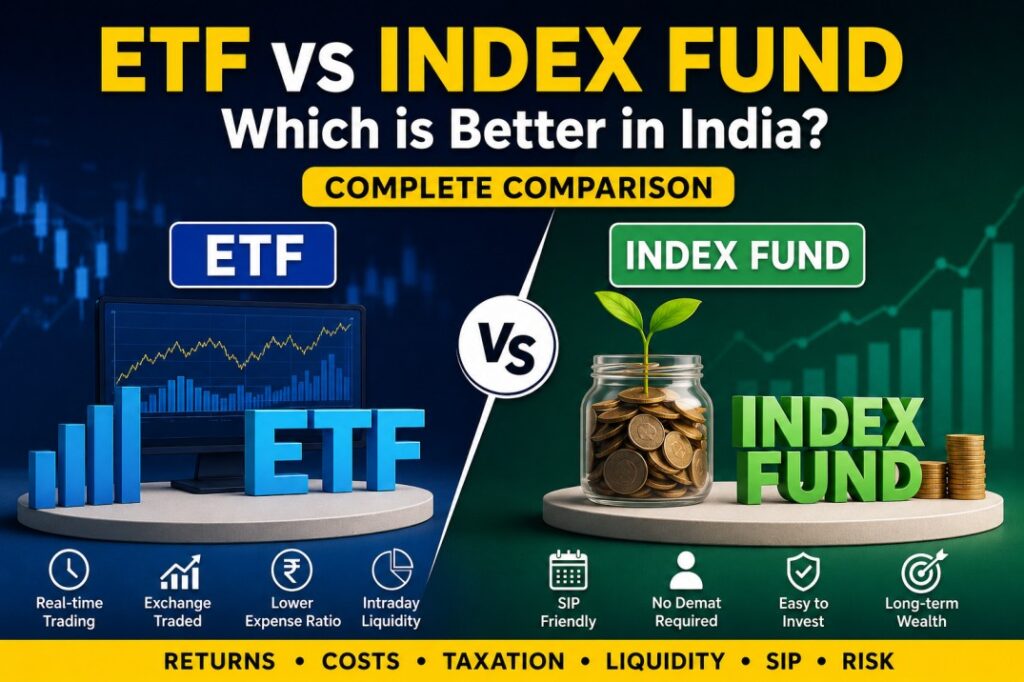
Passive investing has become one of the biggest trends in the Indian stock market over the last few years, and the debate around ETF vs Index Fund Which is Better has gained massive attention among beginner as well as experienced investors. More investors are now realizing that consistently beating the market is difficult, and simply following the market through low-cost investment products can often produce better long-term results.
This is where ETFs and Index Funds come into the picture.
But many beginners still get confused about one important question:
ETF vs Index Fund Which is Better in India?
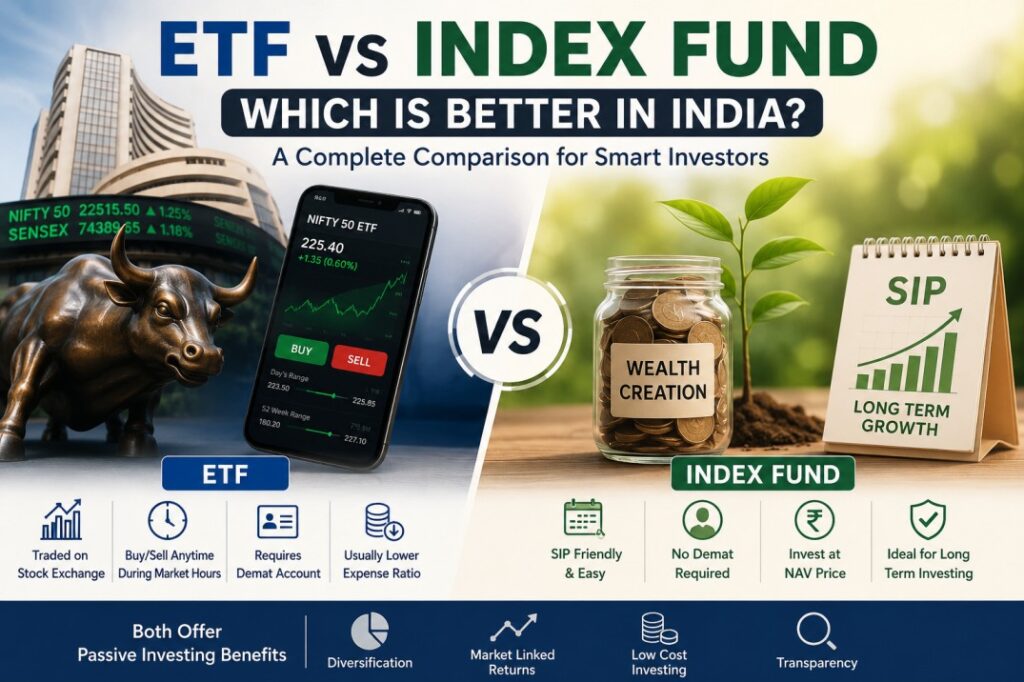
At first glance, both products look almost identical. Both track indices like Nifty 50 or Sensex. These are considered passive investments. Both usually have lower costs than actively managed mutual funds.
Yet the investing experience in both is completely different.
One gives you the flexibility of stock trading. The other gives you the simplicity of SIP investing.
One requires a demat account. The other does not.
One trades live on the stock exchange. The other works on end-of-day NAV.
And surprisingly, these small differences can significantly impact your investing journey over the long term.
In this detailed guide, we will compare ETF vs Index Fund in India based on:
- Returns
- Costs
- Liquidity
- Taxation
- SIP investing
- Ease of use
- Tracking error
- Risk
- Long-term suitability
By the end of this article, you will clearly know which option is better for your investment style.
What is an ETF?
ETF stands for Exchange Traded Fund.
An ETF is a market-traded investment fund that tracks an index such as:
- Nifty 50
- Sensex
- Nifty Next 50
- Bank Nifty
- Gold
- International indices
An ETF is traded on the stock exchange just like a normal share.
For example, if you buy a Nifty ETF, the fund tries to replicate the performance of the Nifty 50 index.
So if Nifty rises by 10%, the ETF should also rise close to 10%.
Key Features of ETFs
- Bought and sold on stock exchanges
- Requires demat and trading account
- Can be traded anytime during market hours
- Usually lower expense ratio
- Real-time market pricing
- Suitable for active passive investors
Popular ETF examples in India include:
- Nippon India ETF Nifty BeES
- SBI Nifty ETF
- HDFC Sensex ETF
- ICICI Prudential Nifty ETF
For detailed information about Best Emerging Market Value ETFs for Long-Term Investment
What is an Index Fund?
An Index Fund is a mutual fund that tracks a market index.
Instead of trying to beat the market, the fund simply copies the index composition.
For example:
A Nifty 50 Index Fund invests in the same 50 companies present in the Nifty 50 index in similar proportions.
Unlike ETFs, index funds are not traded on exchanges.
You directly invest through:
- AMC websites
- Mutual fund apps
- Banks
- Platforms like Groww, Zerodha Coin, Paytm Money, ET Money, etc.
Key Features of Index Funds
- No demat account needed
- Easy SIP setup
- End-of-day NAV pricing
- Beginner friendly
- Passive investing approach
- Long-term wealth creation focused
Popular Index Funds in India include:
- UTI Nifty Index Fund
- HDFC Index Fund Nifty 50 Plan
- ICICI Prudential Nifty Index Fund
- SBI Nifty Index Fund
For complete Guide to ETF investing for Beginners
ETF vs Index Fund Which is Better? Quick Comparison Table
| Feature | ETF | Index Fund |
|---|---|---|
| Trading | Stock exchange | AMC / Mutual fund platform |
| Demat Required | Yes | No |
| SIP Convenience | Limited | Excellent |
| Pricing | Real-time | End-of-day NAV |
| Expense Ratio | Usually lower | Slightly higher |
| Liquidity | Depends on volume | High redemption ease |
| Ease for Beginners | Medium | Very easy |
| Intraday Trading | Yes | No |
| Automation | Limited | Easy SIP |
| Best For | Experienced investors | Beginners & long-term SIP investors |
ETF vs Index Fund Returns Comparison
One of the biggest myths is that ETFs always give better returns.
In reality, both ETFs and index funds are designed to mirror the same benchmark index.
That means:
- Nifty ETF tracks Nifty
- Nifty Index Fund tracks Nifty
So theoretically, returns should be almost similar.
However, in practice, small differences happen because of:
- Expense ratio
- Tracking error
- Liquidity
- Cash holding
- Fund management efficiency
For detailed information about Best Index Funds for beginners in India
What is Tracking Error?
Tracking error means how closely a fund follows its benchmark index.
Lower tracking error = better replication.
For example:
If Nifty gives 12% return and your ETF gives 11.6%, the difference is due to tracking error and costs.
ETFs Usually Have Slightly Lower Tracking Error
Because ETFs trade continuously and remain fully invested, they sometimes track the index more efficiently.
But this difference is often very small for retail investors.
For long-term wealth creation, investor discipline matters much more than tiny return differences.
Expense Ratio: ETF vs Index Fund
Expense ratio is the annual fee charged by the fund house.
This is where ETFs often look more attractive.
ETF Expense Ratios
Many ETFs have extremely low expense ratios.
Some even below:
- 0.10%
- 0.05%
Index Fund Expense Ratios
Index funds are also low-cost but usually slightly higher:
- 0.20%
- 0.30%
- 0.40%
But Here’s the Important Reality
ETFs also involve:
- Brokerage charges
- Bid-ask spread
- Market execution cost
So the actual savings may not be huge for small investors.
If you invest monthly through SIPs, index funds often become more practical despite slightly higher expense ratios.
ETF vs Index Fund for SIP Investors
This is one of the most important sections for Indian investors.
Most people in India invest through monthly SIPs.
And this is where Index Funds clearly become more convenient.
Why Index Funds Are Better for SIP
- Automatic monthly investing
- No manual order placement
- No need to monitor market timing
- Easier long-term discipline
- Direct bank auto-debit
You simply start a SIP and continue investing every month.
ETF SIP Problem
Although some brokers offer ETF SIP features, ETFs are fundamentally exchange-traded products.
This means:
- Orders still execute on market price
- You may need manual intervention
- Fractional investing is limited
- Timing and liquidity matter
For salaried investors wanting stress-free wealth creation, index funds usually provide a smoother experience.
ETF vs Index Fund Taxation in India
Taxation is another major consideration.
The good news is:
For equity-oriented ETFs and index funds, taxation is largely similar.
Short-Term Capital Gains (STCG)
If sold within 1 year:
- Taxed at applicable short-term equity capital gains rate
Long-Term Capital Gains (LTCG)
If held for more than 1 year:
- LTCG taxation applies according to prevailing equity taxation rules
Dividend Taxation
Dividends are taxed as per the investor’s income tax slab.
So Which is Better for Tax Saving?
Neither has a huge advantage in equity taxation.
The decision should mainly depend on:
- Investing style
- Convenience
- Trading flexibility
- Long-term discipline
ETF vs Index Fund Liquidity Comparison
Liquidity means how easily you can buy or sell your investment.
ETF Liquidity
ETF liquidity depends on:
- Trading volume
- Market demand
- Bid-ask spread
Popular ETFs usually have good liquidity.
But some smaller ETFs may face:
- Low volume
- Wide spreads
- Price mismatch
Index Fund Liquidity
Index funds are redeemed directly with the AMC.
This means liquidity issues are usually minimal.
You simply place redemption and receive funds based on NAV.
For beginners, this process feels much easier and cleaner.
ETF vs Index Fund Which is Better for Beginners?
For beginners, Index Funds are usually the better choice.
Here’s why:
1. Simplicity
No demat account needed.
No stock market trading knowledge required.
2. Easy SIP
You can automate investments effortlessly.
3. Less Stress
No need to monitor prices throughout the day.
4. Better Long-Term Discipline
The simplicity of index funds helps investors remain consistent.
And consistency is one of the biggest drivers of long-term wealth creation.
ETF vs Index Fund for Experienced Investors
Experienced investors may prefer ETFs because they offer:
- Intraday trading flexibility
- Better control over execution
- Real-time pricing
- Tactical portfolio management
- Easier portfolio rebalancing
If someone already actively uses a demat account and understands market behavior, ETFs can feel more efficient.
Hidden Costs Investors Ignore
Many comparison articles only focus on expense ratio.
But real-world investing involves more than that.
ETF Hidden Costs
1. Brokerage Charges
Every transaction may include broker fees.
2. Bid-Ask Spread
You may buy slightly higher and sell slightly lower.
3. Slippage
Market price may differ from NAV.
4. Liquidity Risk
Low-volume ETFs can create inefficiencies.
Index Fund Hidden Costs
Mostly limited to:
- Expense ratio
- Minor tracking error
This simplicity is one reason many retail investors prefer index funds.
Psychological Difference: Very Important
This is a rarely discussed but extremely important point.
ETFs Encourage Trading Behavior
Since ETFs trade like stocks, investors may:
- Check prices frequently
- Time the market
- Overtrade
- Panic during volatility
Index Funds Encourage Investing Behavior
Index funds feel boring.
And boring is often good in investing.
You simply:
- Invest monthly
- Ignore market noise
- Stay invested long term
This behavioral advantage can sometimes produce better investor outcomes than lower expense ratios.
Best ETFs in India
Some popular ETFs include:
| ETF | Index |
|---|---|
| Nippon India ETF Nifty BeES | Nifty 50 |
| SBI ETF Nifty 50 | Nifty 50 |
| ICICI Prudential Nifty ETF | Nifty 50 |
| HDFC Sensex ETF | Sensex |
Best Index Funds in India
Popular index funds include:
| Index Fund | Benchmark |
|---|---|
| UTI Nifty Index Fund | Nifty 50 |
| HDFC Nifty Index Fund | Nifty 50 |
| ICICI Prudential Nifty Index Fund | Nifty 50 |
| SBI Nifty Index Fund | Nifty 50 |
ETF vs Index Fund: Real-Life Example
Suppose two investors invest ₹10,000 monthly for 15 years.
Investor A
- Uses ETF
- Places orders manually
- Misses some months
- Tries market timing
Investor B
- Uses Index Fund SIP
- Fully automated
- Never misses investment
Even if ETF costs are slightly lower, Investor B may end up with higher wealth simply because of consistency.
This is why convenience matters more than many people realize.
Common Mistakes to Avoid
Choosing Only Based on Expense Ratio
Low fees are good, but convenience matters too.
Ignoring Liquidity in ETFs
Some ETFs have poor trading volume.
Overtrading ETFs
Passive investing should remain passive.
Stopping SIPs During Market Crashes
Market crashes are often the best long-term buying opportunities.
ETF vs Index Fund Which is Better for Long-Term Wealth Creation?
For most Indian investors:
Index Funds Win on Simplicity
Especially for:
- Beginners
- Salaried employees
- SIP investors
- Long-term wealth builders
ETFs Win on Flexibility
Especially for:
- Experienced investors
- Active portfolio managers
- Tactical allocators
- Investors comfortable with demat investing
Final Verdict: ETF vs Index Fund Which is Better?
If you want the simplest possible answer:
Choose Index Funds If:
- You are a beginner
- You prefer SIP investing
- You want automation
- You dislike market monitoring
- You want long-term simplicity
Choose ETFs If:
- You already use demat accounts
- You want real-time trading
- You prefer lower expense ratios
- You understand market execution
- You actively manage investments
For most retail Indian investors, Index Funds are usually the more practical choice.
Not because ETFs are bad.
But because simplicity increases consistency.
And consistency is what ultimately creates wealth.
Frequently Asked Questions (FAQs)
Are ETFs safer than Index Funds?
Both are generally similar in risk because both track market indices.
Can I do SIP in ETFs?
Some platforms offer ETF SIPs, but they are not as seamless as index fund SIPs.
Which has lower expense ratio?
ETFs usually have lower expense ratios.
Which is better for beginners?
Index funds are usually easier for beginners.
Do ETFs give higher returns?
Not necessarily. Returns are usually very similar over the long term.
Conclusion
The debate around ETF vs Index Fund Which is Better does not have a one-size-fits-all answer.
Both are excellent passive investing tools.
Index Fund and ETF also can help build long-term wealth.
Both are far better than randomly chasing hot stocks or expensive mutual funds.
But the best choice depends on your personality and investing behavior.
If you want maximum simplicity, stress-free SIPs, and long-term consistency, Index Funds are probably the better choice.
If you want exchange flexibility and already understand stock market investing, ETFs can be extremely effective.
In the end, the most important factor is not choosing the “perfect” product.
It is staying invested consistently for years.
Because long-term wealth is built not through complexity, but through discipline.
To know more about Index Funds vs Mutual Funds: Which Is Better for Beginners in India
Disclaimer: The content provided is for educational and informational purposes only and should not be considered financial, investment, insurance, or legal advice.




Pingback: Best S&P 500 Index Fund in India (2026): Top Funds to Invest USA