


Last Updated on 10 November 2026
Introduction
SBI Gold ETF investment for beginners can be a convenient way to include gold in an investment portfolio without dealing with the challenges of physical gold ownership. Managed by SBI Mutual Fund, this ETF is listed on the stock exchange, where investors can purchase and sell its units through a demat and trading account.
However, investing in a Gold ETF is not the same as keeping gold in a locker. Its value fluctuates with gold prices, and investors must understand expenses, tracking differences, market liquidity and taxation before investing.
In this guide, we will explain how SBI Gold ETF works, how beginners can invest in it, its advantages and disadvantages, and how it compares with physical gold.
Gold has always held an important place in Indian households. People buy gold jewellery for weddings, festivals and family occasions. Many investors also consider gold a way to diversify their savings and reduce dependence on traditional investment options.
However, buying physical gold is not always convenient. Jewellery involves making charges, coins and bars require safe storage, and buyers must pay attention to purity and authenticity. These concerns have encouraged many investors to explore digital alternatives.
One such option is the SBI Gold ETF, a mutual fund scheme that allows investors to gain exposure to gold prices without personally purchasing or storing gold.
1. What Is SBI Gold ETF?
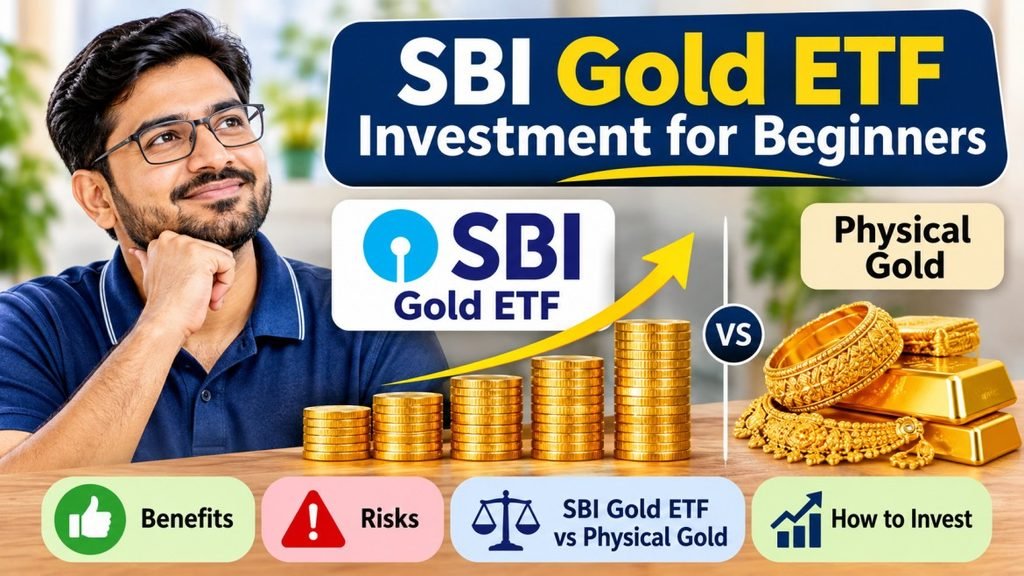
SBI Gold ETF is an open-ended Gold Exchange Traded Fund offered by SBI Mutual Fund.
An Exchange Traded Fund (ETF) is a mutual fund scheme whose units are listed and traded on a stock exchange. Instead of purchasing gold jewellery or coins, investors purchase units representing an interest in a scheme that holds gold and permitted gold-related instruments.
The primary objective of SBI Gold ETF is to generate returns that closely correspond to the returns from the domestic price of gold, subject to tracking error.
In simple language, when domestic gold prices increase, the ETF’s value will generally increase as well. Similarly, when gold prices decline, its value may also fall.
However, the two returns may not match exactly because the scheme has expenses, cash holdings and other operational factors.
Important Features of SBI Gold ETF
| Feature | Details |
|---|---|
| Fund House | SBI Mutual Fund |
| Scheme Name | SBI Gold ETF |
| Category | Gold ETF |
| Scheme Type | Open-ended Exchange Traded Fund |
| Investment Objective | To track returns corresponding to gold prices |
| Benchmark | Domestic gold price |
| Underlying Asset | Physical gold and permitted gold-related instruments |
| Launch Date | May 2009 |
| Exchange Listing | National Stock Exchange (NSE) |
| NSE Trading Symbol | SETFGOLD |
| Investment Method | Through a trading and demat account |
Note: Investors should check the latest SBI Gold ETF Scheme Information Document and monthly factsheet for updated scheme details, portfolio allocation, benchmark information and other disclosures.
Is SBI Gold ETF a Mutual Fund or a Stock?
SBI Gold ETF is technically a mutual fund scheme, but its units trade on the stock exchange like shares.
This is an important distinction for beginners.
When you purchase SBI Gold ETF units, you are not buying shares of SBI. You are purchasing units of a mutual fund scheme whose underlying investment is gold.
The ETF’s market price changes during trading hours depending on gold prices, demand, supply and market liquidity.
2. How Does SBI Gold ETF Work?
Understanding how a Gold ETF operates makes it easier to decide whether it suits your investment needs.
SBI Gold ETF collects money from investors and invests primarily in physical gold and permitted gold-related instruments in accordance with its investment objective and applicable regulations.
The physical gold is held through the scheme’s authorised custody arrangements. Investors do not personally receive gold bars or coins when purchasing ETF units.
Instead, they hold electronic units in their demat accounts.
Here is a simplified explanation.
- SBI Mutual Fund manages the Gold ETF scheme.
- The scheme holds physical gold and permitted gold-related instruments.
- Investors purchase ETF units through the stock exchange.
- The units are credited to their demat accounts.
- The value of the units changes as domestic gold prices and market trading conditions change.
- Investors can sell their units through the stock exchange during trading hours.
What Is NAV in SBI Gold ETF?
NAV stands for Net Asset Value.
It represents the per-unit value of a mutual fund scheme’s net assets after deducting its liabilities.
For a Gold ETF, NAV is influenced mainly by the value of the gold and other assets held by the scheme, after accounting for expenses and liabilities.
However, beginners should understand that the NAV and stock exchange trading price are not necessarily identical.
For example:
Suppose the indicative value of an SBI Gold ETF unit is ₹120.
- If buyers are willing to pay ₹121, the ETF trades at a premium.
- If sellers are willing to accept ₹119, the ETF trades at a discount.
These differences can occur because of demand, supply and liquidity conditions.
Therefore, checking the indicative NAV (iNAV), where available, before placing an order can help investors avoid paying an unnecessarily high price.
What Is Tracking Error?
Tracking error measures how closely an ETF follows its benchmark over time.
For example, assume domestic gold prices increase by 10% over a particular period, while SBI Gold ETF delivers 9.6%.
The difference may arise from expenses, cash holdings, transaction costs and other operational factors.
This difference is important because investors are ultimately interested in the returns they receive, not just the performance of gold itself.
Before investing, compare the scheme’s tracking error and tracking difference with those of other Gold ETFs.
3. How to Invest in SBI Gold ETF in India
Investing in SBI Gold ETF is relatively straightforward for someone who already invests in shares.
Unlike a conventional mutual fund where investors can purchase units directly through an AMC website without a demat account, an ETF is normally purchased through the stock exchange.
Follow these steps.
Step 1: Open a Demat and Trading Account
You need:
- A PAN card.
- A bank account.
- A trading account with a stockbroker.
- A demat account to hold the ETF units.
- Completed KYC formalities.
Most stockbrokers allow investors to open these accounts online.
Step 2: Log In to Your Trading Platform
Open your broker’s mobile application or website.
Go to the stock or ETF search section.
Step 3: Search for SBI Gold ETF
Search for:
SETFGOLD
Check that the displayed instrument is SBI-ETF Gold and not another gold-related mutual fund.
Always verify the scheme name before placing an order.
Step 4: Check the Current Market Price
ETF prices fluctuate during market hours.
Before investing, examine:
- Current trading price.
- Indicative NAV, if available.
- Bid and ask prices.
- Trading volume.
- Bid-ask spread.
A narrow bid-ask spread generally makes entering and exiting a position more economical.
Step 5: Decide How Many Units to Purchase
You can generally buy units in whole-number quantities, subject to the exchange’s applicable lot size.
For example, if the market price is ₹120 per unit and you want to invest approximately ₹6,000, you could purchase 50 units.
This is only an illustration. The actual market price will change.
The amount required depends on the unit price, the quantity purchased and applicable transaction charges.
Step 6: Place Your Buy Order
You can generally choose between a market order and a limit order.
A market order attempts to execute at the available market price. A limit order allows you to specify the maximum price you are willing to pay.
Beginners may find limit orders useful, particularly when the bid-ask spread is wide.
Step 7: Monitor Your Investment
Once the transaction is successfully completed, the units will be credited to your demat account.
You can monitor their value through your broker’s platform and compare the ETF’s performance with domestic gold prices.
Important: The exchange price is not guaranteed to match the NAV exactly. Do not place an order without checking the prevailing price and liquidity.
4. Can Beginners Invest Through an SIP in SBI Gold ETF?
This is a common question among first-time investors.
A conventional mutual fund SIP automatically invests a predetermined amount at regular intervals, such as monthly.
An ETF works differently because its units are bought and sold on the exchange.
SBI Gold ETF does not operate like a regular open-ended mutual fund SIP with the same direct AMC purchase mechanism.
However, investors can create a disciplined monthly investment approach by purchasing a selected number of ETF units periodically.
Some stockbrokers also provide recurring ETF investment facilities. Their availability and operating conditions depend on the platform.
For example, an investor who decides to allocate ₹2,000 towards gold every month could set a monthly reminder and purchase available units through a broker.
The actual amount invested may differ slightly because ETF prices change.
SBI Gold ETF vs SBI Gold Fund: What Is the Difference?
Beginners sometimes confuse SBI Gold ETF with SBI Gold Fund.
Although both provide exposure to gold, their investment methods are different.
| Particulars | SBI Gold ETF | SBI Gold Fund |
|---|---|---|
| Investment Structure | Exchange Traded Fund | Fund of Funds |
| Underlying Investment | Gold and permitted gold-related instruments | Primarily SBI Gold ETF units |
| Demat Account | Generally required | Not required |
| Purchase Method | Stock exchange | Mutual fund platform or AMC |
| SIP Facility | Not a conventional AMC SIP | Conventional mutual fund SIP facility |
| Cost Structure | ETF’s own expenses and transaction costs | FoF expenses plus underlying ETF expenses |
A person who already has a demat account may find the ETF convenient.
Someone who wants a conventional mutual fund SIP without managing stock exchange orders may explore SBI Gold Fund instead.
However, the expense ratio and exit load of the FoF should also be checked before investing.
5. SBI Gold ETF vs Physical Gold: Which Is Better?
The choice between an SBI Gold ETF and physical gold depends on why you are purchasing gold.
Physical gold has emotional, cultural and practical value in Indian households. People purchase jewellery for weddings, gifts and personal use.
A Gold ETF is primarily an investment instrument designed to provide exposure to gold prices.
The following comparison explains the major differences.
| Comparison | SBI Gold ETF | Physical Gold |
|---|---|---|
| Ownership | Electronic ETF units | Actual jewellery, coins or bars |
| Storage | Demat account | Locker or personal storage |
| Purity Concern | Managed through scheme’s gold custody and valuation arrangements | Depends on seller and product certification |
| Making Charges | No jewellery-making charges | Applicable to jewellery |
| Investment Amount | Can start with the price of eligible ETF units | Depends on the product and seller |
| Liquidity | Exchange-based trading | Depends on buyer, dealer and product |
| Pricing | Market price influenced by gold value and trading conditions | Includes product-specific premiums and costs |
| Physical Use | Cannot ordinarily be used as jewellery | Can be worn, gifted or stored |
| Recurring Expenses | ETF expense ratio and trading costs | Storage and other ownership-related costs may apply |
| Demat Account | Generally required | Not required |
To know more details about ETF vs Index Fund Which is Better in India
Advantages of SBI Gold ETF Over Physical Gold
1. No Physical Storage
You do not need to keep jewellery or gold coins at home.
The ETF units are held electronically in a demat account.
2. No Jewellery-Making Charges
Jewellery buyers often pay making charges in addition to the gold value.
These charges can reduce the resale value of jewellery.
A Gold ETF does not involve jewellery-making charges.
3. Easier Transactions
ETF units can be bought or sold through the stock exchange during trading hours.
Investors do not have to visit a jewellery shop to complete every transaction.
4. Smaller Investment Amounts
You can generally purchase individual ETF units rather than purchasing a complete gold coin or bar.
This allows investors to build gold exposure using smaller amounts.
When Is Physical Gold Better?
Physical gold may be more appropriate when the purpose is personal use, gifting or jewellery purchases.
For example, parents planning to purchase jewellery for a daughter’s wedding may prefer physical gold.
An investor who simply wants exposure to gold prices without handling jewellery may find an ETF more convenient.
There is no single answer for everyone. The purpose of the purchase should determine the choice.
For detailed information about Best Motilal Oswal ETF to Buy
6. Benefits of SBI Gold ETF Investment
There are several reasons beginners may consider a Gold ETF as part of their portfolio.
1. Portfolio Diversification
Investing in different asset classes can help reduce dependence on a single investment category.
For example, an investor may hold equity mutual funds, fixed deposits and gold.
Gold prices do not always move in the same direction or at the same pace as stock markets.
However, gold does not guarantee protection from equity market declines.
2. Convenient Gold Exposure
Investors can gain exposure to gold without purchasing, transporting or storing physical gold.
This makes the investment process more convenient.
3. Transparent Market Pricing
Gold ETF units trade on a recognised stock exchange.
Investors can view market prices and place their orders through their trading platforms.
4. Easy Buying and Selling
Unlike physical jewellery, investors can transact in ETF units electronically during exchange trading hours.
Actual execution depends on market liquidity and the available bid and ask prices.
5. Regulated Investment Structure
Gold ETFs operate within the mutual fund regulatory framework.
SBI Mutual Fund provides scheme-related disclosures, portfolio information and other investor documents.
Investors should still read the Scheme Information Document before making a decision.
6. No Need to Manage Physical Purity
Investors do not have to inspect the purity of individual coins or jewellery pieces.
The scheme is responsible for managing its underlying assets according to its regulatory and scheme requirements.
To know more about Silver ETF Investment
7. Risks of Investing in SBI Gold ETF
Although Gold ETFs offer convenience, they are not risk-free.
Beginners should understand the following risks.
1. Gold Price Fluctuation
The biggest risk is a decline in gold prices.
Gold prices are influenced by international demand, central bank activity, interest rates, geopolitical conditions, currency movements and investor sentiment.
If gold prices fall, the ETF’s value can also decline.
2. Tracking Error
The ETF may not deliver exactly the same return as its gold benchmark.
Management expenses, cash holdings, transaction costs and operational factors can create a difference.
3. Market Liquidity Risk
Although SBI Gold ETF is listed on the stock exchange, trading liquidity can vary.
A low trading volume or wide bid-ask spread may affect the price at which an investor can buy or sell.
4. Premium and Discount Risk
ETF units may trade above or below their indicative underlying value.
Purchasing at a substantial premium can negatively affect the investor’s effective purchase price.
5. Currency Risk
Indian gold prices are influenced not only by international gold prices but also by movements in the rupee against the US dollar.
Currency movements can affect domestic gold valuations.
6. Opportunity Cost
Gold does not generate interest like fixed deposits or coupon payments like bonds.
It also does not represent ownership in a growing business like an equity share.
During certain periods, gold may underperform equity or other asset classes.
7. Regulatory and Taxation Changes
Investment regulations and tax rules can change.
Investors should periodically review official announcements and scheme disclosures.
For detailed information about Complete Guide to the Best Gold ETFs
8. Pros and Cons of SBI Gold ETF
The following table summarises the major advantages and disadvantages.
| Pros | Cons |
|---|---|
| Convenient electronic gold investment | Requires a demat and trading account |
| No physical storage requirement | Gold prices can decline |
| No jewellery-making charges | Expense ratio reduces returns |
| Can invest through small unit purchases | Tracking error is possible |
| Exchange-based buying and selling | Liquidity varies |
| Helps diversify an investment portfolio | Does not generate regular income |
| No need to personally check jewellery purity | Cannot ordinarily be used as physical jewellery |
The main advantage is convenience. The main limitation is that investors remain exposed to gold price fluctuations without receiving physical gold for ordinary exchange-traded holdings.
9. Taxation on SBI Gold ETF in India
Taxation is an important consideration before investing.
Gold ETF taxation is different from equity mutual fund taxation. Investors should not automatically apply equity capital gains rules to their Gold ETF investments.
For fresh investments under the Indian tax framework applicable in FY 2026–27, the general treatment is as follows.
Short-Term Capital Gains
If you sell listed Gold ETF units within 12 months of purchase, the gains are generally treated as short-term capital gains.
These gains are taxed according to your applicable income tax slab.
For example:
Suppose you purchase SBI Gold ETF units for ₹50,000 and sell them for ₹55,000 after 8 months.
Your capital gain is:
₹55,000 – ₹50,000 = ₹5,000.
The ₹5,000 gain is generally added to your taxable income and taxed at your applicable slab rate.
Long-Term Capital Gains
If you sell listed Gold ETF units after holding them for more than 12 months, the gains generally qualify as long-term capital gains.
The applicable general LTCG rate is 12.5% without indexation, subject to applicable surcharge and cess.
For example:
Suppose you invest ₹2,00,000 in SBI Gold ETF and sell your holdings for ₹2,50,000 after 14 months.
| Particulars | Amount |
|---|---|
| Purchase Value | ₹2,00,000 |
| Sale Value | ₹2,50,000 |
| Capital Gain | ₹50,000 |
| LTCG Tax at 12.5% | ₹6,250 |
| Health and Education Cess at 4% | ₹250 |
| Total Tax | ₹6,500 |
This is a simplified illustration assuming no other adjustments or surcharge.
Does the ₹1.25 Lakh LTCG Exemption Apply to Gold ETFs?
No. The annual ₹1.25 lakh exemption available under the special long-term capital gains provisions for eligible equity shares and equity-oriented mutual funds does not generally apply to Gold ETFs.
This is a common mistake among investors who assume that every exchange-traded fund receives the same tax treatment.
Important Tax Note
The above explanation covers the general treatment of fresh listed Gold ETF investments under the rules applicable in 2026–27.
Tax treatment can depend on acquisition dates, transaction dates, residency, individual circumstances and amendments to tax laws.
Always verify the latest Income Tax Department guidance or consult a qualified tax professional before selling your investment.
10. Who Should Consider Investing in SBI Gold ETF?
SBI Gold ETF may be worth evaluating for investors who:
- Want exposure to domestic gold prices.
- Prefer electronic gold investments over physical jewellery.
- Already have a demat and trading account.
- Want to diversify their existing investment portfolio.
- Understand that gold prices can fluctuate.
- Do not need regular interest or dividend income from the investment.
It may also interest investors who want to make periodic purchases without storing physical gold.
However, investors should select an allocation based on their financial situation, investment goals and risk tolerance rather than following a fixed percentage blindly.
11. Who Should Avoid SBI Gold ETF?
SBI Gold ETF may not be suitable for everyone.
Consider avoiding it when:
- You need guaranteed returns.
- You require regular income.
- You cannot tolerate fluctuations in investment value.
- You are purchasing gold primarily for jewellery or gifting.
- You need money for an important short-term financial goal.
- You do not have a demat account and do not want to open one.
- You are investing only because gold prices have recently increased.
Gold ETFs should not replace emergency savings, fixed deposits or a diversified long-term investment plan.
12. Common Mistakes Beginners Should Avoid
Many first-time investors focus only on the recent performance of gold and ignore other important factors.
Here are some mistakes worth avoiding.
Mistake 1: Investing After Seeing a Sharp Rise in Gold Prices
Gold prices can rise substantially during periods of uncertainty.
However, a strong recent performance does not guarantee similar future returns.
Avoid investing simply because everyone around you is purchasing gold.
Mistake 2: Ignoring the Expense Ratio
Every mutual fund scheme has operating expenses.
Even a relatively small annual expense can affect returns over longer periods.
Check the latest Total Expense Ratio (TER) through SBI Mutual Fund’s official disclosure page.
Mistake 3: Ignoring Tracking Difference
Two Gold ETFs can follow the same underlying asset but deliver slightly different returns.
Compare tracking difference over multiple periods instead of choosing a fund based only on its brand name.
Mistake 4: Placing Orders Without Checking Liquidity
Some beginners use market orders without examining the bid-ask spread.
This can result in buying above or selling below a reasonable market price.
Use limit orders where appropriate and examine trading volume.
Mistake 5: Treating Gold as a Guaranteed Investment
Gold prices can remain flat or decline for extended periods.
Investors should not assume that gold will always protect their purchasing power.
Mistake 6: Confusing SBI Gold ETF With SBI Gold Fund
These are different products.
SBI Gold ETF requires exchange-based trading, while SBI Gold Fund is a Fund of Funds structure.
Understand the purchase method and total expenses before choosing either product.
Mistake 7: Ignoring Taxation
Some investors focus on purchase prices and selling prices but forget about capital gains tax.
Calculate the potential tax liability before redeeming or selling units.
13. Practical Example: How an Investment in SBI Gold ETF Works
Consider a hypothetical investor named Amit.
Amit wants to invest ₹10,000 in gold but does not want to purchase jewellery or worry about storing coins.
He decides to explore SBI Gold ETF.
Suppose the market price is ₹100 per unit.
With ₹10,000, he purchases 100 units, excluding transaction charges.
Now consider two possible outcomes.
Scenario A: Gold Prices Increase
Suppose the ETF price increases to ₹108 per unit.
The investment value becomes:
100 × ₹108 = ₹10,800.
The gain is ₹800 before applicable charges and taxes.
Scenario B: Gold Prices Decline
Suppose the ETF price falls to ₹92 per unit.
The investment value becomes:
100 × ₹92 = ₹9,200.
The loss is ₹800 before applicable charges.
This example demonstrates an important principle: an ETF makes gold investment easier, but it does not remove the risk of a decline in gold prices.
Actual returns will depend on market movements, scheme expenses, tracking differences and the price at which units are purchased and sold.
14. How to Evaluate SBI Gold ETF Before Investing
Before purchasing any Gold ETF, beginners should examine a few important parameters.
Expense Ratio
The expense ratio is the annual operating cost charged to the scheme’s assets.
A lower expense ratio can be beneficial, all else being equal.
However, investors should not select an ETF based only on expenses.
Tracking Error and Tracking Difference
These measures indicate how closely the ETF follows its benchmark.
Lower tracking difference over comparable periods can be an advantage, provided the comparison uses consistent dates and return calculations.
Assets Under Management
Assets Under Management (AUM) indicate the total assets managed by the scheme.
A larger AUM can indicate an established fund, but it does not automatically guarantee better returns or superior trading liquidity.
Trading Volume and Bid-Ask Spread
Check the average trading volume and bid-ask spread before placing orders.
These factors are particularly important for investors who plan to transact regularly.
Scheme Information Document
Read the latest Scheme Information Document (SID) and factsheet issued by SBI Mutual Fund.
These documents provide information about investment objectives, asset allocation, expenses, risks and other scheme-related conditions.
Do not rely exclusively on third-party websites for information that may have changed.
Frequently Asked Questions (FAQs)
1. Is SBI Gold ETF good for beginners?
SBI Gold ETF can be considered by beginners who understand gold price fluctuations and want electronic exposure to gold. It is relatively convenient because investors do not have to purchase or store physical gold. However, it is important to understand its costs, tracking difference and market risks before investing.
2. How can I invest in SBI Gold ETF?
You can invest through a stockbroker by opening a demat and trading account. Search for SBI Gold ETF using its NSE trading symbol, SETFGOLD, check its market price and liquidity, and place a buy order. The units are held in electronic form in your demat account.
3. What is the minimum investment in SBI Gold ETF?
The minimum exchange purchase generally depends on the price of one unit and the exchange’s applicable lot size. Unlike a conventional mutual fund SIP, you purchase whole ETF units through the market. The actual investment amount changes with the market price.
4. Is SBI Gold ETF better than physical gold?
It depends on your purpose. A Gold ETF may be more convenient for investment because it avoids physical storage and jewellery-making charges. Physical gold is more appropriate when you want jewellery for personal use, gifting or family occasions.
5. Does SBI Gold ETF provide monthly SIP?
SBI Gold ETF does not follow the conventional mutual fund SIP purchase mechanism. Investors can purchase ETF units periodically through their trading accounts. Some brokers may also provide recurring ETF investment facilities.
6. Can I lose money in SBI Gold ETF?
Yes. Gold prices fluctuate. If gold prices decline, the value of SBI Gold ETF units may also decrease. Investors can experience losses when selling their holdings at a price below their purchase cost.
7. Does SBI Gold ETF give dividends?
SBI Gold ETF is primarily designed to track gold prices rather than generate regular income. Gold itself does not pay interest or dividends. Investors should therefore not expect a regular income stream from this scheme.
8. Is a demat account compulsory for SBI Gold ETF?
A demat and trading account is generally required to purchase and hold SBI Gold ETF units through the stock exchange. Investors who do not want a demat account can examine a Gold Fund of Funds, which offers gold exposure through mutual fund units.
9. What is the taxation on SBI Gold ETF?
Under the general rules applicable to fresh listed Gold ETF investments in FY 2026–27, gains on units held for 12 months or less are generally taxed at the investor’s applicable income tax slab rate. Gains on units held for more than 12 months are generally taxed at 12.5% without indexation, subject to applicable surcharge and cess.
10. Can SBI Gold ETF replace equity mutual funds?
No. Gold ETFs and equity mutual funds serve different investment purposes. Equity funds invest in businesses and aim for long-term capital appreciation, while Gold ETFs provide exposure to gold prices. A diversified portfolio may hold different asset classes depending on individual financial goals and risk tolerance.
Key Takeaways
- SBI Gold ETF is an exchange-traded mutual fund scheme that aims to track domestic gold prices.
- Investors can buy and sell its units through a stock exchange.
- A demat and trading account is generally required.
- The investment offers exposure to gold without the need to store physical gold.
- Its returns depend primarily on gold prices and may differ from the underlying gold price because of expenses and tracking error.
- Gold ETFs are subject to market risk and do not guarantee returns.
- Under the tax framework applicable to fresh investments in 2026–27, listed Gold ETF units held for more than 12 months generally qualify for long-term capital gains taxation at 12.5%, without indexation.
- Physical gold and Gold ETFs serve different purposes, so investors should understand their requirements before choosing between them.
Conclusion
SBI Gold ETF offers Indian investors a convenient way to gain exposure to gold without purchasing physical jewellery, coins or bars. Its exchange-traded structure makes buying and selling units relatively straightforward for investors who already have a demat and trading account.
However, convenience does not mean guaranteed returns. The value of SBI Gold ETF depends primarily on domestic gold prices, and its performance can differ from the benchmark because of expenses and tracking error.
Before investing, compare its expense ratio, tracking difference, liquidity and trading price. Also understand the difference between SBI Gold ETF and SBI Gold Fund, particularly if you prefer a conventional mutual fund SIP.
Most importantly, treat gold as one possible component of a diversified financial portfolio rather than a replacement for all other investments.
The right investment decision should depend on your financial goals, time horizon, risk tolerance and overall asset allocation.
Author Note: I have been investing in the Indian stock market since 2018, with practical experience in mutual funds and equities. For U.S.-focused articles, I research information from official fund providers, regulatory sources, company filings, and other reliable sources. I also use AI-assisted research and writing tools to help organize and explain information, while reviewing the content for accuracy and clarity before publication. This article is intended for educational purposes and is not personalized financial advice.
Disclaimer: The content provided is for educational and informational purposes only and should not be considered financial, investment, insurance, or legal advice.