


Last Updated on 16 June 2026
Best Corporate Bond Funds in India have emerged as a popular investment choice for investors seeking a balance between stability, income generation, and relatively lower risk. While equity mutual funds offer the potential for higher long-term returns, they can also experience significant market volatility. On the other hand, traditional fixed deposits provide capital safety but often struggle to deliver inflation-beating returns over the long run.
This leaves many investors wondering where they can park their money to earn better returns without taking excessive risk. This is where corporate bond funds come into the picture.
Corporate bond funds are debt mutual funds that primarily invest in high-quality bonds issued by financially strong companies. By focusing on highly rated corporate debt securities, these funds aim to provide relatively stable returns while maintaining lower volatility than equity investments. They can be particularly suitable for conservative investors, retirees, and individuals looking to diversify their portfolios with fixed-income investments.
In this comprehensive guide, we’ll explore the best corporate bond funds in India, understand how these funds work, compare some of the top options available, analyze their benefits and risks, discuss taxation rules, and help you determine whether they fit your investment goals and risk profile.
What Are Corporate Bond Funds?
Corporate bond funds are debt mutual funds that predominantly invest in highly rated corporate bonds.
According to SEBI’s mutual fund categorization rules, corporate bond funds must invest at least 80% of their assets in the highest-rated corporate bonds.
These bonds are issued by large corporations to raise capital. In return, investors receive interest payments, which become the primary source of returns for the fund.
Unlike equity funds, corporate bond funds do not invest significantly in stocks. Their performance depends mainly on:
- Interest rate movements
- Bond yields
- Credit quality of issuers
- Portfolio duration
- Market liquidity
As a result, they generally experience lower volatility than equity mutual funds.
For detailed information about Best Debt Mutual Funds
Why Investors Are Choosing Corporate Bond Funds in 2026
The current investment environment has made fixed-income investing increasingly attractive.
Here are some reasons why investors are showing interest in corporate bond funds:
1. Higher Potential Returns Than Savings Accounts
Savings accounts provide liquidity but often generate modest returns.
Corporate bond funds may offer better income potential because they invest in higher-yielding debt instruments.
2. Better Credit Quality
Corporate bond funds typically invest in AA+ and AAA-rated securities.
This reduces default risk compared to lower-rated debt funds.
3. Diversification Benefits
Adding debt funds alongside equity funds can reduce overall portfolio volatility.
4. Professional Management
Fund managers continuously monitor:
- Interest rates
- Credit ratings
- Market conditions
- Bond maturities
This expertise helps investors access the bond market without selecting individual bonds.
Best Corporate Bond Funds in India 2026
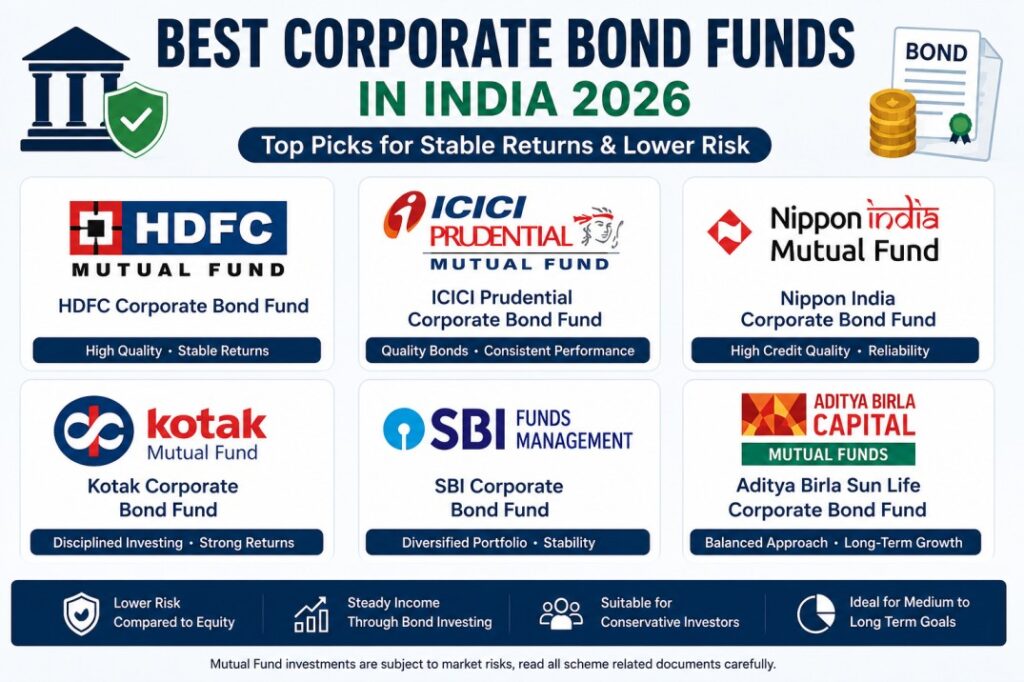
The following corporate bond funds have consistently remained among the most popular options in the category.
Comparison Table: Best Corporate Bond Funds in India
| Fund Name | Risk Level | Suitable For | Investment Horizon |
|---|---|---|---|
| HDFC Corporate Bond Fund | Moderate | Conservative Investors | 2-4 Years |
| ICICI Prudential Corporate Bond Fund | Moderate | Long-Term Debt Allocation | 2-5 Years |
| Nippon India Corporate Bond Fund | Moderate | Stable Income Seekers | 2-4 Years |
| Kotak Corporate Bond Fund | Moderate | Conservative Investors | 2-4 Years |
| SBI Corporate Bond Fund | Moderate | Portfolio Diversification | 2-5 Years |
| Aditya Birla Sun Life Corporate Bond Fund | Moderate | Medium-Term Goals | 2-5 Years |
1. HDFC Corporate Bond Fund
HDFC Corporate Bond Fund is one of the most recognized names in the debt fund category.
Key Highlights
- Invests predominantly in high-rated corporate bonds
- Focuses on quality and stability
- Suitable for medium-term investors
Pros
Strong fund house reputation
Diversified debt portfolio
High-quality bond holdings
Cons
Sensitive to interest rate changes
2. ICICI Prudential Corporate Bond Fund
This fund has maintained a strong presence among debt investors.
Why Investors Like It
- Focus on highly rated issuers
- Experienced fund management
- Strong risk-management framework
Best For
Investors seeking relatively stable debt exposure with professional management.
3. Nippon India Corporate Bond Fund
Nippon India has built a reputation in both equity and debt fund categories.
Features
- Predominantly invests in AA+ and above-rated bonds
- Focuses on accrual income
- Suitable for conservative investors
Who Should Invest?
Investors looking for relatively predictable debt fund performance.
4. Kotak Corporate Bond Fund
Kotak Mutual Fund is known for its disciplined debt fund management.
Key Benefits
- High credit quality portfolio
- Active duration management
- Suitable for medium-term investments
Ideal For
Investors prioritizing capital preservation and income generation.
5. SBI Corporate Bond Fund
SBI Mutual Fund remains one of India’s largest asset management companies.
Why Consider It?
- Large asset base
- Diversified bond holdings
- Strong institutional backing
Suitable For
Conservative and moderate-risk investors.
6. Aditya Birla Sun Life Corporate Bond Fund
A popular choice among investors seeking stable debt returns.
Highlights
- Focus on quality bonds
- Diversified portfolio
- Managed by an experienced debt team
For detailed information about Best Overnight Mutual Funds
How Corporate Bond Funds Generate Returns
Understanding return generation helps investors set realistic expectations.
Corporate bond funds primarily earn returns through:
1. Interest Income
Bonds pay regular interest.
This income becomes the primary source of returns.
2. Capital Appreciation
When interest rates decline, bond prices typically rise.
This can increase the NAV of the fund.
3. Active Portfolio Management
Fund managers buy and sell bonds to capitalize on market opportunities.
Corporate Bond Funds vs Fixed Deposits
Many investors compare corporate bond funds with fixed deposits.
Here’s a simple comparison:
| Feature | Corporate Bond Funds | Fixed Deposits |
|---|---|---|
| Returns | Market-Linked | Fixed |
| Liquidity | High | Moderate |
| Risk | Moderate | Low |
| Professional Management | Yes | No |
| Inflation Beating Potential | Better | Limited |
| Diversification | High | Low |
Which Is Better?
If you prioritize guaranteed returns, fixed deposits may be preferable.
If you’re comfortable with modest market fluctuations for potentially higher returns, corporate bond funds may be worth considering.
Corporate Bond Funds vs Banking and PSU Funds
Investors often confuse these two categories.
Corporate Bond Funds
- Invest mainly in corporate bonds
- Higher yield potential
- Focus on private and public corporate issuers
Banking and PSU Funds
- Invest primarily in bonds issued by banks and public sector enterprises
- Often considered relatively safer
- Lower credit risk perception
Neither category is universally superior.
The right choice depends on your investment goals.
Risks of Investing in Corporate Bond Funds
Although corporate bond funds are considered relatively safer than equity funds, they still carry risks.
Interest Rate Risk
Interest rates and bond prices move in opposite directions.
When interest rates rise:
- Existing bond prices may fall
- Fund NAV can decline temporarily
Credit Risk
Although these funds invest in highly rated securities, credit events can still occur.
Liquidity Risk
In stressed market conditions, certain bonds may become difficult to sell quickly.
Market Risk
Debt markets can experience volatility due to economic events.
Who Should Invest in Corporate Bond Funds?
Corporate bond funds may be suitable for:
Conservative Investors
Those seeking lower volatility than equity funds.
Retirees
Investors looking for relatively stable income generation.
Medium-Term Investors
People with investment horizons of 2-5 years.
Portfolio Diversifiers
Investors wanting to balance equity exposure.
Who Should Avoid Corporate Bond Funds?
These funds may not be suitable for:
Very Short-Term Investors
Money needed within a few weeks or months may be better placed in liquid funds.
Aggressive Growth Investors
Those seeking high wealth creation may prefer equity mutual funds.
Investors Expecting Guaranteed Returns
Corporate bond funds are market-linked and do not guarantee returns.
How to Choose the Best Corporate Bond Fund
Instead of selecting a fund solely based on recent returns, evaluate these factors.
Credit Quality
Look for portfolios with:
- AAA-rated bonds
- AA+ rated bonds
- Strong issuers
Expense Ratio
Lower expense ratios help improve net returns.
Fund House Reputation
Choose experienced fund houses with strong debt management teams.
Portfolio Duration
Duration affects sensitivity to interest rate changes.
Consistency
Evaluate performance across different market cycles.
For detailed information about Best Money Market Funds
Common Mistakes Investors Make
Chasing Recent Returns
Past performance does not guarantee future results.
Ignoring Portfolio Quality
Credit quality matters more than temporary yield differences.
Investing Without a Goal
Always match the fund to your investment horizon.
Exiting During Temporary Volatility
Debt funds can experience short-term fluctuations.
Avoid reacting emotionally.
Are Corporate Bond Funds Safe?
A common question investors ask is:
“Are corporate bond funds safe?”
The answer is:
Relatively safe, but not risk-free.
Compared to:
- Equity funds
- Small-cap funds
- Sector funds
Corporate bond funds generally carry lower risk.
However, they still face:
- Interest rate risk
- Credit risk
- Market risk
Therefore, investors should maintain realistic expectations.
Best Strategy for Investing in Corporate Bond Funds
A practical approach could include:
SIP Investing
Regular SIPs help average investment costs.
Lump Sum Investing
Suitable when interest rate conditions are favorable.
Portfolio Allocation
Example:
- 70% Equity Funds
- 20% Corporate Bond Funds
- 10% Liquid Funds
The allocation should depend on individual goals and risk tolerance.
Frequently Asked Questions
Which is the best corporate bond fund in India?
Popular choices include HDFC Corporate Bond Fund, ICICI Prudential Corporate Bond Fund, Nippon India Corporate Bond Fund, Kotak Corporate Bond Fund, and SBI Corporate Bond Fund.
Can corporate bond funds give negative returns?
Yes.
Short-term negative returns can occur due to interest rate movements.
What is the ideal investment horizon?
Generally, 2-5 years.
Are corporate bond funds better than fixed deposits?
They offer different benefits.
Corporate bond funds provide market-linked returns and professional management, while fixed deposits offer guaranteed returns.
Can I invest through SIP?
Yes.
Most corporate bond funds allow SIP investments.
Final Thoughts
The best corporate bond funds in India can play an important role in a well-diversified portfolio.
They offer a compelling balance between risk and return by investing primarily in high-quality corporate debt instruments.
While they may not generate the spectacular gains associated with equity funds, they can provide stability, income potential, and diversification benefits that many investors value.
For investors with a medium-term horizon seeking relatively lower volatility than stocks, corporate bond funds deserve serious consideration.
Rather than chasing the highest recent returns, focus on credit quality, fund management, consistency, and alignment with your financial goals.
Over time, this disciplined approach is more likely to deliver successful investment outcomes.
For detailed information about Best Liquid Funds in India
Disclaimer: The content provided is for educational and informational purposes only and should not be considered financial, investment, insurance, or legal advice.