


Last Updated on 12 June 2026
Have you ever wondered where you should keep your money if you need it within a few weeks or months? Many investors searching for the best liquid funds for beginners in India face this exact dilemma. Keeping money in a savings account offers convenience but often delivers modest returns. On the other hand, investing in stocks or equity mutual funds can expose your short-term money to market volatility.
This is where liquid funds come into the picture.
Liquid funds are among the safest categories of debt mutual funds and are specifically designed for investors who want liquidity, stability, and relatively better returns than traditional savings accounts. They are ideal for parking emergency funds, surplus cash, bonus payments, business funds, or money earmarked for short-term goals.
In this comprehensive guide, you’ll learn everything about the best liquid funds for beginners in India, including how they work, their advantages, risks, taxation, and how to choose the right liquid fund for your needs.
What Are Liquid Funds?
Liquid funds are a category of debt mutual funds that invest primarily in highly liquid money market instruments and debt securities with maturities of up to 91 days.
These instruments typically include:
- Treasury Bills (T-Bills)
- Commercial Papers (CPs)
- Certificates of Deposit (CDs)
- Call Money
- Short-term Government Securities
Because these securities mature quickly, liquid funds generally experience lower interest-rate risk compared to other debt funds.
Simple Example
Suppose you receive a bonus of ₹1 lakh and plan to use it after three months for a vacation or down payment.
Instead of letting the money sit idle in your bank account, you can park it in a liquid fund. Your money remains accessible while potentially earning better returns than a standard savings account.
Why Beginners Should Consider Liquid Funds
Most new investors immediately think about stocks and equity mutual funds.
However, every investor needs a place to park short-term money safely.
Liquid funds can serve this purpose effectively.
Key Benefits
1. High Liquidity
One of the biggest advantages of liquid funds is easy access to your money.
Most liquid funds allow redemption within one business day.
Some fund houses even provide instant redemption facilities (subject to limits).
2. Lower Risk
Since liquid funds invest in short-duration securities, they are generally less volatile than long-duration debt funds or equity funds.
3. Better Utilization of Idle Cash
Rather than earning low returns in a savings account, surplus money can potentially generate slightly better returns while remaining accessible.
4. Suitable for Emergency Funds
Financial planners often recommend keeping part of your emergency corpus in liquid funds because they combine accessibility with relatively stable returns.
5. No Lock-in Period
Unlike fixed deposits, liquid funds generally don’t impose lock-in periods.
You can redeem your investment whenever required.
Who Should Invest in Liquid Funds?
Liquid funds are suitable for:
Salaried Employees
Ideal for emergency funds and short-term goals.
Business Owners
Useful for managing temporary cash surpluses.
Retirees
Can serve as a low-volatility parking option for near-term expenses.
First-Time Investors
Provide an introduction to mutual fund investing without significant market volatility.
Conservative Investors
Suitable for individuals prioritizing capital preservation and liquidity.
Best Liquid Funds for Beginners in India
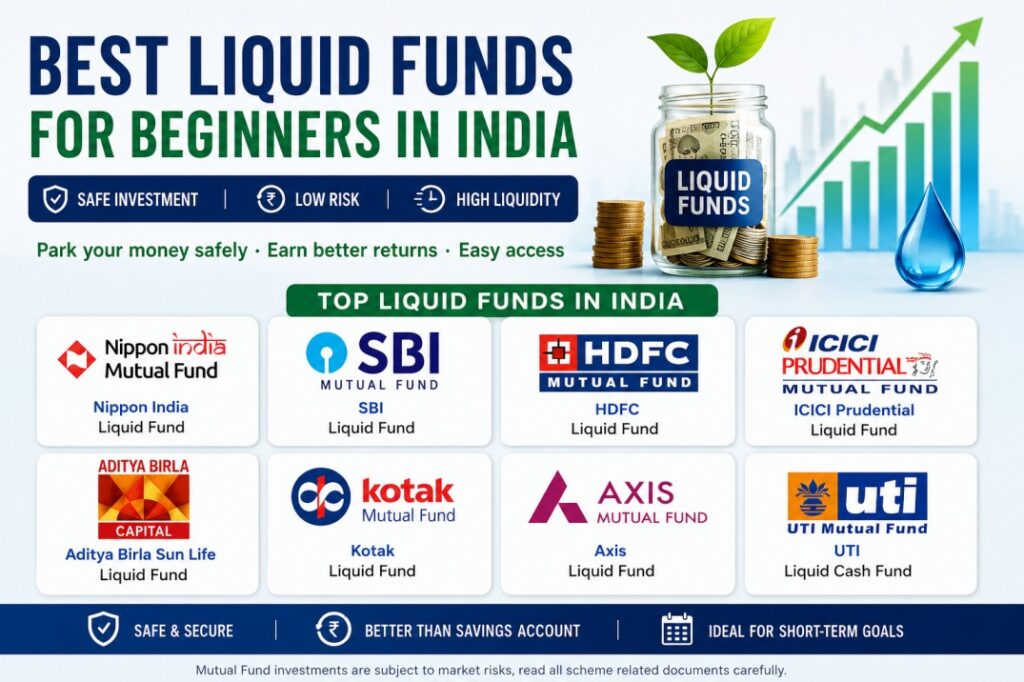
The following liquid funds have historically been popular among investors due to their large asset base, strong fund management, and consistent performance.
Comparison Table
| Fund Name | Category | Suitable For |
|---|---|---|
| Nippon India Liquid Fund | Liquid Fund | Beginners seeking liquidity |
| SBI Liquid Fund | Liquid Fund | Emergency fund parking |
| HDFC Liquid Fund | Liquid Fund | Conservative investors |
| ICICI Prudential Liquid Fund | Liquid Fund | Short-term cash management |
| Aditya Birla Sun Life Liquid Fund | Liquid Fund | First-time investors |
| Kotak Liquid Fund | Liquid Fund | Corporate and retail investors |
| Axis Liquid Fund | Liquid Fund | Short-duration investing |
| UTI Liquid Cash Fund | Liquid Fund | Beginners and conservative investors |
Important Note
Past performance does not guarantee future returns. Always review the latest portfolio quality, expense ratio, and scheme documents before investing.
How to Choose the Best Liquid Fund
Many beginners simply select the fund with the highest recent return.
This approach can be misleading.
Instead, consider the following factors.
1. Portfolio Quality
Check whether the fund invests in high-quality debt instruments.
Higher credit quality generally indicates lower risk.
2. Expense Ratio
A lower expense ratio helps investors retain more returns.
Compare direct plans whenever possible.
3. Fund Size
Large funds often benefit from greater diversification and liquidity.
4. Consistency
Avoid focusing solely on short-term returns.
Look for consistency across different market conditions.
5. Redemption Convenience
Review redemption timelines and any instant redemption features.
Liquid Funds vs Savings Account
Many beginners compare liquid funds with savings accounts.
Here’s how they differ.
| Feature | Liquid Fund | Savings Account |
|---|---|---|
| Potential Return | Usually higher | Usually lower |
| Liquidity | High | Very High |
| Market Risk | Low but present | Negligible |
| Taxation | Capital gains taxation | Interest taxable |
| Investment Horizon | Few days to months | Any duration |
Which Is Better?
For immediate day-to-day transactions, a savings account remains essential.
For surplus money that may remain unused for weeks or months, liquid funds can be a practical alternative.
Liquid Funds vs Fixed Deposits
Another common comparison is between liquid funds and fixed deposits.
| Feature | Liquid Fund | Fixed Deposit |
|---|---|---|
| Lock-in | No | Usually fixed tenure |
| Premature Withdrawal | Easy | Penalty may apply |
| Return Predictability | Market-linked | Fixed |
| Liquidity | High | Moderate |
| Flexibility | Excellent | Limited |
When Liquid Funds Are Better
Liquid funds may be preferable when:
- You need flexibility.
- Your investment horizon is uncertain.
- You may require money unexpectedly.
When Fixed Deposits Are Better
FDs may be suitable when:
- You want fixed returns.
- You know your exact investment duration.
- You prefer guaranteed outcomes.
Understanding Risks in Liquid Funds
Although liquid funds are considered relatively safe, they are not risk-free.
Interest Rate Risk
Changes in interest rates can affect debt instruments.
However, due to the short maturity profile, this risk remains limited.
Credit Risk
If a security held by the fund faces financial stress, returns may be impacted.
Choosing funds with high-quality portfolios helps reduce this risk.
Liquidity Risk
Rare but possible during severe market disruptions.
Well-managed funds generally maintain sufficient liquidity.
Ideal Uses of Liquid Funds
Emergency Fund Parking
Many investors keep six months of expenses as an emergency corpus.
Liquid funds can hold a portion of this money while maintaining accessibility.
Short-Term Goals
Examples include:
- Vacation planning
- School fees
- Home renovation
- Insurance premiums
- Tax payments
Temporary Cash Parking
Suppose you plan to invest in equity mutual funds through SIPs over several months.
Your lump sum amount can remain in a liquid fund until deployment.
Business Cash Management
Businesses often use liquid funds to manage short-term working capital requirements.
Also read about Best Money Market Mutual Funds
How Much Return Can You Expect?
One of the most common questions among beginners is:
“What returns do liquid funds generate?”
Returns vary depending on:
- Interest rate environment
- Portfolio composition
- Market liquidity conditions
Historically, liquid funds have generally delivered returns higher than many savings accounts but lower than long-term equity investments.
Investors should avoid choosing liquid funds solely based on recent returns.
Consistency and safety matter more.
Taxation of Liquid Funds in India
Tax rules have changed significantly in recent years.
Currently, gains from many debt-oriented mutual funds are taxed according to the investor’s applicable income tax slab.
Therefore:
- Investors in higher tax brackets should carefully evaluate post-tax returns.
- Tax efficiency should not be the primary reason for investing in liquid funds.
Instead, focus on liquidity, stability, and short-term cash management.
Since tax laws can change, always verify the latest regulations before investing.
Common Mistakes Beginners Make
Chasing Highest Returns
A slightly higher return may come with higher portfolio risk.
Ignoring Portfolio Quality
Credit quality matters more than short-term performance rankings.
Using Liquid Funds for Long-Term Goals
Liquid funds are designed for short-term needs.
Long-term goals are usually better served by equity mutual funds.
Investing Entire Emergency Corpus
Maintain some cash in your savings account for immediate access.
Not Understanding Taxation
Always evaluate post-tax returns rather than headline returns.
Step-by-Step Guide to Investing in Liquid Funds
Step 1: Complete KYC
Ensure your KYC is completed through a registered platform.
Step 2: Choose a Mutual Fund Platform
You can invest through:
- AMC websites
- MF Central
- Online investment platforms
- Banks
- Brokers
Step 3: Select a Liquid Fund
Compare:
- Expense ratio
- Portfolio quality
- Fund size
- Redemption process
Step 4: Invest
You can start with a lump sum investment.
Step 5: Monitor Periodically
Review the fund occasionally rather than daily.
Liquid funds are not meant for active trading.
Frequently Asked Questions (FAQs)
Are liquid funds safe for beginners?
Liquid funds are generally considered among the safer mutual fund categories because they invest in short-term debt instruments.
Can liquid funds give negative returns?
While uncommon, temporary negative returns are possible due to market or credit events.
Are liquid funds better than savings accounts?
For surplus money that doesn’t require immediate daily access, liquid funds can be a useful alternative.
Can I withdraw money anytime?
Yes, liquid funds generally allow redemption on any business day.
What is the ideal investment horizon?
Liquid funds are typically suitable for periods ranging from a few days to several months.
Final Thoughts
For beginners, investing is not only about earning the highest returns. It’s also about learning how to manage money efficiently.
The best liquid funds for beginners in India can play an important role in a well-balanced financial plan. They provide a convenient place to park short-term money while maintaining liquidity and relative stability.
Think of liquid funds as a financial waiting room-not a wealth-creation engine.
Use them for emergency funds, temporary cash parking, and short-term goals. For long-term wealth creation, continue building exposure to equity mutual funds through disciplined investing.
By understanding how liquid funds work and selecting quality schemes with strong portfolios, beginners can make smarter decisions and avoid many common investing mistakes.
What About You?
Do you currently keep your emergency fund in a savings account, fixed deposit, or liquid fund?
Share your thoughts in the comments below. If you found this guide helpful, don’t forget to share it with friends and family who are starting their investment journey.
Also read:
Detailed information about Best Debt Mutual Funds in India
Disclaimer: The content provided is for educational and informational purposes only and should not be considered financial, investment, insurance, or legal advice.