

Last Updated on 21 July 2026
Investing is one of the most effective ways to build wealth over time, but every investor faces the same challenge—how to earn higher returns without taking unnecessary risks. While there is no investment that guarantees high returns with zero risk, there are several High Return Investment Options that offer the potential for attractive long-term growth when approached with a well-planned strategy.
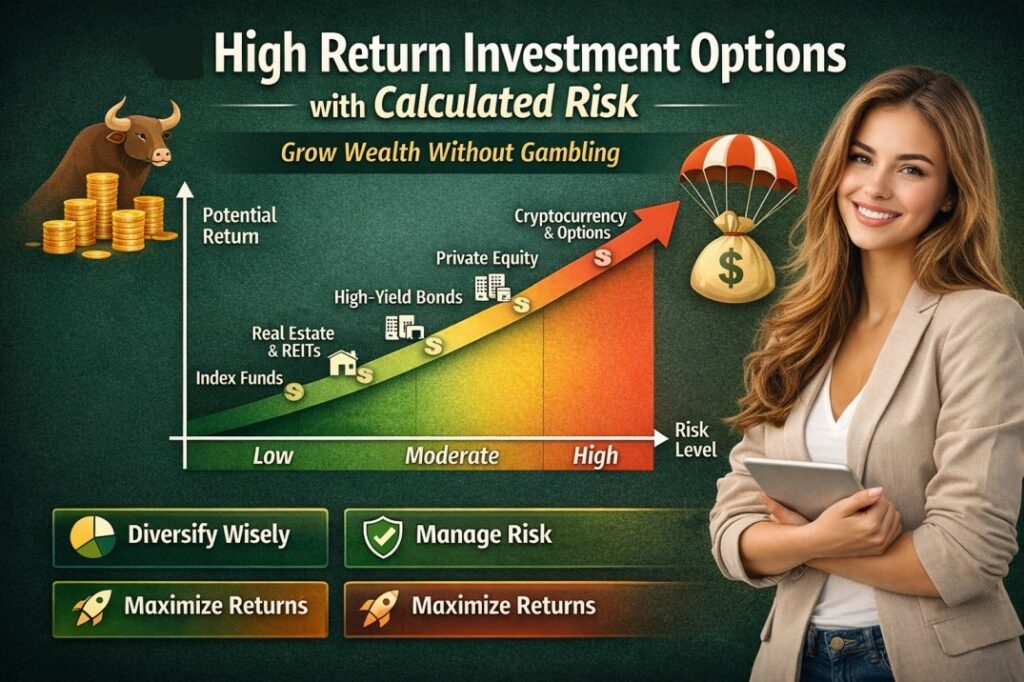
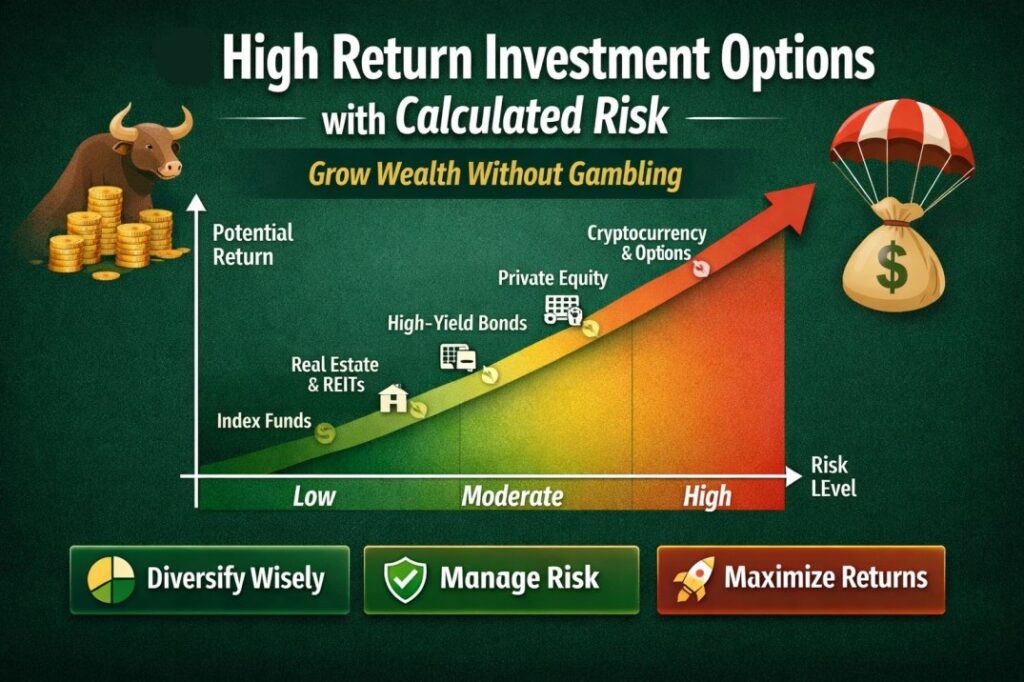
The key is understanding the relationship between risk and reward. Generally, investments with higher return potential involve greater volatility, while safer investments tend to generate lower returns. Rather than chasing unrealistic promises, successful investors focus on smart investment options with balanced risk that match their financial goals, investment horizon, and risk tolerance.
In this guide, we’ll explore some of the best high-return investment opportunities available for U.S. investors, explain their advantages and risks, and help you choose investments that fit your long-term financial plan.
Why This Topic Matters
Many new investors believe they must choose between high returns or safety. In reality, successful investing is about managing risk rather than avoiding it completely.
Understanding calculated risk can help you:
- Build wealth steadily over time
- Reduce emotional investing
- Diversify your portfolio
- Protect against inflation
- Achieve long-term financial goals
Understanding Risk vs Return
Before choosing an investment, it’s important to understand the relationship between risk and return.
| Investment Type | Potential Return | Risk Level | Liquidity | Suitable For |
|---|---|---|---|---|
| High-Yield Savings Account | Low | Very Low | High | Emergency savings |
| Treasury Securities | Low | Very Low | High | Conservative investors |
| Corporate Bonds | Moderate | Low-Medium | Medium | Income investors |
| Dividend Stocks | Moderate-High | Medium | High | Long-term investing |
| Index ETFs | High | Medium | High | Beginners |
| Growth Stocks | Very High | High | High | Aggressive investors |
| REITs | Moderate-High | Medium | High | Passive income |
| Real Estate | High | Medium-High | Low | Long-term wealth |
| Cryptocurrency | Very High | Very High | High | Speculative investors |
What Does “Calculated Risk” Mean?
Calculated risk means making investment decisions after understanding:
- Potential rewards
- Possible losses
- Market conditions
- Investment timeline
- Personal financial goals
Instead of avoiding risk entirely, investors manage it through diversification, research, and long-term planning.
12 High Return Investment Options
1. Index Funds
Index funds remain one of the most recommended investments for beginners.
They track a market index instead of relying on active stock selection.
Examples include:
- S&P 500 Index Funds
- Total Stock Market Funds
- Nasdaq-100 Funds
Benefits
- Low costs
- Broad diversification
- Historically strong long-term returns
- Easy to invest
Risks
- Market downturns
- No downside protection
- Returns depend on overall market performance
For detailed information about Best Fidelity Index Funds for Beginners
For detailed information about Low Cost Index Funds
2. Exchange-Traded Funds (ETFs)
ETFs combine diversification with the flexibility of stock trading.
Investors can buy ETFs focused on:
- Technology
- Healthcare
- Artificial Intelligence
- Energy
- Dividend income
- International markets
Benefits
- Instant diversification
- Low expense ratios
- Tax efficiency
- High liquidity
Risks
- Sector concentration
- Market volatility
For detailed information about Complete Guide to ETF Investing for Beginners
3. Dividend Stocks
Dividend-paying companies provide regular income while offering potential capital appreciation.
Examples include businesses from sectors such as:
- Consumer staples
- Utilities
- Healthcare
- Financial services
Benefits
- Passive income
- Potential dividend growth
- Lower volatility than many growth stocks
Risks
- Dividend cuts
- Company-specific risks
Also know about Best Long Term Dividend Stocks
4. Growth Stocks
Growth companies reinvest profits to expand rapidly.
Technology companies often fall into this category.
Benefits
- Significant long-term appreciation
- Innovation-driven growth
Risks
- High volatility
- Expensive valuations
- Earnings uncertainty
For detailed information Best Growth Stock Mutual Funds in India
5. Real Estate Investment Trusts (REITs)
REITs allow investors to own real estate without purchasing physical properties.
They may invest in:
- Apartments
- Warehouses
- Hospitals
- Data centers
- Shopping centers
Benefits
- Dividend income
- Portfolio diversification
- Real estate exposure
Risks
- Interest rate sensitivity
- Property market downturns
For more information about Best REIT Stocks to Buy in the USA
6. Rental Real Estate
Owning rental properties can generate both monthly income and long-term appreciation.
Benefits
- Cash flow
- Tax advantages
- Inflation hedge
Risks
- Property maintenance
- Vacancy risk
- Large upfront investment
7. Corporate Bonds
Corporate bonds generally offer higher yields than government bonds.
Investment-grade bonds may suit investors seeking income with moderate risk.
Benefits
- Predictable income
- Lower volatility than stocks
Risks
- Credit risk
- Interest rate risk
8. Treasury Securities
U.S. Treasury bills, notes, and bonds are backed by the U.S. government.
While returns are usually lower than stocks, they provide stability.
Benefits
- High safety
- Reliable income
Risks
- Lower long-term growth
- Inflation risk
For more information about Treasury Bonds for Beginners
9. High-Yield Savings Accounts
Although not technically growth investments, high-yield savings accounts offer competitive interest while keeping funds accessible.
Benefits
- FDIC insurance (within applicable limits)
- Excellent liquidity
Risks
- Returns may not beat inflation over long periods
10. Certificates of Deposit (CDs)
CDs lock your money for a fixed period in exchange for higher interest rates.
Benefits
- Guaranteed returns (subject to issuer terms)
- Predictable income
Risks
- Early withdrawal penalties
- Inflation risk
11. Small Business Investments
Investing in a business can produce significant returns.
Examples include:
- Franchise ownership
- Private businesses
- Online businesses
Benefits
- High earning potential
- Greater control
Risks
- Business failure
- Cash flow uncertainty
12. Alternative Investments
Alternative investments include:
- Private equity
- Commodities
- Infrastructure
- Farmland
- Collectibles
These investments can diversify portfolios but often involve unique risks and lower liquidity.
Comparing the Best High Return Investment Options
| Investment | Expected Long-Term Growth | Risk | Income | Liquidity |
|---|---|---|---|---|
| Index Funds | High | Medium | Low | High |
| ETFs | High | Medium | Medium | High |
| Dividend Stocks | High | Medium | High | High |
| Growth Stocks | Very High | High | Low | High |
| REITs | Moderate-High | Medium | High | High |
| Rental Property | High | Medium-High | High | Low |
| Corporate Bonds | Moderate | Medium | High | Medium |
| Treasury Bonds | Low-Moderate | Low | Medium | High |
| High-Yield Savings | Low | Very Low | Low | High |
| CDs | Low | Very Low | Medium | Low |
How Diversification Reduces Risk
Instead of putting all your money into one investment, diversification spreads your investments across multiple asset classes.
For example:
- 50% Index ETFs
- 20% Dividend Stocks
- 15% Bonds
- 10% REITs
- 5% Cash
This approach can reduce the impact of poor performance in any single investment.
Practical Example
Imagine Sarah has $20,000 to invest for retirement.
Instead of investing everything in one technology stock, she builds a diversified portfolio:
- $10,000 in an S&P 500 Index ETF
- $4,000 in dividend-paying stocks
- $3,000 in REITs
- $2,000 in investment-grade bonds
- $1,000 in a high-yield savings account
If one asset class experiences a downturn, the others may help cushion overall portfolio performance. While returns are never guaranteed, diversification can reduce portfolio volatility over time.
Benefits of High Return Investment Options
- Greater long-term wealth creation
- Potential to outpace inflation
- Passive income opportunities
- Flexible investment choices
- Compounding over time
- Better retirement planning
Risks to Consider
- Market volatility
- Inflation
- Interest rate changes
- Company-specific risk
- Liquidity risk
- Economic recessions
- Emotional decision-making
Pros and Cons
Pros
- Higher growth potential
- Multiple investment choices
- Long-term wealth building
- Diversification opportunities
- Suitable for retirement planning
Cons
- Market fluctuations
- Potential capital losses
- Requires patience
- Some investments need active monitoring
- No guaranteed returns
Who Should Invest?
These investment options may suit:
- Young professionals
- Retirement savers
- Long-term investors
- Investors comfortable with market fluctuations
- Individuals seeking portfolio diversification
Who Should Avoid High-Risk Investments?
High-risk investments may not be appropriate for:
- Investors needing immediate cash
- Individuals with very low risk tolerance
- People without an emergency fund
- Those investing money needed in the short term
Common Mistakes Investors Make
Chasing Unrealistic Returns
Promises of guaranteed high returns are often warning signs of scams.
Ignoring Diversification
Concentrating investments in a single company or sector increases risk.
Investing Without Goals
Define whether you’re investing for retirement, education, or another long-term objective.
Panic Selling
Markets naturally fluctuate. Selling during downturns can lock in losses and disrupt long-term plans.
Not Reviewing Investments
Your portfolio should be reviewed periodically to ensure it still aligns with your goals and risk tolerance.
Tips for Managing Calculated Risk
- Build an emergency fund before investing.
- Invest consistently through dollar-cost averaging.
- Diversify across asset classes and industries.
- Rebalance your portfolio periodically.
- Keep investment costs low where possible.
- Maintain a long-term perspective rather than reacting to short-term market movements.
Frequently Asked Questions (FAQs)
1. What are the best high return investment options?
Index funds, ETFs, growth stocks, dividend stocks, REITs, and rental real estate are among the most popular options for long-term investors seeking higher return potential.
2. Can I earn high returns without risk?
No. Every investment carries some level of risk. Higher potential returns generally come with greater uncertainty.
3. Are ETFs safer than individual stocks?
ETFs typically provide diversification by holding multiple securities, which can reduce company-specific risk compared with investing in a single stock.
4. How much should beginners invest?
The amount depends on your budget and financial goals. Many investors start with small, regular contributions and increase them over time.
5. Should I invest during a market downturn?
Some long-term investors continue investing through market declines using dollar-cost averaging, but every situation is different. Consider your financial goals and risk tolerance.
6. Is real estate still a good investment?
Real estate can provide income and long-term appreciation, but it also involves costs, management responsibilities, and market risk.
7. How often should I review my portfolio?
Many investors review their portfolios once or twice a year or after significant life changes to ensure their asset allocation still matches their objectives.
8. What is the biggest mistake new investors make?
Common mistakes include chasing recent winners, failing to diversify, investing without clear goals, and reacting emotionally to market volatility.
9. How can I reduce investment risk?
Diversification, regular investing, maintaining an emergency fund, and investing with a long-term perspective can help manage risk.
10. Should I seek professional advice?
If you’re unsure how to build a portfolio or have complex financial needs, consulting a qualified financial professional may be beneficial.
Key Takeaways
- Higher returns almost always involve higher risk.
- Diversification helps reduce overall portfolio risk.
- Stocks and ETFs have historically outperformed many traditional investments over long periods.
- Real estate and REITs provide income and diversification.
- Bonds help stabilize portfolios.
- Dollar-cost averaging reduces timing risk.
- Avoid investments promising guaranteed high returns.
- Always review your investment strategy periodically.
Conclusion
Finding the right High Return Investment Options is not about discovering a secret investment that delivers extraordinary profits without risk. Instead, it’s about understanding how different investments work, accepting that risk and return go hand in hand, and building a diversified portfolio aligned with your financial goals.
For many investors, a combination of broad-market index funds, ETFs, dividend-paying stocks, bonds, and REITs can provide a balanced approach that seeks long-term growth while managing risk. Your ideal mix will depend on factors such as your investment horizon, income needs, and comfort with market fluctuations.
Remember that market conditions, interest rates, tax rules, and investment products can change over time. Before investing, review the latest information from official sources, understand the risks involved, and consider seeking professional financial advice if needed. A disciplined, long-term approach is often more effective than chasing short-term returns or trying to time the market.
Author’s Note: I’ve been investing in mutual funds and stocks since 2018 and have practical experience in business and personal finance. While I’m not a licensed financial advisor or investment professional, I write educational content based on years of hands-on investing experience, business knowledge, extensive research, and reliable sources. My goal through TheInvestorStory.com is to simplify investing, personal finance, business, and financial concepts so readers can make more informed financial decisions.
Disclaimer: The content provided is for educational and informational purposes only and should not be considered financial, investment, insurance, or legal advice.