


Last Updated on 29 June 2026
Have you ever wondered how some investors manage to build substantial wealth over time without constantly buying and selling stocks? If you’re searching for the Best Growth Stock Mutual Funds, you’re likely looking for investment options that can help create long-term wealth while reducing the need to pick individual stocks. These funds allow investors to participate in the growth of high-potential companies through professionally managed portfolios.
The answer often lies in investing in high-quality growth businesses and staying invested for the long term. However, identifying future winners in the stock market isn’t always easy. This is where growth stock mutual funds come into the picture.
These funds invest in companies that have strong earnings growth potential, expanding market share, innovative business models, and the ability to generate superior returns over the long term.
For investors who want exposure to India’s growth story but don’t have the time or expertise to research individual stocks, growth-oriented mutual funds can be an excellent solution. In this comprehensive guide, we’ll explore the Best Growth Stock Mutual Funds in India, how they work, their benefits and risks, and how to choose the right fund for your financial goals
What Are Growth Stock Mutual Funds?
Growth stock mutual funds primarily invest in companies expected to grow their revenues, earnings, and market value faster than the overall market.
These companies often:
- Reinvest profits into expansion
- Focus on innovation and business growth
- Operate in fast-growing industries
- Have strong competitive advantages
- Offer high capital appreciation potential
Unlike value stocks that may appear undervalued, growth stocks typically trade at higher valuations because investors expect strong future growth.
The objective of growth mutual funds is simple:
Generate long-term capital appreciation.
Why Growth Stock Mutual Funds Are Popular in India
India remains one of the world’s fastest-growing major economies.
Several long-term trends continue to support growth-oriented companies:
- Digital transformation
- Rising middle-class consumption
- Financialization of savings
- Infrastructure development
- Manufacturing growth
- Technology adoption
- Increasing internet penetration
Many companies benefiting from these trends have delivered significant wealth creation over the last decade.
Growth-oriented mutual funds help investors participate in these opportunities through professional portfolio management.
Benefits of Investing in Growth Stock Mutual Funds
1. Higher Wealth Creation Potential
Growth companies can increase earnings rapidly.
As profits rise, stock prices often follow over the long term.
This creates the possibility of substantial wealth creation for investors.
2. Professional Fund Management
Fund managers continuously analyze:
- Company financials
- Industry trends
- Management quality
- Valuation metrics
- Growth prospects
Investors gain access to professional expertise without researching hundreds of companies themselves.
3. Diversification
Instead of buying a few individual stocks, growth mutual funds spread investments across multiple companies and sectors.
This reduces company-specific risk.
4. SIP-Friendly Investing
Investors can start with small monthly investments through SIPs.
Even ₹500 or ₹1,000 per month can help build wealth over time.
5. Long-Term Compounding
One of the biggest advantages is the power of compounding.
A quality growth fund held for 10-20 years can potentially generate significant returns.
Who Should Invest in Growth Stock Mutual Funds?
Growth funds may be suitable for investors who:
Have a long-term investment horizon
Want higher returns than traditional fixed-income products
Can tolerate market volatility
Want exposure to India’s growth story
Are building long-term wealth
They may not be ideal for investors needing regular income or those with very short investment horizons.
Best Growth Stock Mutual Funds in India 2026
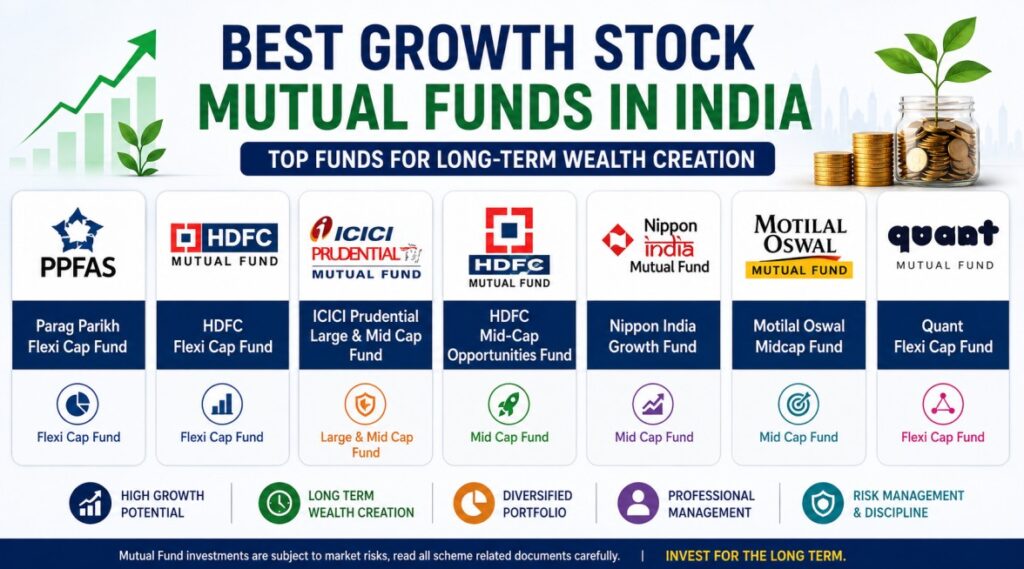
Here are some of the most popular growth-oriented mutual funds that have attracted long-term investors.
Comparison Table
| Fund Name | Category | Risk Level | Suitable For |
|---|---|---|---|
| Parag Parikh Flexi Cap Fund | Flexi Cap | High | Long-term investors |
| HDFC Flexi Cap Fund | Flexi Cap | High | Diversified growth seekers |
| ICICI Prudential Large & Mid Cap Fund | Large & Mid Cap | High | Balanced growth |
| HDFC Mid-Cap Opportunities Fund | Mid Cap | Very High | Aggressive investors |
| Nippon India Growth Fund | Mid Cap | Very High | Long-term growth |
| Motilal Oswal Midcap Fund | Mid Cap | Very High | High-growth investors |
| Quant Flexi Cap Fund | Flexi Cap | Very High | Aggressive investors |
1. Parag Parikh Flexi Cap Fund
Why Investors Like It
Parag Parikh Flexi Cap Fund has become one of India’s most popular equity mutual funds.
The fund follows a value-conscious growth investing approach.
Key Advantages
- Flexible investment strategy
- Diversified portfolio
- Long-term wealth creation focus
- Experienced fund management
- Consistent performance track record
Suitable For
Investors seeking a core long-term growth fund.
For detailed information about Parag Parikh Flexi Cap Fund Review
2. HDFC Flexi Cap Fund
HDFC Flexi Cap Fund is one of the largest actively managed equity funds in India.
The fund invests across:
- Large-cap stocks
- Mid-cap stocks
- Small-cap stocks
This flexibility allows fund managers to identify opportunities across market segments.
Why It Stands Out
- Large asset base
- Strong research capabilities
- Diversified portfolio
- Long-term performance history
3. ICICI Prudential Large & Mid Cap Fund
This fund combines the stability of large-cap companies with the growth potential of mid-cap businesses.
Key Features
- Balanced risk-reward profile
- Exposure to established businesses
- Participation in emerging growth companies
- Suitable for long-term investors
For many investors, this category provides an excellent middle ground.
4. HDFC Mid-Cap Opportunities Fund
Mid-cap companies often represent tomorrow’s market leaders.
HDFC Mid-Cap Opportunities Fund focuses on businesses with strong growth prospects.
Potential Benefits
- Higher growth potential
- Exposure to emerging industry leaders
- Long-term wealth creation opportunities
Risks
- Higher volatility
- Sharp corrections during bear markets
5. Nippon India Growth Fund
Nippon India Growth Fund has been a well-known name among growth-oriented investors.
The fund seeks businesses capable of sustained earnings growth.
Why Investors Consider It
- Mid-cap focus
- Long-term growth orientation
- Active portfolio management
- Potential for superior returns
6. Motilal Oswal Midcap Fund
Motilal Oswal is known for its “Buy Right, Sit Tight” philosophy.
The fund typically focuses on quality businesses with long-term growth opportunities.
Key Strengths
- Concentrated portfolio
- Growth-oriented strategy
- Focus on quality companies
This fund may suit investors comfortable with higher risk.
7. Quant Flexi Cap Fund
Quant has gained significant attention in recent years due to its dynamic investment approach.
What Makes It Different?
- Data-driven investment process
- Dynamic sector allocation
- Aggressive growth strategy
However, investors should understand that aggressive strategies can lead to higher volatility.
Growth Funds vs Value Funds
Many investors get confused between growth and value investing.
Here’s a simple comparison.
| Feature | Growth Funds | Value Funds |
|---|---|---|
| Objective | Capital appreciation | Buy undervalued stocks |
| Risk Level | Higher | Moderate |
| Growth Potential | High | Moderate to High |
| Dividend Yield | Low | Often Higher |
| Investment Horizon | Long Term | Long Term |
Both approaches can create wealth, but growth funds focus more on future earnings potential.
Growth Funds vs Index Funds
| Feature | Growth Funds | Index Funds |
|---|---|---|
| Management | Active | Passive |
| Goal | Beat market returns | Match market returns |
| Expense Ratio | Higher | Lower |
| Potential Returns | Higher | Market Returns |
| Risk | Depends on manager | Market Risk |
Index funds are excellent for passive investors, while growth funds aim to outperform the market.
To know more about best index funds for beginners in India
For detailed information about Best Multicap Mutual Funds
How to Choose the Best Growth Stock Mutual Fund
Selecting a fund should involve more than looking at recent returns.
Consider these factors:
1. Investment Objective
Understand whether the fund aligns with your goals.
2. Fund Manager Experience
Experienced managers often navigate market cycles better.
3. Portfolio Quality
Look at:
- Sector allocation
- Top holdings
- Diversification
- Growth potential
4. Expense Ratio
Lower costs help improve long-term returns.
5. Risk Profile
Ensure the fund matches your risk tolerance.
6. Performance Across Market Cycles
Evaluate how the fund performed during:
- Bull markets
- Bear markets
- Economic slowdowns
Common Mistakes Investors Make
Chasing Recent Performance
Many investors buy funds after strong rallies.
This often leads to disappointment.
Ignoring Risk
Higher returns usually come with higher volatility.
Over-Diversification
Owning too many similar funds can reduce effectiveness.
Frequent Switching
Long-term wealth creation requires patience.
Constant switching can hurt returns.
SIP in Growth Stock Mutual Funds
Systematic Investment Plans (SIPs) are one of the best ways to invest in growth funds.
Benefits of SIP Investing
- Rupee cost averaging
- Disciplined investing
- Lower timing risk
- Compounding benefits
Example:
| Monthly SIP | 12% Return | 15 Years |
|---|---|---|
| ₹5,000 | Approx. ₹25 Lakhs | |
| ₹10,000 | Approx. ₹50 Lakhs | |
| ₹20,000 | Approx. ₹1 Crore |
To calculate SIP Investment, you may use our Free SIP Calculator
Returns are illustrative and not guaranteed.
Are Growth Stock Mutual Funds Safe?
No equity mutual fund is completely safe.
Growth funds are subject to:
- Market risk
- Economic risk
- Sector risk
- Interest rate changes
- Global market events
However, diversification and professional management help manage these risks.
Investors should maintain a long-term perspective.
Taxation of Growth Mutual Funds in India
For equity-oriented mutual funds:
Short-Term Capital Gains (STCG)
- Holding period less than 12 months
- Taxed at applicable rates as per current tax rules
Long-Term Capital Gains (LTCG)
- Holding period more than 12 months
- Taxation as per prevailing government regulations
Always consult a tax professional for updated rules.
My Personal View on Growth Mutual Funds
One lesson I’ve observed repeatedly in investing is that wealth is rarely created through frequent trading.
Instead, it often comes from identifying quality businesses and staying invested for years.
Growth mutual funds provide a practical way to do exactly that.
The biggest challenge isn’t selecting the perfect fund.
It’s staying invested during temporary market declines.
Investors who maintain discipline through market cycles often benefit the most from long-term compounding.
You may also read about Best Flexi Cap Mutual Funds
Final Thoughts
The best growth stock mutual funds in India can play a crucial role in building long-term wealth.
Funds such as:
- Parag Parikh Flexi Cap Fund
- HDFC Flexi Cap Fund
- ICICI Prudential Large & Mid Cap Fund
- HDFC Mid-Cap Opportunities Fund
- Nippon India Growth Fund
- Motilal Oswal Midcap Fund
have become popular choices among investors seeking growth-oriented portfolios.
However, remember that no mutual fund remains the best forever.
The right fund for you depends on:
- Financial goals
- Risk tolerance
- Investment horizon
- Asset allocation strategy
Focus on consistency, stay invested for the long term, and allow compounding to work its magic.
Frequently Asked Questions (FAQs)
Which is the best growth stock mutual fund in India?
Parag Parikh Flexi Cap Fund, HDFC Flexi Cap Fund, and Nippon India Growth Fund are among the popular growth-oriented mutual funds in India.
Are growth mutual funds good for long-term investment?
Yes, growth mutual funds are generally designed for long-term capital appreciation and may be suitable for investors with a horizon of 5 years or more.
Can beginners invest in growth mutual funds?
Yes. Beginners can start through SIPs and gradually build exposure to growth-oriented equity funds.
How much should I invest in growth mutual funds?
The amount depends on your financial goals, risk tolerance, and investment horizon. Many investors start with SIPs of ₹1,000-₹5,000 per month.
Are growth mutual funds risky?
Yes. Since they invest primarily in equities, they are subject to market volatility. Long-term investing can help manage short-term fluctuations.
Disclaimer: The content provided is for educational and informational purposes only and should not be considered financial, investment, insurance, or legal advice.




Pingback: High Return Investment Options in 2026: 12 Smart Ways for wealth