


Last Updated on 21 August 2026
Introduction
Learning how to start investing in stock market for beginners can feel confusing at first. You may hear terms such as shares, NSE, BSE, demat account, market capitalisation, dividends, P/E ratio, SIP, and brokerage charges and wonder where you should begin.
The good news is that you do not need to be a financial expert before buying your first stock.
What you do need is a basic understanding of how the stock market works, a properly opened investment account, a sensible approach to choosing companies, and the discipline to manage risk.
Investing in stocks means buying a small ownership interest in a company. If the company grows and the market values it more highly, the share price may rise. You may also receive dividends when a company distributes part of its profits to shareholders. However, neither price appreciation nor dividends is guaranteed. A company can perform poorly, and an investment can lose part or even all of its value. NSE itself notes that there is no guarantee of returns in the stock market and that a company going bankrupt can leave its stock worth nothing.
This guide explains how to start investing in stock market for beginners in India, step by step.
For detailed information about SIP vs Lumpsum Mutual Fund
Why Should Beginners Learn About Stock Market Investing?
Keeping all your long-term savings in cash or traditional deposits may not provide enough growth to meet every financial goal. Equity investing gives you an opportunity to participate in the growth of businesses and the broader economy.
For example, imagine you invest ₹5,000 in a company after researching its business and financial position. If the business grows over several years and the market price increases, your investment could become more valuable.
But the opposite can happen too.
A company can lose customers, face increasing competition, report falling profits, take on excessive debt, or experience management problems. Its share price can decline significantly.
That is why successful investing is not simply about finding stocks that might go up. It is about understanding what you own, paying attention to risk, diversifying appropriately, and maintaining a long-term mindset.
What Is the Stock Market?
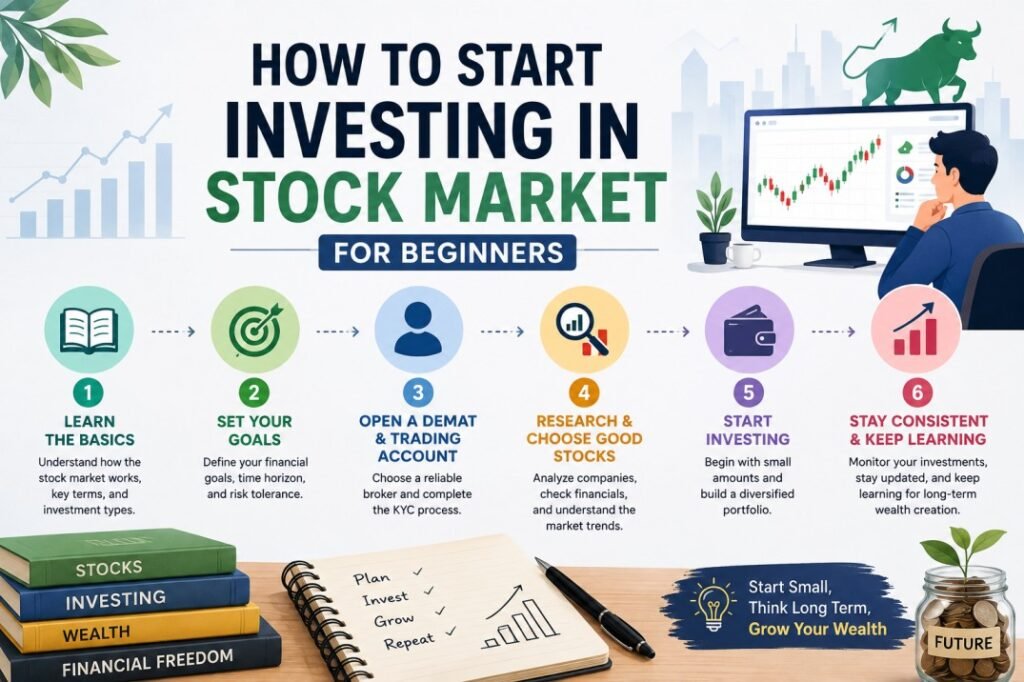
The stock market is a marketplace where securities such as shares can be bought and sold.
In India, two major stock exchanges are the National Stock Exchange (NSE) and BSE Ltd. Investors generally access these exchanges through registered stock brokers.
There are broadly two ways companies enter the equity market:
- Primary market: Investors buy securities when a company offers them to the public, such as through an IPO.
- Secondary market: Investors buy and sell shares that are already listed on a stock exchange.
When you buy a listed company’s share in the secondary market, you are purchasing it from another market participant rather than directly from the company.
How to Start Investing in Stock Market for Beginners: Step-by-Step
To know how to start Investing in Stock Market for Beginners, the process can be broken into a few straightforward steps.
Step 1: Get Your Basic Finances in Order
Before purchasing individual stocks, check your overall financial situation.
Stock-market investments should generally be made with money that you can leave invested for an appropriate period. You should not depend on equity investments for an emergency expense that may arise next month.
A sensible starting point is to consider:
- Emergency savings
- Regular monthly expenses
- High-interest debt
- Insurance needs
- Short-term financial goals
- Long-term investment goals
For example, someone who has ₹1 lakh in savings but also has ₹80,000 of high-cost debt should think carefully before putting a large portion of the remaining money into individual stocks.
Investing should fit into your financial plan rather than replace it.
Step 2: Understand What You Are Buying
A share represents fractional ownership of a company.
Suppose a company has 10 lakh shares outstanding and you own 100 shares. You own a tiny fraction of that business.
However, owning a share does not mean you should automatically hold it forever. The investment thesis needs to make sense based on the company’s business, financial health, valuation, and future prospects.
As a beginner, learn at least these basic concepts:
| Term | Simple Meaning |
|---|---|
| Revenue | Money generated by the business |
| Profit | Earnings remaining after expenses |
| EPS | Earnings attributable to each share |
| P/E Ratio | Share price compared with earnings per share |
| Market Capitalisation | Total market value of a company’s shares |
| Dividend | Part of profit distributed to shareholders |
| Debt | Money borrowed by the company |
| ROE | Return generated on shareholders’ equity |
| Cash Flow | Movement of cash into and out of the business |
| Valuation | How expensive or cheap a stock appears relative to fundamentals |
You do not need to master every financial ratio before investing. But you should understand what the company does and why you believe it can remain financially healthy.
Step 3: Open a Demat Account and Trading Account
One of the most practical steps in learning how to invest in stocks for beginners is understanding the difference between your accounts.
A demat account holds your securities electronically.
A trading account is used to place buy and sell orders through a broker.
Your bank account is used to transfer money to and from the investment process.
SEBI’s investor education material describes a bank account, demat account and trading account as the basic accounts used for buying and selling securities.
The NSE also explains that investors should choose a SEBI-registered broker and complete the required KYC process before beginning to invest.
Common documents requested during account opening include PAN, identity proof and address-related documentation, depending on the broker and applicable KYC requirements.
Step 4: Choose a SEBI-Registered Broker
Do not select a broker only because a friend uses it or because an advertisement promises a particular feature.
Check whether the intermediary is appropriately registered and understand its charges and services.
Consider:
- Brokerage structure
- Account opening charges, if any
- Annual maintenance charges
- Other applicable transaction charges
- Platform reliability
- Customer support
- Research and educational tools
- Ease of placing orders
- Security features
Always review the broker’s latest official fee schedule because charges and product features can change.
The NSE specifically advises investors to use a SEBI-registered member or broker when investing in shares.
Step 5: Decide How Much to Invest
There is no universal minimum amount that every beginner should invest.
Your starting amount should depend on your income, savings, obligations, risk tolerance and financial goals.
Suppose you earn ₹50,000 a month and can comfortably allocate ₹5,000 toward long-term equity investments after handling your other priorities.
You could begin with ₹2,000–₹5,000 rather than feeling that you need ₹1 lakh to start.
The objective during your first year should not necessarily be to maximise returns. Your first objective can be learning how the market behaves and developing good habits.
Step 6: Decide Whether Individual Stocks Are Right for You
This is an important decision.
Buying individual stocks gives you direct ownership of specific companies, but it also requires more research and carries company-specific risk.
A beginner who does not have the time or confidence to analyse businesses may prefer diversified investment products such as mutual funds or index funds.
For example:
Investor A: Researches companies, reads annual reports and understands valuations.
Investor B: Works 10 hours a day and does not want to study individual businesses.
Individual stocks might be more appropriate for Investor A, while a diversified fund could be more practical for Investor B.
Neither approach is automatically better for everyone.
Step 7: Learn How to Research a Stock
Before buying a company’s shares, ask basic questions.
What does the company actually do?
You should be able to explain its business in simple language.
If you cannot explain how a company makes money, it may be too early to invest in it.
Is revenue growing?
Look at the company’s historical revenue and consider whether growth appears sustainable.
Rapid growth can be attractive, but growth alone does not make a good investment.
Is the company profitable?
Study operating profits, net profits and margins.
A growing company that continually consumes cash and produces large losses deserves more careful analysis than a profitable company with predictable cash flows.
How much debt does it have?
Debt is not automatically bad. Many businesses use debt productively.
The problem arises when debt becomes excessive relative to the company’s cash generation and ability to service it.
Is cash flow healthy?
Accounting profit and actual cash generation are not always the same.
Cash-flow trends can provide useful information about the quality of earnings and the financial strength of a business.
Is the valuation reasonable?
A wonderful company can still be a poor investment if you pay an excessively high price for it.
The P/E ratio is one commonly used valuation measure, but it should not be used in isolation.
Compare valuation with factors such as:
- Growth expectations
- Profit margins
- Debt
- Industry characteristics
- Historical valuation
- Competitors
- Business quality
Step 8: Build a Diversified Portfolio
One of the biggest beginner mistakes is putting a large amount of money into one stock simply because somebody recommended it.
Imagine you have ₹1 lakh and invest the entire amount in one company. If that stock falls 40%, your portfolio falls approximately 40%.
A diversified portfolio spreads money across multiple investments.
Diversification does not remove market risk. If the overall market declines, diversified equity holdings can still fall. But diversification can reduce the damage caused by problems in one individual company.
Beginners should also remember that owning 15 companies does not automatically mean they are diversified. If all 15 companies operate in the same industry, your portfolio can still be heavily concentrated.
Also know more detail about Mutual Funds vs Stocks
How Much Money Should a Beginner Invest in Stocks?
The answer depends on personal circumstances.
A better question than “How much should I invest?” is:
“How much can I invest without affecting my essential expenses, emergency savings and other financial goals?”
For example, consider a salaried employee with:
- Monthly income: ₹60,000
- Monthly expenses: ₹35,000
- Emergency fund: Already established
- No expensive consumer debt
- Long-term investment horizon
Such an investor may be able to allocate a portion of monthly savings toward equities.
Another person earning ₹60,000 with ₹55,000 of unavoidable monthly expenses may not have the same capacity.
Your investment amount should be based on your financial situation rather than a social-media challenge or a fixed percentage suggested by someone else.
Should Beginners Invest a Lump Sum or Monthly?
Both approaches can be useful.
A lump-sum investment means investing a larger amount at once.
A monthly investment approach means investing a predetermined amount regularly.
For example, suppose you have ₹60,000 available for long-term investment.
You could invest ₹10,000 per month for six months rather than investing the entire amount on one day. Whether this produces a better return cannot be known in advance because future market prices are uncertain.
Regular investing can help some beginners develop discipline and avoid the emotional pressure of trying to identify the perfect entry point.
However, spreading purchases over time does not guarantee better performance.
Market Order vs Limit Order
Beginners should understand two basic order types.
Market Order
A market order instructs the broker to buy or sell at the best available price in the market.
The final execution price may vary from the price you see moments earlier, particularly in less liquid securities or volatile markets.
Limit Order
A limit order specifies the maximum price you are willing to pay when buying, or the minimum price you are willing to accept when selling.
For example, if a stock is trading around ₹500 and you place a buy limit order at ₹490, the order may execute only if suitable sellers are available at ₹490 or below.
Neither order type is universally better. Understanding how each works is more important than memorising terminology.
Also know detailed information about How to Avoid Losses in Stock Market
What Are the Benefits of Stock Market Investing?
Potential for Long-Term Wealth Creation
Equities provide investors with an opportunity to participate in the growth of businesses.
Over long periods, successful companies can increase earnings and potentially create value for shareholders.
Ownership in Businesses
When you buy shares, you are not simply buying a number on a screen. You are buying an ownership interest in a real business.
This mindset can encourage investors to focus on business performance instead of constantly watching price movements.
Liquidity
Listed shares can generally be bought and sold during market hours through the exchange mechanism.
However, liquidity varies among securities. A liquid large-cap stock may be easier to transact in than a thinly traded security.
Dividend Income
Some companies distribute dividends to shareholders.
Dividends should not be considered guaranteed income. Companies can reduce, cancel or change dividend payments depending on their circumstances.
Risks of Investing in Stocks
Market Risk
Stock prices can fall because of economic conditions, interest rates, geopolitical events, investor sentiment or company-specific issues.
Business Risk
Even a well-known company can make poor decisions.
A new competitor, regulatory change, product failure, fraud, declining demand or management problem can damage shareholder value.
Valuation Risk
Buying an excellent business at an unreasonable valuation can still lead to disappointing investment returns.
Concentration Risk
Putting too much money into one company, sector or theme can make your portfolio vulnerable.
Emotional Risk
Beginners often buy when prices are rising because they fear missing out and sell after a major decline because they become frightened.
This is one of the most damaging behavioural patterns in investing.
Pros and Cons of Investing in Individual Stocks
| Pros | Cons |
|---|---|
| Direct ownership of companies | Higher company-specific risk |
| Potential for capital appreciation | Requires research |
| Possibility of dividend income | Prices can be highly volatile |
| Greater control over portfolio | Emotional decisions can hurt returns |
| Can build a customised portfolio | Diversification requires planning |
Who Should Invest in Individual Stocks?
Individual stocks may be worth considering for investors who:
- Have a long-term investment horizon
- Understand basic financial statements
- Are willing to research companies
- Can tolerate significant price fluctuations
- Can diversify appropriately
- Do not need the invested money immediately
The key is not simply having a high risk tolerance. You should also have the time and willingness to understand what you are buying.
Who Should Avoid Individual Stocks?
Individual stocks may not be suitable for someone who:
- Needs the money in the near future
- Cannot tolerate temporary losses
- Wants guaranteed returns
- Has not built basic emergency savings
- Is buying purely on tips
- Does not want to research companies
- Will panic during market corrections
A diversified mutual fund or index fund may be worth researching in such cases, depending on the investor’s objectives and risk profile.
Practical Example(How to start Investing in Stock Market for Beginners): A Beginner Starting With ₹5,000
Suppose Rahul, a 28-year-old salaried employee, wants to begin investing.
He has an emergency fund and no high-cost debt. He can invest ₹5,000 per month for the long term.
Instead of immediately searching for “multibagger stocks,” Rahul decides to spend several weeks learning about:
- Basic financial statements
- Valuation
- Diversification
- Market cycles
- Investment risk
- Taxes
- Order types
He then researches companies before investing rather than buying because a social-media influencer mentioned them.
The important lesson is not which stock Rahul chooses.
The important lesson is process.
A beginner’s early success should be measured by whether they develop a disciplined investment process—not by whether their first stock doubles in six months.
How to Start Investing in Stock Market for Beginners Without Getting Overwhelmed
To know how to start Investing in Stock Market for Beginners, You do not need to learn everything simultaneously.
A practical learning sequence is month wise:
1: Learn stock-market basics.
2: Understand financial statements and basic ratios.
3: Study several companies from different sectors.
4: Learn portfolio construction and diversification.
5: Understand taxation and investment costs.
6: Review your investing process and mistakes.
Even after you start investing, keep learning.
The stock market is not an examination where you must know every answer before opening an account. It is better to begin cautiously with a clear process than to wait indefinitely for perfect knowledge.
Common Mistakes Beginners Should Avoid
Buying Stocks Because Someone Gave a Tip
A colleague, YouTuber, Telegram channel or social-media account may recommend a stock.
That does not mean it belongs in your portfolio.
Treat recommendations as ideas for research—not as instructions.
Chasing Multibagger Stories
Stories about stocks that went up 5x or 10x are attractive because they focus on successful outcomes.
But for every spectacular winner, many investments may have produced mediocre or negative results.
Study the full picture rather than only looking at winners.
Investing Without Knowing the Business
If your only reason for buying a stock is “everyone is buying it,” you do not have an investment thesis.
Checking Your Portfolio Every Five Minutes
Prices move throughout the trading day.
Watching every tick can encourage unnecessary buying and selling.
Long-term investors should spend more time analysing businesses and less time reacting to every market movement.
Ignoring Valuation
A company can be excellent and still be overpriced.
Always distinguish between business quality and price paid.
Putting Emergency Money Into Stocks
Equity markets can decline exactly when you need money.
Keep short-term financial requirements separate from long-term investments.
Using Leverage or Derivatives Before Understanding Them
Beginners sometimes move quickly from investing to futures, options and leveraged trading.
These products involve additional risks and complexity. Learning basic investing first is generally a more sensible starting point.
Ignoring Taxes and Costs
Returns should be considered after taxes and applicable transaction costs, not just based on the headline change in share price.
Stock Market Tax Basics for Indian Investors
Tax treatment depends on the nature of the security, holding period, transaction conditions and applicable tax rules.
For listed equity transactions that qualify for the relevant provisions, the current tax framework includes a 20% special rate for certain short-term capital gains under Section 111A and 12.5% for specified long-term capital gains under Section 112A above the applicable ₹1.25 lakh threshold. These provisions were changed from earlier rates, so older articles can contain outdated information.
Tax rules can change through future budgets, Finance Acts, notifications and other amendments. Investors should verify the latest rules on the Income Tax Department’s official website before filing a return or making tax-related decisions.
Capital gains are also only one part of the tax picture. Dividends and other forms of investment income can have separate tax treatment.
The appropriate ITR form can also depend on your broader income and transaction circumstances. For example, the Income Tax Department notes that certain taxpayers with short-term capital gains or specified long-term capital gains may not be eligible to use simplified ITR forms such as ITR-4.
How to Keep Your Stock Investments Safe
Security is just as important as investment selection.
Never share:
- OTPs
- Trading passwords
- Demat credentials
- PINs
- Login details
SEBI’s investor guidance specifically advises investors not to share OTPs or depository login credentials with others.
Also review your transaction statements regularly and investigate any transaction you do not recognise.
Use only official broker applications and websites when accessing your account.
A Simple Beginner Stock Research Checklist
Before buying an individual stock, ask yourself:
- What does the company do?
- How does it make money?
- Are revenue and profits reasonably healthy?
- How much debt does it have?
- Is cash flow strong?
- What are its major competitive advantages?
- What risks could damage the business?
- Is the valuation reasonable?
- Am I diversified?
- Why am I buying this company?
- What would make me reconsider my investment?
- Can I stay invested if the stock falls substantially?
If you cannot answer these questions, consider doing more research before investing.
How Long Should Beginners Stay Invested?
There is no universal holding period that guarantees a good result.
Your investment horizon should depend on the objective.
Money needed for an upcoming expense is generally very different from money being invested for a retirement goal decades away.
Long-term investing also does not mean blindly holding every stock forever.
A company can deteriorate over time. The investor’s job is to periodically review whether the original investment thesis still makes sense.
Stock Market vs Mutual Funds for Beginners
| Feature | Individual Stocks | Mutual Funds |
|---|---|---|
| Decision-making | Investor chooses companies | Fund manager follows fund strategy |
| Diversification | Investor must create it | Usually built into the fund |
| Research required | Higher | Lower for individual investor |
| Control | High | Lower |
| Company-specific risk | Can be high | Usually reduced through diversification |
| Suitable for | Hands-on investors | Investors seeking diversified exposure |
This comparison does not mean mutual funds are risk-free. Equity mutual funds can also fall when markets decline.
The better choice depends on your knowledge, goals, risk tolerance, time and preferred level of involvement.
Key Takeaways
- Learning how to start investing in stock market for beginners starts with understanding the basics rather than searching for quick profits.
- Open the appropriate bank, demat and trading accounts through regulated intermediaries.
- Use a SEBI-registered broker.
- Invest only money that is suitable for your investment horizon.
- Understand a company’s business before buying its stock.
- Look at revenue, profits, debt, cash flow and valuation.
- Diversification can help reduce company-specific risk.
- Do not buy stocks solely because of tips or social-media recommendations.
- Avoid using leverage or complex derivatives before understanding their risks.
- Keep your emergency money separate from equity investments.
- Review taxes and transaction costs before making investment decisions.
- Keep your OTPs, passwords and demat credentials private.
- Stock-market returns are not guaranteed, and losses are possible.
Frequently Asked Questions
1. How to start investing in stock market for beginners in India?
Start by understanding basic market concepts, organising your finances, obtaining the required KYC documentation, opening a demat and trading account with a suitable SEBI-registered intermediary, and learning how to research investments. NSE states that investors need a PAN, bank account, demat account and a suitable registered broker as part of the basic process.
2. How much money is needed to start investing in stocks?
There is no single amount required for every beginner. Because individual shares have different prices, you can start with a relatively small amount, but the more important question is whether the money is suitable for long-term investment and whether the portfolio can be diversified sensibly.
3. Can I start investing in stocks with ₹500?
In some cases, yes. It depends on the share prices you are considering and the broker’s applicable charges. However, starting with ₹500 does not automatically make a portfolio diversified, so focus on learning and building a sensible process rather than the amount alone.
4. Is the stock market safe for beginners?
The stock market is regulated, but individual investments are not guaranteed to be safe or profitable. Share prices can fall substantially, and individual companies can fail. NSE explicitly states that returns are not guaranteed and that investors can lose their investment.
For more detail about What Is NSE Stock Exchange
5. Should beginners buy individual stocks or mutual funds?
It depends on the investor. Individual stocks require more research and carry greater company-specific risk. Mutual funds can provide diversification and may be easier for people who do not want to analyse individual companies.
6. How should beginners choose stocks?
Start by understanding the business, revenue, profitability, debt, cash flow, competitive position, industry risks and valuation. Avoid relying on a single ratio or prediction. Research should be based on multiple sources, including company disclosures and official filings.
7. Should I invest all my money in the stock market?
Generally, putting all your available money into equities is not a sensible approach for most beginners. Your portfolio should reflect your financial goals, emergency requirements, risk tolerance and investment horizon.
8. Can I make guaranteed returns from stocks?
No. There is no guaranteed return from investing in individual shares. Prices can rise or fall, and even financially strong businesses can experience periods of poor performance.
9. What is a demat account?
A demat account is an electronic account used to hold securities. Your trading account facilitates the buying and selling process, while your bank account is used for transferring money. SEBI describes the demat account as the account used to hold securities electronically.
10. How should beginners protect their trading account?
Use strong authentication, keep your passwords private, avoid sharing OTPs and monitor your transaction statements. SEBI specifically warns investors not to share OTPs and depository login credentials.
the links in WordPress, and keep the anchor text natural rather than repeatedly using exact-match keywords.
Conclusion
Learning how to start investing in stock market for beginners does not require predicting the next multibagger stock or understanding every financial concept on day one.
A better starting point is to build a disciplined process.
Get your financial foundation in place. Open the appropriate accounts with a regulated intermediary. Learn how businesses make money. Understand basic financial statements and valuation. Diversify appropriately. Invest according to your time horizon and risk tolerance, and avoid making decisions based on fear, greed or social-media tips.
Most importantly, remember that investing is a long-term learning process.
The goal is not to win every investment.
The goal is to make informed decisions, manage risk and give your money a reasonable opportunity to grow over time while understanding that losses are always possible.
Before acting on any investment information, conduct your own research and verify current regulatory, tax, product and company-specific information from official sources. Figures such as tax rates, broker charges, financial results and other market data can change.
Author Note: I have been investing in the Indian stock market since 2018, with practical experience in mutual funds and equities. For U.S.-focused articles, I research information from official fund providers, regulatory sources, company filings, and other reliable sources. I also use AI-assisted research and writing tools to help organize and explain information, while reviewing the content for accuracy and clarity before publication. This article is intended for educational purposes and is not personalized financial advice.
Disclaimer: The content provided is for educational and informational purposes only and should not be considered financial, investment, insurance, or legal advice.