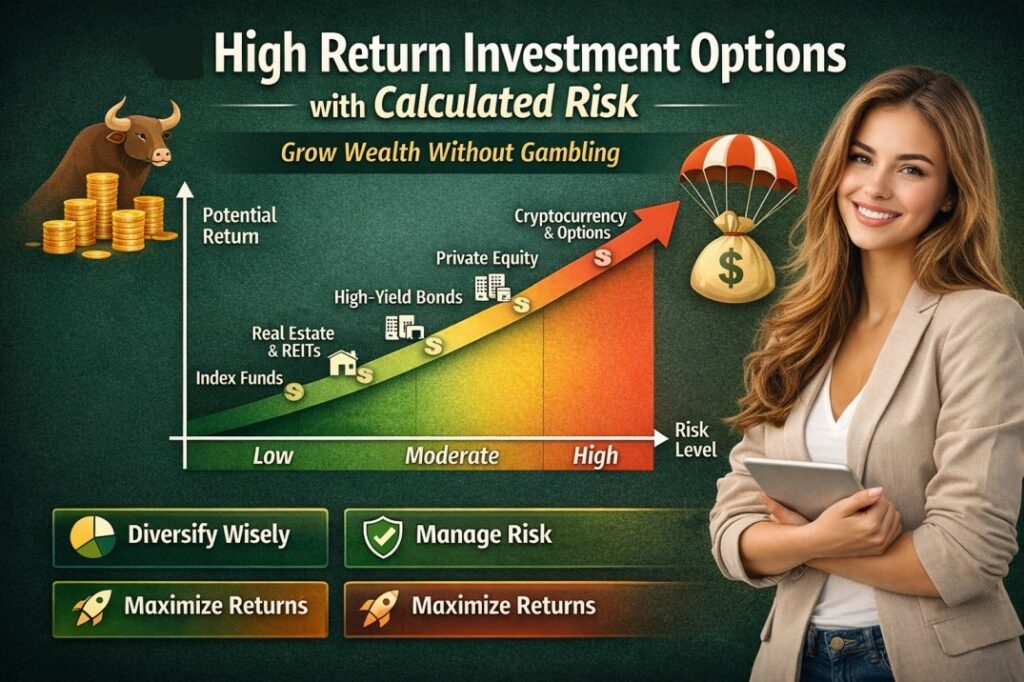

Introduction: High Returns Don’t Come from Luck – They Come from Strategy
Everyone wants high returns, but very few investors want the stress, sleepless nights, and losses that often come with risky decisions. The truth is, high return investment options don’t have to mean reckless bets or blind speculation.
Smart investors focus on calculated risk – understanding why an investment can generate higher returns, how much risk is involved, and how to manage that risk effectively.
In this guide, we’ll break down the best high return investment options, compare them honestly, and show you how real investors combine them to grow wealth faster without gambling their hard-earned money.
Whether you’re a beginner or someone tired of low fixed-deposit returns, this article will give you a clear, practical roadmap.
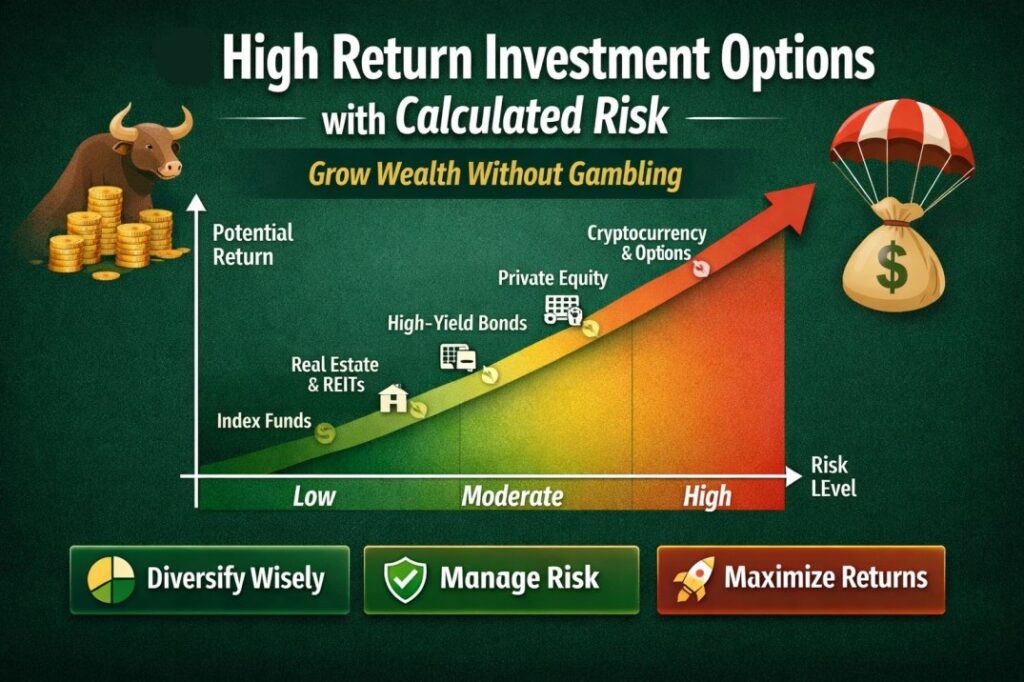
What Are High Return Investment Options?
High return investment options are assets that historically or structurally offer returns significantly higher than traditional savings accounts, fixed deposits, or government bonds.
However, higher returns always come with at least one of these:
- Higher volatility
- Higher uncertainty
- Lower liquidity
- Longer lock-in periods
The key is not avoiding risk – it’s calculating and controlling it.
Quick Comparison: Returns vs Risk
| Investment Option | Expected Annual Return | Risk Level | Liquidity | Time Horizon |
|---|---|---|---|---|
| Equity Mutual Funds / ETFs | 10–14% | Medium–High | High | 5–10 years |
| Direct Stocks | 12–18%+ | High | High | 5–15 years |
| Small-Cap Funds | 14–20% | Very High | Medium | 7–15 years |
| Real Estate | 10–16% | Medium | Low | 7–20 years |
| REITs | 9–13% | Medium | High | 5–10 years |
| Private Equity / VC | 15–25%+ | Very High | Very Low | 8–12 years |
| High-Yield Bonds | 8–11% | Medium | Medium | 3–7 years |
| Cryptocurrency | Highly Variable | Extremely High | High | Speculative |
| Options / Leverage | Unlimited (theoretically) | Extreme | High | Short-term |
1. Equity Mutual Funds & Index ETFs (The Smart Foundation)
For most investors, equity mutual funds and index ETFs are the best starting point among high return investment options.
Why they work:
- Businesses grow with inflation and economic expansion
- Professional management or passive diversification
- Long-term compounding does the heavy lifting
Historically, broad equity markets have delivered 10–12% annualized returns over long periods.
Calculated risk strategy:
- Use index funds as your core
- Add actively managed funds only where managers have proven consistency
- Stay invested during market corrections
📌 Ideal for: Beginners, long-term investors, retirement planning
2. Direct Stock Investing (High Reward, Skill-Based)
Buying individual stocks can significantly outperform mutual funds – if done right.
Why returns can be higher:
- Concentrated bets on fast-growing companies
- Ability to buy undervalued businesses early
But stock picking punishes emotion, overconfidence, and impatience.
How to manage risk:
- Limit any single stock to 5-7% of portfolio
- Focus on companies with strong cash flow and management
- Avoid chasing “hot tips” and social media hype
📌 Ideal for: Investors willing to research and monitor regularly
3. Small-Cap & Mid-Cap Funds (Volatility with Potential)
Small-cap companies grow faster – but fall harder during market crashes.
Why they deliver higher returns:
- Smaller base = faster expansion
- Under-researched opportunities
Risk control tips:
- Invest through mutual funds, not individual stocks
- Allocate 20–30% max of equity exposure
- Hold through full market cycles
📌 Ideal for: Long-term investors with high risk tolerance
4. Real Estate (Wealth Builder with Patience)
Real estate remains one of the most trusted high return investment options in India and globally.
Return drivers:
- Capital appreciation
- Rental income
- Leverage (bank financing)
Combined returns can reach 12-16% annually in prime locations.
Calculated risk approach:
- Focus on cash-flow-positive properties
- Avoid over-leveraging
- Choose location over size
📌 Ideal for: Investors with long horizons and stable income
5. REITs (Real Estate Without the Headaches)
Real Estate Investment Trusts (REITs) allow you to invest in commercial real estate without buying property directly.
Why REITs are attractive:
- Regular dividend income
- Liquidity like stocks
- Lower entry cost
Risk factors:
- Interest rate sensitivity
- Market volatility
📌 Ideal for: Income-focused investors wanting diversification
6. Private Equity & Venture Capital (Ultra High Return Zone)
Private equity and venture capital are where exceptional returns are possible – but so are losses.
Why returns can explode:
- Early access to fast-scaling businesses
- Operational improvements and strategic exits
Why most people fail:
- Illiquidity (money locked for years)
- Poor deal selection
Smart allocation rule:
- Limit to 5–10% of net worth
- Invest only surplus capital
📌 Ideal for: Experienced, high-net-worth investors
7. High-Yield Bonds & Credit Funds
These instruments pay higher interest because they lend to riskier borrowers.
Expected returns:
- Typically 8–11% annually
Risk management:
- Use diversified funds
- Avoid chasing the highest yield blindly
- Monitor credit quality
📌 Ideal for: Investors seeking income with moderate risk
8. Cryptocurrency (High Risk, Asymmetric Returns)
Crypto assets like Bitcoin and Ethereum have delivered massive returns — but also brutal crashes.
Why people invest:
- Limited supply (Bitcoin)
- Institutional adoption narrative
- Hedge against fiat currency debasement
Calculated risk rules:
- Allocate 1–5% max
- Avoid leverage
- Use secure wallets
📌 Ideal for: Risk-tolerant investors only
9. Options & Leveraged Strategies (Not for Everyone)
Options can generate income or hedge risk – but misuse leads to rapid losses.
Safer uses:
- Covered call strategies
- Protective puts
Dangerous practices:
- Naked options
- Excessive leverage
📌 Ideal for: Experienced traders only
How Smart Investors Combine High Return Investment Options
Sample Balanced Aggressive Portfolio
| Asset Class | Allocation |
|---|---|
| Index Funds / ETFs | 45% |
| Growth & Small-Cap Funds | 25% |
| Direct Stocks | 15% |
| REITs / Real Estate | 10% |
| Crypto / Alternatives | 5% |
This structure:
- Protects capital
- Targets above-average returns
- Limits downside damage
Key Insights Most Investors Miss
- High returns come from time + discipline, not constant trading
- Risk is highest when emotions drive decisions
- Diversification doesn’t reduce returns — it improves survival
- The best portfolio is one you can stick with during crashes
Final Thoughts: High Returns Without Recklessness
The goal isn’t to chase the highest return – it’s to achieve the best risk-adjusted return.
By combining multiple high return investment options, sizing your risk correctly, and staying patient, you dramatically improve your chances of long-term wealth creation.
Calculated risk beats blind courage – every single time.
Disclaimer: The content provided is for educational and informational purposes only and should not be considered financial, investment, insurance, or legal advice.