

Last Updated on 23 July 2026
Introduction
If you’ve ever watched financial news, you’ve probably heard headlines like, “The Dow closed up 300 points today,” or “The Dow fell after inflation data was released.” While these updates are common, many new investors don’t fully understand what the Dow Jones Industrial Average Index actually represents or why it matters.
The Dow Jones Industrial Average (DJIA), often simply called the Dow, is one of the oldest and most recognized stock market indexes in the world. It tracks the performance of 30 large, well-established U.S. companies across various industries. Although it includes only a small number of stocks compared to broader indexes, it remains an important benchmark for measuring the overall health of the U.S. economy and investor sentiment.
Whether you’re just beginning your investing journey or trying to understand how financial markets work, learning about the Dow can help you interpret market news, compare investment performance, and make more informed financial decisions.
In this beginner-friendly guide, you’ll learn:
- What the Dow Jones Industrial Average Index is
- Why investors pay attention to it
- How it is calculated
- Which companies are included
- Its advantages and limitations
- How beginners can use it as part of their investment education
By the end of this guide, you’ll have a solid understanding of one of the world’s most influential stock market indexes.
Why the Dow Jones Industrial Average Index Matters
The Dow Jones Industrial Average is more than just a number shown on television every evening. It serves as a widely recognized indicator of how some of America’s largest and most influential companies are performing.
Because these companies operate across different sectors-including technology, healthcare, finance, retail, and manufacturing—the Dow often reflects broader economic trends. While it doesn’t represent every publicly traded company in the United States, it provides a snapshot of how established businesses are performing under current market conditions.
For example:
- Rising consumer spending may benefit retail companies in the Dow.
- Lower interest rates can positively affect financial institutions.
- Advances in technology may boost technology companies included in the index.
- Economic uncertainty can cause the index to decline as investors become more cautious.
Although professional investors rely on many different indicators, the Dow remains one of the easiest ways for beginners to understand whether the market had a generally positive or negative trading day.
What Is the Dow Jones Industrial Average Index?
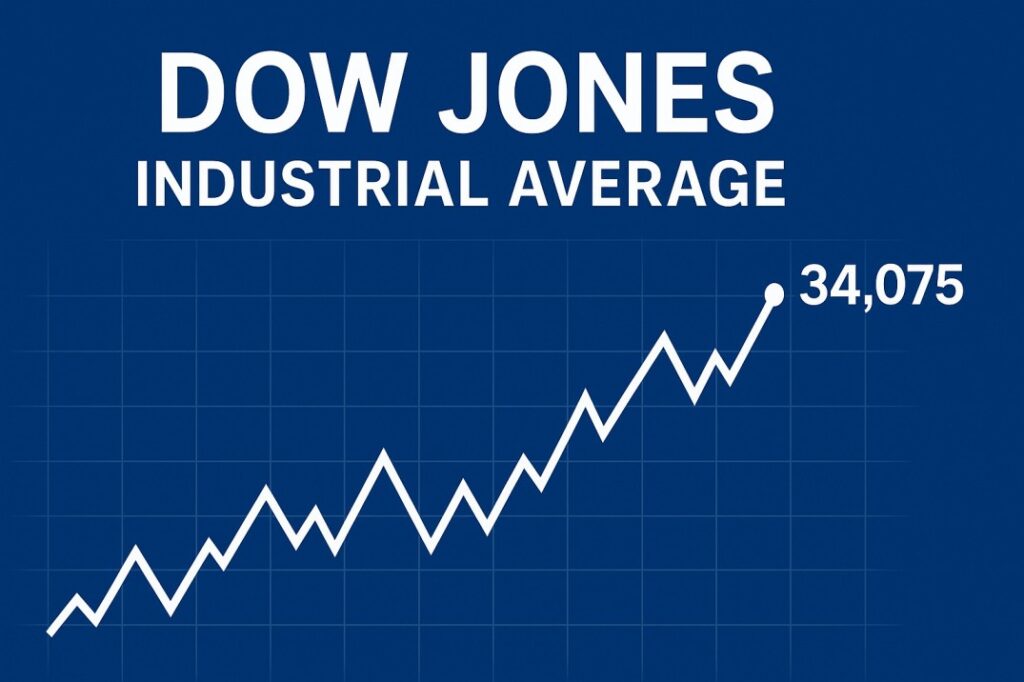
The Dow Jones Industrial Average Index (DJIA) is a stock market index that measures the performance of 30 large publicly traded U.S. companies.
Unlike individual stocks, an index is simply a measurement tool. It groups selected companies together and tracks their combined performance over time.
Think of it like a report card.
Instead of evaluating one company, the Dow summarizes how 30 major corporations are performing collectively.
Some of these companies have operated for decades and are household names around the world. They generally have:
- Strong financial positions
- Long operating histories
- Significant market influence
- Large customer bases
- Consistent profitability (although profits are never guaranteed)
Because these businesses play important roles in the U.S. economy, many investors view the Dow as a reliable barometer of market confidence.
A Simple Example
Imagine a teacher wants to measure the overall performance of an entire class.
Rather than reviewing every student in the school, the teacher selects the top 30 students from different subjects and tracks their average scores throughout the year.
While these students don’t represent every learner, they provide a useful indication of how the class is performing overall.
The Dow works in a similar way.
Instead of tracking thousands of U.S. companies, it focuses on 30 prominent businesses from various industries.
What Does “Industrial Average” Mean Today?
When the Dow was first introduced, most major American companies were involved in manufacturing and industrial production. Railroads, steel companies, machinery manufacturers, and similar businesses dominated the economy.
Today, the U.S. economy looks very different.
Modern Dow companies include businesses from sectors such as:
| Industry | Example Type |
|---|---|
| Technology | Software and consumer electronics |
| Healthcare | Pharmaceutical and medical companies |
| Financial Services | Banks and payment companies |
| Consumer Goods | Household products |
| Retail | Large retail chains |
| Energy | Oil and energy companies |
| Industrial Manufacturing | Aerospace and engineering firms |
Although the word “Industrial” remains part of its name, the index now reflects a much broader range of industries than it did over a century ago.
History of the Dow Jones Industrial Average Index
Understanding the Dow’s history helps explain why it continues to receive so much attention from investors worldwide.
The Dow Jones Industrial Average was introduced on May 26, 1896, by financial journalist Charles Dow and statistician Edward Jones.
Their goal was simple:
Create an easy-to-understand indicator showing whether America’s largest industrial businesses were becoming more valuable over time.
At launch, the index included only 12 companies, primarily involved in:
- Cotton
- Sugar
- Tobacco
- Railroads
- Steel
- Gas
- Leather
As the American economy expanded, the index evolved as well.
Important Milestones
| Year | Milestone |
|---|---|
| 1896 | Dow Jones Industrial Average launched with 12 companies |
| 1916 | Expanded to 20 companies |
| 1928 | Expanded to 30 companies |
| Modern Era | Continues tracking 30 leading U.S. companies while updating constituents as industries evolve |
Over the decades, many companies have been removed and replaced to ensure the index continues reflecting the changing U.S. economy.
For example, technology companies eventually joined the Dow as innovation became a major driver of economic growth.
How the Dow Jones Industrial Average Index Works
Many beginners assume the Dow simply averages the prices of its 30 companies.
The reality is a little more complex.
The Dow is a price-weighted index.
This means companies with higher share prices have a greater influence on the index’s daily movement than companies with lower share prices, regardless of their overall size or market value.
Understanding Price Weighting
Imagine there are only three companies in a fictional index.
| Company | Share Price |
|---|---|
| Company A | $400 |
| Company B | $150 |
| Company C | $40 |
If:
- Company A rises by $10
- Company C rises by $10
Both increased by the same dollar amount.
However, Company A would have a much larger effect on the index because its stock price is higher.
This differs from indexes such as the S&P 500, which are weighted by market capitalization rather than stock price.
What Is the Dow Divisor?
Because companies occasionally split their stock or undergo corporate actions, simply averaging stock prices would produce misleading results.
To maintain continuity, the Dow uses a mathematical adjustment known as the Dow Divisor.
The divisor is updated when events such as:
- Stock splits
- Spin-offs
- Company replacements
- Corporate restructurings
occur, helping ensure these changes do not create artificial jumps or drops in the index.
For most investors, there’s no need to calculate the divisor manually. Understanding that it exists to keep the index consistent is sufficient.
Why Doesn’t the Dow Include Thousands of Companies?
This is a common question among new investors.
The answer lies in the Dow’s purpose.
Rather than tracking the entire U.S. stock market, the index is designed to follow a carefully selected group of influential, financially established companies that collectively offer a snapshot of corporate America.
For broader market coverage, investors often look to indexes that include hundreds or even thousands of companies. The Dow, however, remains valuable because of its long history, simplicity, and focus on well-known industry leaders.
Why Investors Still Follow the Dow
Even though newer indexes cover more companies, the Dow continues to attract global attention because it:
- Has more than a century of historical data
- Tracks many of America’s best-known corporations
- Provides a quick measure of market sentiment
- Is widely reported by financial media
- Helps investors compare market performance over time
For beginners, the Dow often serves as an accessible starting point before exploring broader market indexes and investment strategies.
Dow Jones Industrial Average Companies
One of the most common questions beginners ask is, “Which companies are included in the Dow?”
The Dow Jones Industrial Average companies are 30 large, financially established U.S. businesses that are considered leaders in their respective industries. These companies are often referred to as blue-chip stocks because of their strong reputations, long operating histories, and significant influence on the U.S. economy.
It’s important to remember that the list of companies is not permanent. As industries evolve and the economy changes, companies may be added to or removed from the index. This helps keep the Dow relevant to the modern U.S. market.
Note: The list of Dow companies can change over time. Always verify the latest constituents from the official S&P Dow Jones Indices website.
Current Dow Jones Industrial Average Companies
The Dow currently consists of companies from multiple sectors, providing exposure to different parts of the U.S. economy.
| Company | Industry |
|---|---|
| 3M | Industrials |
| American Express | Financial Services |
| Amgen | Healthcare |
| Amazon | Consumer Discretionary |
| Apple | Technology |
| Boeing | Aerospace & Defense |
| Caterpillar | Heavy Equipment |
| Chevron | Energy |
| Cisco | Technology |
| Coca-Cola | Consumer Staples |
| Disney | Entertainment |
| Goldman Sachs | Financial Services |
| Home Depot | Home Improvement |
| Honeywell | Industrials |
| IBM | Technology |
| Johnson & Johnson | Healthcare |
| JPMorgan Chase | Banking |
| McDonald’s | Restaurants |
| Merck | Pharmaceuticals |
| Microsoft | Technology |
| Nike | Consumer Goods |
| NVIDIA | Technology |
| Procter & Gamble | Consumer Staples |
| Salesforce | Software |
| Sherwin-Williams | Chemicals |
| Travelers | Insurance |
| UnitedHealth Group | Healthcare |
| Verizon | Telecommunications |
| Visa | Payment Technology |
| Walmart | Retail |
What Makes These Companies Special?
The Dow doesn’t simply include the largest companies by market value. Instead, it focuses on businesses that have demonstrated long-term stability and play an important role in the U.S. economy.
Many Dow companies share several characteristics:
- Well-known global brands
- Strong financial performance over long periods
- Consistent business operations
- Large customer bases
- Significant impact on their industries
These companies often operate internationally, meaning their performance can also reflect global economic trends.
How Are Companies Selected for the Dow?
Unlike some indexes that follow strict mathematical rules, the Dow is curated by an index committee.
The committee considers several factors before adding or removing a company, including:
- Reputation and industry leadership
- Financial stability
- Importance to the U.S. economy
- Consistent investor interest
- Representation of major economic sectors
The goal is not to include every successful company but to create a balanced snapshot of corporate America.
Why Companies Are Sometimes Replaced
A company may be removed from the Dow if:
- Its industry becomes less important to the economy.
- Another company better represents a growing sector.
- Significant mergers or acquisitions change its structure.
- It no longer reflects the index’s objectives.
For example, as technology became increasingly important, several technology companies were added while some traditional industrial businesses were removed.
Sectors Represented in the Dow
Although the index contains only 30 companies, it covers a broad range of industries.
| Sector | Examples |
|---|---|
| Technology | Apple, Microsoft, Cisco, NVIDIA, Salesforce |
| Financial Services | American Express, Goldman Sachs, JPMorgan Chase, Visa |
| Healthcare | Johnson & Johnson, Amgen, Merck, UnitedHealth Group |
| Consumer Staples | Coca-Cola, Procter & Gamble, Walmart |
| Consumer Discretionary | Amazon, Home Depot, McDonald’s, Nike, Disney |
| Industrials | Caterpillar, Honeywell, 3M, Boeing |
| Energy | Chevron |
| Telecommunications | Verizon |
| Insurance | Travelers |
| Chemicals | Sherwin-Williams |
This sector diversification helps reduce the impact of weakness in any single industry, although it does not eliminate investment risk.
How Is the Dow Jones Industrial Average Calculated?
One feature that makes the Dow unique is its price-weighted methodology.
Instead of giving greater influence to larger companies based on their total market value, the Dow assigns more weight to companies with higher stock prices.
Simplified Example
Imagine the Dow consisted of only three companies.
| Company | Share Price |
|---|---|
| Company A | $450 |
| Company B | $200 |
| Company C | $40 |
Suppose:
- Company A increases by $15
- Company C increases by $15
Even though both stocks rose by the same dollar amount, Company A would have a much larger impact on the index because of its higher share price.
This approach is different from most modern stock market indexes.
Why Doesn’t Market Value Determine Weight?
Many investors assume that the largest companies should have the greatest influence on an index.
That is true for the S&P 500 and Nasdaq-100, but not for the Dow.
The Dow was created in the late 19th century when calculating market capitalization manually wasn’t practical. Its price-weighted method has been preserved for historical continuity.
While this methodology is sometimes criticized, it remains one of the defining characteristics of the DJIA.
Dow Jones Industrial Average vs S&P 500 vs Nasdaq Composite
Many beginners confuse these three major U.S. stock market indexes. Although they often move in the same direction, they measure different parts of the market.
| Feature | Dow Jones Industrial Average | S&P 500 | Nasdaq Composite |
|---|---|---|---|
| Number of Companies | 30 | About 500 | More than 3,000 |
| Weighting Method | Price-weighted | Market-cap weighted | Market-cap weighted |
| Focus | Large blue-chip companies | Broad U.S. market | Nasdaq-listed companies |
| Technology Exposure | Moderate | High | Very High |
| Diversification | Limited | Broad | Broad but tech-heavy |
| Best Use | Market snapshot | Overall market benchmark | Technology market performance |
Which Index Is Best?
There isn’t a single “best” index.
Each serves a different purpose:
- Dow Jones Industrial Average: A quick indicator of how major U.S. companies are performing.
- S&P 500: A broader representation of the U.S. stock market.
- Nasdaq Composite: A useful benchmark for technology and growth-oriented companies.
Professional investors often monitor all three indexes together to gain a more complete understanding of market conditions.
For detailed information about Ave Maria Funds Review 2026
Advantages of the Dow Jones Industrial Average
Despite having only 30 companies, the Dow remains one of the world’s most recognized market benchmarks.
1. Easy to Understand
The Dow tracks a relatively small number of companies, making it easier for beginners to follow.
2. Includes Established Businesses
Most Dow companies have long operating histories and globally recognized brands.
3. Long Historical Record
With data dating back to 1896, the Dow provides valuable insight into how markets have performed through wars, recessions, booms, and technological revolutions.
4. Widely Reported
Financial news outlets frequently reference the Dow, making it easy for investors to stay informed.
5. Represents Multiple Industries
Although limited to 30 companies, the index spans sectors such as healthcare, technology, finance, industrials, consumer goods, and energy.
Limitations of the Dow Jones Industrial Average
While the Dow is influential, it’s not a perfect representation of the entire stock market.
1. Tracks Only 30 Companies
Thousands of publicly traded U.S. companies are not included.
2. Price-Weighted Methodology
A higher-priced stock has more influence than a lower-priced one, even if the latter has a much larger market value.
3. Limited Small-Company Exposure
The Dow focuses on large, established corporations and does not include small-cap businesses.
4. Not Fully Representative
Fast-growing industries and emerging companies may be underrepresented until they become large and established.
5. Company Changes Over Time
The list of constituents evolves, meaning the index today is different from the one investors followed decades ago.
Pros and Cons of the Dow Jones Industrial Average
| Pros | Cons |
|---|---|
| Simple to understand | Tracks only 30 companies |
| Includes leading U.S. businesses | Price-weighted methodology can distort influence |
| Strong historical record | Less diversified than broader indexes |
| Frequently used by financial media | Doesn’t include many mid-cap or small-cap stocks |
| Good indicator of market sentiment | Not a complete picture of the U.S. economy |
Is the Dow Still Relevant Today?
Some investors argue that broader indexes such as the S&P 500 provide a more comprehensive view of the U.S. market. While that’s true in terms of diversification, the Dow continues to play an important role.
Its long history, recognizable companies, and daily visibility in financial news make it a useful benchmark for tracking market sentiment. For beginners, it offers an accessible introduction to how stock market indexes work before moving on to more complex benchmarks.
Understanding the Dow also helps investors interpret headlines and economic events with greater confidence.
Also know about the Best Charles Schwab Money Market Funds
Benefits of Following the Dow Jones Industrial Average Index
Whether you’re an active investor or simply interested in understanding financial markets, the Dow Jones Industrial Average Index can be a valuable learning and benchmarking tool.
Although you cannot invest directly in the index itself, tracking its performance can help you better understand market trends and economic conditions.
1. Provides a Snapshot of the U.S. Economy
The Dow includes some of America’s largest and most influential companies. Because these businesses operate across different industries, the index often reflects broader economic trends.
For example:
- Strong consumer spending may support retail and consumer goods companies.
- Higher business investment can benefit industrial companies.
- Advances in technology may improve the performance of technology stocks in the index.
While the Dow doesn’t represent every company, it offers a quick overview of how major corporations are performing.
2. Helps Investors Understand Market Sentiment
When financial news reports that “the Dow gained 500 points” or “the Dow fell sharply,” it often reflects how investors are reacting to new information such as:
- Inflation reports
- Interest rate decisions
- Corporate earnings
- Employment data
- Geopolitical events
Following the Dow can help beginners connect economic news with stock market movements.
3. Encourages Long-Term Thinking
Many Dow companies have operated successfully for decades.
Studying these businesses can teach investors important lessons about:
- Business resilience
- Competitive advantages
- Long-term growth
- Dividend-paying companies
- Economic cycles
This perspective encourages patience rather than reacting to short-term market fluctuations.
4. Useful as a Performance Benchmark
Investors often compare the performance of their portfolios against major indexes.
For example:
- If your diversified portfolio gains 10% in a year while the Dow rises 8%, your investments outperformed the index.
- If the Dow performs better than your portfolio over several years, it may be worth reviewing your investment strategy.
Remember, past performance does not guarantee future results.
5. Supports Financial Education
Understanding how the Dow works also helps investors learn about broader investment concepts such as:
- Stock market indexes
- Diversification
- Market cycles
- Blue-chip companies
- Risk management
Risks and Limitations of Relying on the Dow
Although the Dow is one of the world’s best-known stock indexes, investors should also understand its limitations.
1. It Doesn’t Represent the Entire Stock Market
The United States has thousands of publicly traded companies.
Since the Dow tracks only 30 companies, it cannot fully represent every industry or market segment.
2. Price Weighting Can Be Misleading
Because the Dow is price-weighted, a company with a higher stock price can have a greater impact on the index than a larger company with a lower share price.
This differs from market-cap-weighted indexes like the S&P 500.
3. Daily Market Movements Can Be Volatile
Stock prices can fluctuate significantly due to:
- Economic reports
- Corporate earnings
- Interest rate announcements
- Political developments
- Global events
Short-term movements do not necessarily indicate long-term economic strength or weakness.
4. No Guaranteed Investment Returns
Even though many Dow companies have long histories, investing in stocks always involves risk.
Potential risks include:
- Market downturns
- Company-specific challenges
- Economic recessions
- Inflation
- Changing consumer demand
Investors should never assume that historical performance guarantees future returns.
For detailed information about Fidelity Investments Roth IRA for Beginners
Can You Invest Directly in the Dow Jones Industrial Average?
A common misconception is that investors can buy the Dow itself.
The answer is no.
The Dow is an index, not a tradable security.
However, investors can gain exposure to its performance through financial products designed to track the index.
Examples include:
- Exchange-Traded Funds (ETFs)
- Index mutual funds
- Certain retirement investment options
Before investing, always review:
- Expense ratio
- Investment objective
- Holdings
- Risks
- Tax implications
These details can change over time, so verify the latest information from the fund provider.
Popular Ways to Gain Exposure to the Dow
| Investment Option | Description | Suitable For |
|---|---|---|
| Dow ETF | Tries to track the performance of the DJIA | Long-term investors seeking index exposure |
| Index Mutual Fund | Professionally managed fund tracking an index | Retirement and regular investing |
| Retirement Accounts | Some 401(k) and IRA plans include Dow-related funds | Long-term retirement savers |
Important: Compare fees, investment objectives, and risks before choosing any fund. Information such as expense ratios and holdings may change over time.
Who Should Consider Dow-Tracking Investments?
While every investor’s financial situation is different, Dow-tracking funds may be suitable for people who:
Beginners
The Dow is relatively easy to understand and introduces investors to large U.S. companies.
Long-Term Investors
Those investing for goals many years away may appreciate exposure to established businesses.
Retirement Investors
Some retirement portfolios include index-based investments that provide broad exposure to large companies.
Passive Investors
People who prefer investing in a diversified basket of companies instead of selecting individual stocks may find index-tracking funds appealing.
Remember, suitability depends on your financial goals, time horizon, and risk tolerance.
Who May Want to Look Beyond the Dow?
The Dow may not be the best fit for everyone.
You may want to explore additional indexes if you:
- Want exposure to hundreds of U.S. companies.
- Prefer technology-focused investments.
- Are interested in small-cap or mid-cap stocks.
- Seek international market diversification.
- Need investments aligned with a specific strategy or sector.
Many investors use the Dow alongside broader indexes rather than relying on it alone.
Also know about Best REIT Stocks to Buy in the USA
Practical Example: Understanding the Dow in Everyday Life
Imagine you hear the following headline:
“The Dow Jones Industrial Average gained 450 points after stronger-than-expected employment data.”
What does this mean?
It does not mean that every stock in the market increased.
Instead, it suggests that many of the large companies within the Dow performed well, possibly because investors viewed the employment report as a positive sign for the economy.
Now consider another example.
Suppose rising interest rates cause investors to worry about future corporate profits. In response, several major Dow companies decline in value, causing the index to fall.
These examples illustrate how the Dow often reflects investor expectations about the economy rather than guaranteeing future market direction.
For detailed information about Dollar Cost Average Investing Strategy for Beginners
Common Mistakes Beginners Make
Understanding these common mistakes can help new investors make more informed decisions.
1. Assuming the Dow Represents the Entire Market
The Dow includes only 30 companies, so it doesn’t capture the full diversity of the U.S. stock market.
2. Focusing Only on Daily Point Changes
Large point movements may seem dramatic, but percentage changes often provide better context.
For example, a 300-point move has a different significance when the index is at 20,000 than when it’s above 40,000.
3. Chasing Headlines
Buying or selling investments solely because the Dow had a strong or weak day can lead to emotional decisions.
Long-term investing generally requires patience and discipline.
4. Ignoring Diversification
Even if you invest in a Dow-tracking fund, it’s important to consider diversification across different asset classes, sectors, and regions based on your financial goals.
5. Overlooking Costs
Before investing in any ETF or mutual fund, review:
- Expense ratio
- Management fees
- Trading costs
- Tax implications
Lower costs can make a meaningful difference over long investment periods.
Tips for Beginners
If you’re just starting your investment journey, consider these practical tips:
- Learn how stock market indexes work before investing.
- Focus on long-term financial goals instead of short-term market movements.
- Avoid making investment decisions based solely on news headlines.
- Build a diversified portfolio that matches your risk tolerance.
- Review your investments periodically instead of checking prices every day.
- Continue improving your financial knowledge through reliable educational resources.
Why the Dow Still Matters in 2026
Despite the rise of broader market indexes, the Dow remains one of the most recognized financial benchmarks worldwide.
Its importance comes from:
- More than a century of historical data
- Representation of well-established U.S. companies
- Daily use by financial media
- Educational value for new investors
- Ability to provide a quick snapshot of market sentiment
While professional investors often rely on multiple benchmarks, the Dow continues to be an excellent starting point for understanding how the U.S. stock market works.
For detailed information about SPY Stock: The Smart Investor’s Guide
Frequently Asked Questions (FAQs)
1. What is the Dow Jones Industrial Average Index?
The Dow Jones Industrial Average Index (DJIA) is a stock market index that tracks the performance of 30 large, well-established U.S. companies. It is one of the oldest and most widely followed indicators of the U.S. stock market.
2. How many companies are in the Dow Jones Industrial Average?
The Dow always contains 30 companies. However, the specific companies can change over time as the U.S. economy evolves and the index committee updates its constituents.
3. Can I invest directly in the Dow Jones Industrial Average?
No. The Dow is an index, not a tradable investment. However, you can invest in ETFs and index funds that are designed to track the performance of the Dow.
Before investing, verify the fund’s latest expense ratio, holdings, and investment objectives from the provider’s official website.
4. Why is the Dow price-weighted instead of market-cap weighted?
The Dow was created in 1896, long before modern computing made complex calculations practical. Its creators used a price-weighted methodology, and that approach has been retained for historical continuity.
5. What is the difference between the Dow and the S&P 500?
The Dow tracks 30 blue-chip companies and is price-weighted, while the S&P 500 tracks approximately 500 large U.S. companies and is market-cap weighted. As a result, many investors consider the S&P 500 a broader measure of the U.S. stock market.
6. Why do the Dow Jones Industrial Average companies change?
The companies are updated to better reflect the changing U.S. economy. Businesses may be added or removed because of industry shifts, mergers, acquisitions, or changes in their economic significance.
7. Is the Dow a good indicator of the economy?
The Dow provides a useful snapshot of the performance of many leading U.S. companies, but it does not represent the entire economy or every publicly traded company. Investors often use it alongside other indexes and economic indicators.
8. What does it mean when the Dow rises or falls?
A rising Dow generally indicates that many of its constituent companies increased in value during the trading session, while a falling Dow indicates the opposite. Daily movements are influenced by many factors, including corporate earnings, economic data, interest rates, and investor sentiment.
9. Are all Dow companies dividend-paying stocks?
Many Dow companies have a history of paying dividends, but not all do, and dividend policies can change at any time. Always verify the latest dividend information from the company’s investor relations website before making investment decisions.
10. Should beginners use the Dow as their only investment benchmark?
The Dow is an excellent educational tool and a useful market indicator, but beginners can benefit from also understanding broader indexes such as the S&P 500 and other diversified benchmarks. Using multiple perspectives provides a more complete picture of the market.
Also know about Is JEPI Stock a Good Investment for Long-Term Investors?
Key Takeaways
- The Dow Jones Industrial Average Index tracks the performance of 30 major U.S. blue-chip companies.
- It was created in 1896, making it one of the oldest stock market indexes in the world.
- The Dow is price-weighted, meaning higher-priced stocks have a greater influence on its movements.
- Companies in the index are selected based on their reputation, financial strength, and importance to the U.S. economy.
- The Dow is widely used as a quick indicator of U.S. stock market performance, though it does not represent the entire market.
- Investors cannot invest directly in the Dow, but they can invest in ETFs and index funds designed to track its performance.
- The list of Dow Jones Industrial Average companies changes over time as the economy evolves.
Also know about VOO Stock: The Ultimate Guide to Vanguard’s Most Popular ETF
For detailed, updated information about Dow Jones Industrial Average Companies
Conclusion
The Dow Jones Industrial Average Index is one of the world’s oldest and most widely followed stock market indexes, tracking the performance of 30 leading U.S. companies across a range of industries. While it doesn’t represent the entire U.S. stock market, it offers a valuable snapshot of how many established blue-chip businesses are performing and helps investors understand overall market sentiment.
For beginners, learning how the Dow works is a great foundation for understanding investing. However, it’s important to remember that no single index tells the whole story, and all investments involve risk. If you choose to invest in a Dow-tracking ETF or index fund, review its objectives, costs, and risks carefully, and verify the latest information from official sources before making any investment decisions. Over time, combining knowledge of the Dow with broader market indexes can help you make more informed long-term investing decisions.
Author’s Note: I’ve been investing in mutual funds and stocks since 2018 and have practical experience in business and personal finance. While I’m not a licensed financial advisor or investment professional, I write educational content based on years of hands-on investing experience, business knowledge, extensive research, and reliable sources. My goal through TheInvestorStory.com is to simplify investing, personal finance, business, and financial concepts so readers can make more informed financial decisions.
Disclaimer: The content provided is for educational and informational purposes only and should not be considered financial, investment, insurance, or legal advice.