

Last Updated on 3 August 2026
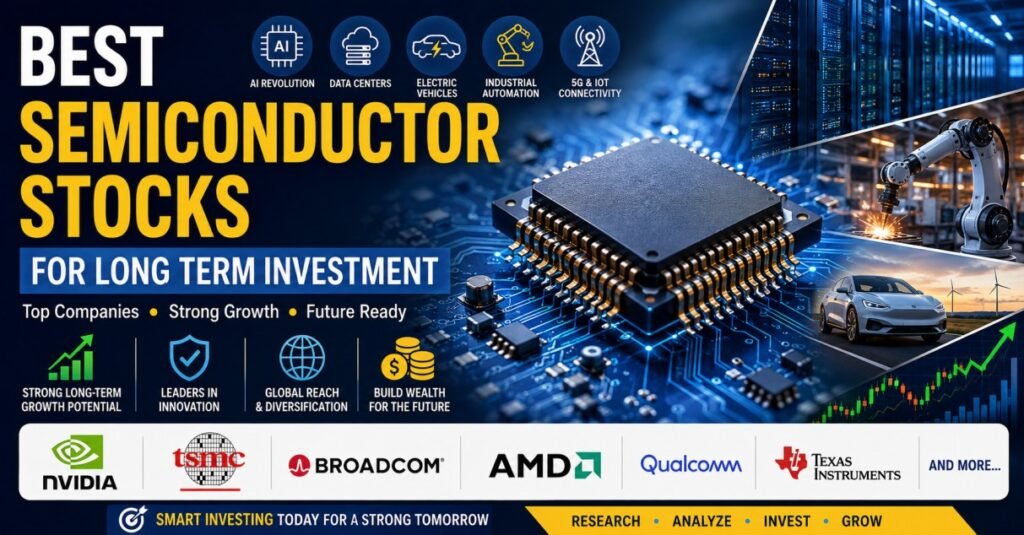
Semiconductors power almost every modern technology we use today. From smartphones and laptops to electric vehicles, artificial intelligence (AI), cloud computing, and advanced medical devices, semiconductor chips are the invisible engines behind digital innovation. As technology adoption accelerates worldwide, many investors are searching for the best semiconductor stocks for long term growth.
While semiconductor companies can experience periods of volatility due to economic cycles and changing demand, the industry’s long-term outlook remains promising. Increasing investments in AI infrastructure, data centers, autonomous vehicles, industrial automation, and 5G networks continue to drive demand for advanced chips.
For long-term investors, semiconductor stocks offer exposure to one of the world’s fastest-evolving industries. However, not every chip company is equally positioned for future success. Understanding the competitive landscape, technological leadership, financial strength, and industry risks is essential before making any investment decision.
In this guide, you’ll learn how the semiconductor industry works, what makes a strong long-term semiconductor investment, and which companies many investors closely watch for their innovation and market leadership.
Important: This article is for educational purposes only and should not be considered financial advice. Stock prices, financial metrics, and company fundamentals change over time. Always conduct your own research before investing.
For detailed information about Best Low Cost Mutual Funds for Beginners
Why Semiconductor Stocks Matter
The semiconductor industry has become one of the most important pillars of the global economy.
Nearly every digital device depends on semiconductor chips to process information, store data, and perform calculations. As technology becomes more integrated into everyday life, semiconductor demand continues to expand across multiple industries.
Some of the biggest long-term growth trends supporting semiconductor companies include:
- Artificial Intelligence (AI)
- Cloud computing
- High-performance computing
- Data centers
- Electric vehicles (EVs)
- Autonomous driving technology
- 5G infrastructure
- Internet of Things (IoT)
- Robotics
- Smart manufacturing
- Healthcare technology
- Consumer electronics
Instead of relying on one industry, semiconductor companies often supply chips to several sectors simultaneously, creating multiple growth opportunities over the coming decades.
For detailed information about NASDAQ Composite Index Explained for Beginners
What Are Semiconductor Stocks?
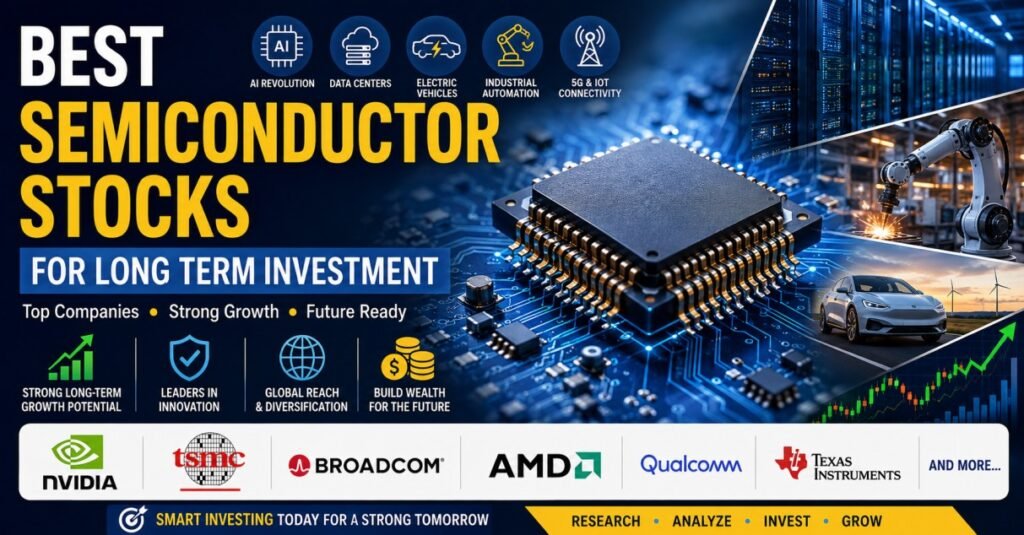
Semiconductor stocks represent publicly traded companies involved in designing, manufacturing, testing, or supplying semiconductor chips and related technologies.
These companies generally fall into several categories.
| Category | Description | Example Business Type |
|---|---|---|
| Chip Designers | Design processors and integrated circuits | AI chips, CPUs, GPUs |
| Manufacturers (Foundries) | Manufacture chips for other companies | Contract chip manufacturing |
| Memory Companies | Produce DRAM and NAND memory | Memory storage chips |
| Equipment Manufacturers | Build machines used to manufacture semiconductors | Lithography systems |
| Analog Chip Companies | Produce chips for industrial and automotive uses | Sensors and power management |
| Networking Chip Companies | Develop communication processors | Networking and data center chips |
Each segment plays a critical role in the semiconductor supply chain.
Why Are Semiconductor Stocks Popular for Long-Term Investors?
Several structural trends continue to support long-term growth.
1. Artificial Intelligence Expansion
AI applications require enormous computing power.
Training large AI models depends on advanced graphics processors, AI accelerators, high-speed networking equipment, and specialized memory chips.
As businesses continue investing in AI infrastructure, semiconductor demand is expected to remain strong.
2. Growth of Cloud Computing
Cloud providers continue building massive data centers around the world.
Every server requires processors, networking chips, storage controllers, and memory components, creating long-term demand for semiconductor manufacturers.
3. Electric Vehicles
Modern electric vehicles contain significantly more semiconductor content than traditional gasoline-powered cars.
Semiconductors help manage:
- Battery systems
- Safety features
- Autonomous driving
- Power management
- Infotainment
- Navigation
- Advanced driver assistance systems (ADAS)
As EV adoption grows, chip demand is likely to increase alongside it.
4. Internet of Things (IoT)
Billions of connected devices require processors and sensors.
Examples include:
- Smart home devices
- Industrial sensors
- Wearable technology
- Smart factories
- Agricultural equipment
- Healthcare monitoring devices
Each connected device adds incremental demand for semiconductor components.
5. Digital Transformation
Businesses continue investing in:
- Automation
- Robotics
- Machine learning
- Cybersecurity
- Industrial software
- Edge computing
All of these technologies rely heavily on semiconductor innovation.
Also know about T. Rowe Price Blue Chip Growth Fund Review
Characteristics of the Best Semiconductor Stocks for Long Term
Long-term investors often evaluate semiconductor companies using several key factors rather than focusing only on recent stock price performance.
Strong Competitive Advantage
Leading semiconductor companies often possess advantages such as:
- Proprietary technology
- Patent portfolios
- Strong customer relationships
- Manufacturing expertise
- High switching costs
- Significant research capabilities
These factors can help companies remain competitive over time.
Consistent Revenue Growth
Steady revenue growth over multiple years may indicate healthy demand and successful execution.
However, investors should remember that semiconductor revenue can fluctuate due to industry cycles.
Healthy Balance Sheet
Companies with manageable debt levels and strong cash reserves are generally better positioned to navigate economic downturns and continue investing in innovation.
Significant Research and Development (R&D)
Innovation drives the semiconductor industry.
Many leading companies invest billions of dollars each year in developing:
- Faster processors
- Energy-efficient chips
- Advanced manufacturing technologies
- AI accelerators
- New semiconductor architectures
Strong R&D spending can support long-term competitiveness.
Diversified Customer Base
Companies serving multiple industries may be less dependent on a single market segment.
Diversification across sectors such as automotive, enterprise computing, industrial automation, consumer electronics, and telecommunications can reduce business risk.
For detailed information about American EuroPacific Growth Fund Review
Comparison Table: Best Semiconductor Stocks for Long-Term Investors
Note: Market capitalization, financial metrics, and valuations change frequently. Verify the latest information from each company’s official investor relations page before making investment decisions.
| Company | Primary Business | Key Strength | Long-Term Growth Drivers | Risk Level |
|---|---|---|---|---|
| NVIDIA | AI GPUs & Accelerated Computing | AI leadership | AI, Data Centers, Robotics | High |
| Broadcom | Networking & Infrastructure Chips | Diversified revenue | AI networking, Enterprise software | Medium |
| Taiwan Semiconductor Manufacturing Company (TSMC) | Contract Chip Manufacturing | Advanced fabrication | Global chip production | Medium |
| Advanced Micro Devices (AMD) | CPUs & GPUs | High-performance computing | AI, Gaming, Data Centers | High |
| Qualcomm | Mobile & Wireless Chips | Wireless leadership | 5G, Automotive, IoT | Medium |
| Texas Instruments | Analog Semiconductors | Stable industrial demand | Automotive, Industrial | Medium-Low |
| ASML Holding | Semiconductor Manufacturing Equipment | EUV lithography monopoly | Global chip manufacturing expansion | Medium |
| Applied Materials | Semiconductor Equipment | Broad customer base | Advanced manufacturing | Medium |
| Micron Technology | Memory Chips | DRAM & NAND expertise | AI memory demand | High |
| Lam Research | Chip Manufacturing Equipment | Etching & deposition technology | Semiconductor fabrication growth | Medium |
For detailed information about JEPI Dividend Yield for Beginners
How to Evaluate Semiconductor Stocks Before Investing
Instead of investing based on headlines or recent price movements, consider evaluating companies using a structured approach:
Business Model
Understand how the company generates revenue and whether its products have long-term demand.
Competitive Position
Assess whether the company has durable advantages such as intellectual property, manufacturing expertise, or strong customer relationships.
Financial Health
Review revenue trends, profitability, cash flow, and debt levels through the company’s latest financial statements.
Industry Exposure
Determine which end markets the company serves, such as AI, automotive, consumer electronics, industrial automation, or communications.
Valuation
A high-quality company may still represent a poor investment if purchased at an excessively high valuation. Compare valuation metrics with peers and historical averages as part of your research.
For detailed information about BlackRock Mutual Funds for Beginners
Best Semiconductor Stocks for Long Term: Detailed Company Analysis
1. NVIDIA (NASDAQ: NVDA)
Company Overview
NVIDIA has evolved from a gaming graphics card company into one of the world’s leading AI computing businesses. Its Graphics Processing Units (GPUs) are widely used in artificial intelligence, cloud computing, machine learning, robotics, autonomous vehicles, and scientific research.
The company has become a key supplier to many of the largest cloud service providers, technology companies, and AI developers.
Why NVIDIA Is Considered One of the Best Semiconductor Stocks for Long Term
Several long-term trends support NVIDIA’s business:
- Leadership in AI accelerators
- Strong software ecosystem with CUDA
- Rapid expansion of AI data centers
- Growing enterprise AI adoption
- Increasing demand for high-performance computing (HPC)
- Strong partnerships with cloud providers
Unlike companies that only sell hardware, NVIDIA also benefits from its software platform, making it more difficult for customers to switch to competitors.
Major Growth Drivers
- Artificial Intelligence infrastructure
- Large Language Models (LLMs)
- Autonomous driving
- Robotics
- Digital twins
- Healthcare AI
- Cloud computing
- Edge AI
Potential Risks
- Premium valuation
- Increasing competition
- Export restrictions
- Dependence on AI spending
- Supply chain disruptions
Best Suited For
Long-term investors who believe AI adoption will continue expanding over the next decade and are comfortable with higher volatility.
2. Taiwan Semiconductor Manufacturing Company (NYSE: TSM)
Company Overview
Taiwan Semiconductor Manufacturing Company (TSMC) is the world’s largest dedicated semiconductor foundry. Instead of designing chips, it manufactures advanced semiconductors for many of the world’s leading technology companies.
Many well-known chip designers rely on TSMC’s manufacturing capabilities because producing advanced chips requires enormous expertise and capital investment.
Why TSMC Is a Long-Term Leader
TSMC plays a central role in the global semiconductor supply chain. As demand for advanced chips grows, the company benefits by manufacturing processors for multiple customers across different industries.
Its technological leadership in advanced fabrication processes has made it one of the industry’s most important companies.
Key Growth Drivers
- AI processors
- Smartphone chips
- Automotive semiconductors
- High-performance computing
- Cloud infrastructure
- Advanced manufacturing technologies
Potential Risks
- Geopolitical uncertainty
- Capital-intensive operations
- Customer concentration
- Semiconductor industry cycles
Best Suited For
Investors seeking exposure to the semiconductor manufacturing side of the industry rather than chip design.
3. Broadcom (NASDAQ: AVGO)
Company Overview
Broadcom is a diversified technology company that develops networking chips, broadband solutions, enterprise storage products, wireless components, and infrastructure software.
The company’s business model is less dependent on a single product category compared to many semiconductor companies.
Why Investors Like Broadcom
Broadcom benefits from several long-term technology trends:
- AI networking infrastructure
- Cloud computing
- Enterprise software
- Broadband expansion
- Data center growth
- Cybersecurity
Its acquisition strategy has also expanded its software business, helping diversify revenue beyond semiconductors.
Competitive Strengths
- Strong free cash flow
- Diversified revenue streams
- Long-term enterprise customers
- Leadership in networking chips
- Consistent innovation
Potential Risks
- Integration risks from acquisitions
- Enterprise spending slowdowns
- Technology competition
Best Suited For
Investors looking for a more diversified technology company with exposure to both semiconductor hardware and enterprise software.
4. Advanced Micro Devices (NASDAQ: AMD)
Company Overview
AMD designs CPUs, GPUs, and adaptive computing solutions for personal computers, gaming consoles, data centers, and AI workloads.
Over the past several years, the company has significantly expanded its presence in enterprise computing and cloud infrastructure.
Long-Term Growth Opportunities
AMD continues investing heavily in:
- AI accelerators
- Cloud computing
- Data center processors
- Gaming graphics
- Embedded computing
- Adaptive computing platforms
Its competitive product roadmap has helped it gain market share in several key markets.
Why Long-Term Investors Watch AMD
- Expanding AI product portfolio
- Growing enterprise business
- Diversified computing products
- Strong innovation pipeline
- Increasing cloud adoption
Risks
- Fierce competition
- Cyclical PC demand
- Execution risk
- Pricing pressure
Best Suited For
Growth-oriented investors willing to accept higher volatility in exchange for long-term growth potential.
5. Qualcomm (NASDAQ: QCOM)
Company Overview
Qualcomm is best known for its smartphone processors and wireless communication technologies. However, the company has increasingly diversified into automotive technology, Internet of Things (IoT), networking, and AI-enabled edge devices.
Its extensive portfolio of wireless patents also generates licensing revenue, providing an additional source of income.
Why Qualcomm Remains Relevant
Although smartphone growth has slowed in some markets, Qualcomm is expanding into several high-growth areas.
These include:
- Connected vehicles
- AI-powered edge computing
- Industrial IoT
- Smart factories
- Wearable technology
- Wi-Fi and networking solutions
Long-Term Growth Drivers
- 5G expansion
- Automotive platforms
- AI at the edge
- Industrial automation
- Connected consumer devices
Risks
- Smartphone market dependence
- Competitive pressures
- Regulatory scrutiny
- Global economic slowdowns
Best Suited For
Investors seeking exposure to wireless technology, automotive innovation, and connected devices.
For detailed information about Fidelity Investments Roth IRA for Beginners
Quick Comparison of the Top Five Semiconductor Stocks
| Company | Primary Business | Main Growth Driver | Dividend | Volatility | Suitable For |
|---|---|---|---|---|---|
| NVIDIA | AI GPUs | Artificial Intelligence | Limited | High | Growth investors |
| TSMC | Chip Manufacturing | Advanced fabrication | Yes | Medium | Core long-term holdings |
| Broadcom | Networking & Infrastructure | AI networking, Software | Yes | Medium | Growth + income investors |
| AMD | CPUs & GPUs | AI, Data Centers | No | High | Aggressive growth investors |
| Qualcomm | Wireless & Mobile Chips | 5G, Automotive, IoT | Yes | Medium | Diversified technology exposure |
Reminder: Dividend policies, yields, and company financials can change over time. Check the latest company announcements before making investment decisions.
What Makes These Companies Stand Out?
Although these businesses operate in different segments of the semiconductor ecosystem, they share several qualities that long-term investors often look for:
- Strong investment in research and development (R&D)
- Global customer bases
- Exposure to long-term technology trends
- Competitive products and intellectual property
- Significant roles in AI, cloud computing, automotive, or communications
- Ability to adapt as technology evolves
At the same time, no company is immune to industry downturns. Semiconductor demand can fluctuate due to economic conditions, inventory cycles, and changes in customer spending. Diversification and a long-term perspective remain important considerations.
Best Semiconductor Stocks for Long Term: More Top Picks and Investing Insights
6. Texas Instruments (NASDAQ: TXN)
Company Overview
Texas Instruments is one of the world’s largest manufacturers of analog and embedded processing semiconductors. Unlike companies focused primarily on AI or consumer electronics, Texas Instruments serves a wide range of industries, including automotive, industrial automation, healthcare, aerospace, and consumer products.
This diversified customer base has helped the company remain resilient through different economic cycles.
Why Texas Instruments Is a Strong Long-Term Stock
Texas Instruments focuses on products that often have long life cycles. Many industrial and automotive customers continue using the same chip designs for years, creating relatively stable demand.
The company is also known for generating strong free cash flow and returning capital to shareholders through dividends and share repurchases.
Key Growth Drivers
- Industrial automation
- Electric vehicles
- Factory robotics
- Renewable energy systems
- Medical devices
- Smart infrastructure
Potential Risks
- Slower growth compared to AI-focused companies
- Industrial spending cycles
- Global economic slowdowns
Best Suited For
Investors looking for a relatively stable semiconductor company with exposure to industrial and automotive markets.
7. ASML Holding (NASDAQ: ASML)
Company Overview
ASML Holding is not a chip manufacturer. Instead, it builds advanced lithography machines used to manufacture cutting-edge semiconductor chips.
Its Extreme Ultraviolet (EUV) lithography systems are considered essential for producing the most advanced processors used in AI, smartphones, and high-performance computing.
Because only a limited number of companies can produce this technology, ASML occupies a unique position in the semiconductor supply chain.
Why Long-Term Investors Watch ASML
Rather than competing with chip designers, ASML supplies equipment to many of the world’s largest semiconductor manufacturers.
As global chip production expands, demand for advanced manufacturing equipment may also increase.
Key Growth Drivers
- AI chip manufacturing
- Advanced semiconductor fabrication
- Smaller and more powerful processors
- Global expansion of semiconductor factories
- Government investments in chip manufacturing
Potential Risks
- Export restrictions
- Large capital expenditure cycles
- Dependence on major chip manufacturers
Best Suited For
Investors who want exposure to semiconductor manufacturing equipment rather than chip design.
8. Applied Materials (NASDAQ: AMAT)
Company Overview
Applied Materials develops equipment, software, and services used throughout the semiconductor manufacturing process.
Its technologies help manufacturers improve chip performance, efficiency, and production yields.
Why Applied Materials Is Important
As semiconductor manufacturing becomes more complex, chipmakers need increasingly sophisticated equipment.
Applied Materials benefits from this trend by serving leading foundries and integrated device manufacturers worldwide.
Growth Drivers
- AI infrastructure
- Advanced packaging
- Memory manufacturing
- Semiconductor process improvements
- Global fabrication capacity expansion
Risks
- Capital spending cycles
- Industry demand fluctuations
- Competitive equipment market
Best Suited For
Long-term investors seeking exposure to the “tools” behind semiconductor manufacturing.
9. Micron Technology (NASDAQ: MU)
Company Overview
Micron Technology specializes in memory and storage solutions, including DRAM and NAND flash memory.
These products are used in smartphones, data centers, gaming systems, enterprise servers, AI hardware, and automotive applications.
Memory demand tends to fluctuate more than some other semiconductor segments, making Micron more cyclical.
Long-Term Growth Opportunities
The rapid growth of AI workloads requires significantly more high-speed memory than traditional computing applications.
If AI adoption continues, demand for advanced memory products could remain an important long-term growth driver.
Growth Drivers
- AI servers
- Data centers
- Enterprise storage
- Automotive electronics
- Cloud computing
Potential Risks
- Memory price volatility
- Industry oversupply
- Economic downturns
- Inventory corrections
Best Suited For
Investors comfortable with higher business cycles who want exposure to memory technology.
10. Lam Research (NASDAQ: LRCX)
Company Overview
Lam Research manufactures equipment used in semiconductor fabrication, particularly for etching, deposition, and wafer processing.
Its equipment plays an important role in producing advanced semiconductor chips.
For detailed information about Dollar Cost Average Investing Strategy for Beginners
Why Investors Follow Lam Research
As chips become smaller and more complex, manufacturers require increasingly advanced production equipment.
Lam Research benefits when semiconductor companies expand manufacturing capacity or upgrade production technologies.
Key Growth Drivers
- Advanced semiconductor fabrication
- AI chip demand
- Memory production
- Expansion of fabrication plants
- Next-generation manufacturing technologies
Risks
- Semiconductor capital expenditure cycles
- Customer concentration
- Global trade restrictions
Best Suited For
Investors seeking indirect exposure to semiconductor growth through manufacturing equipment providers.
Also know about Capital Group American Funds: Complete Beginner’s Guide
Comparison Table: Top Semiconductor Stocks for Long-Term Investors
| Company | Business Focus | Main Growth Opportunity | Dividend | Risk Level |
|---|---|---|---|---|
| NVIDIA | AI GPUs | Artificial Intelligence | Limited | High |
| TSMC | Foundry | Advanced chip manufacturing | Yes | Medium |
| Broadcom | Networking & Software | AI infrastructure | Yes | Medium |
| AMD | CPUs & GPUs | Data centers and AI | No | High |
| Qualcomm | Wireless chips | 5G, Automotive, IoT | Yes | Medium |
| Texas Instruments | Analog chips | Industrial automation | Yes | Medium-Low |
| ASML | Lithography equipment | Advanced chip manufacturing | Yes | Medium |
| Applied Materials | Manufacturing equipment | Semiconductor expansion | Yes | Medium |
| Micron | Memory chips | AI memory demand | Yes | High |
| Lam Research | Fabrication equipment | Advanced manufacturing | Yes | Medium |
Reminder: Dividend policies, revenue, earnings, valuations, and business fundamentals may change over time. Review the latest annual reports, quarterly results, and investor presentations before investing.
Benefits of Investing in Semiconductor Stocks
Semiconductor companies can offer several advantages for long-term investors, although outcomes are never guaranteed.
1. Exposure to Powerful Technology Trends
The industry benefits from long-term developments such as:
- Artificial Intelligence
- Cloud computing
- Electric vehicles
- Robotics
- 5G networks
- Internet of Things (IoT)
These trends are expected to influence global technology spending for years to come.
2. High Innovation Potential
Leading semiconductor companies invest billions of dollars annually in research and development, helping them introduce new products and improve existing technologies.
3. Global Demand
Semiconductors are used across many industries and regions, providing diversified sources of demand.
4. Strong Competitive Advantages
Many established companies possess:
- Extensive patent portfolios
- Advanced manufacturing expertise
- Long-term customer relationships
- High barriers to entry
These factors can strengthen their competitive position over time.
Also know about Ave Maria Funds Review
Risks of Investing in Semiconductor Stocks
Despite attractive growth opportunities, investors should also understand the risks.
Cyclical Industry
Semiconductor demand can rise and fall depending on:
- Consumer spending
- Business investment
- Inventory levels
- Global economic conditions
High Valuations
Popular technology companies sometimes trade at premium valuations, increasing the risk of short-term price corrections.
Geopolitical Risks
Global semiconductor supply chains are affected by:
- Trade restrictions
- Export controls
- Regional tensions
- Manufacturing concentration
Rapid Technological Change
Innovation moves quickly. Companies that fail to keep pace with changing technologies may lose market share.
Pros and Cons
| Pros | Cons |
|---|---|
| Exposure to AI and future technologies | High volatility |
| Strong long-term growth potential | Cyclical earnings |
| Global demand across industries | Premium valuations |
| Continuous innovation | Geopolitical uncertainty |
| High barriers to entry for industry leaders | Competitive pressure |
Who Should Consider Semiconductor Stocks?
Semiconductor stocks may be suitable for investors who:
- Have a long-term investment horizon (typically five years or more)
- Can tolerate short-term market volatility
- Want exposure to technology and innovation
- Prefer diversified portfolios rather than relying on a single sector
- Regularly review their investments and financial goals
Who May Want to Avoid This Sector?
This sector may not be ideal for investors who:
- Need stable short-term returns
- Are uncomfortable with price fluctuations
- Have very short investment horizons
- Depend on their investments for immediate income
- Prefer lower-risk asset classes such as cash equivalents or certain fixed-income investments
Common Mistakes Investors Make
Avoiding these mistakes may help improve long-term decision-making:
Chasing Momentum
Buying a stock simply because it has recently risen sharply can increase risk if valuations become stretched.
Ignoring Diversification
Holding only semiconductor stocks may expose a portfolio to sector-specific downturns.
Focusing Only on Stock Price
A lower share price does not necessarily make a company a better value. Consider earnings, cash flow, competitive position, and valuation.
Overlooking Valuation
Even high-quality businesses can underperform if purchased at excessively high prices.
Reacting Emotionally
Semiconductor stocks can be volatile. Long-term investors often benefit from making decisions based on research rather than short-term market movements.
Practical Example
Imagine two investors each invest $10,000 in technology-related assets.
- Investor A places the entire amount in a single semiconductor stock.
- Investor B spreads the investment across several leading semiconductor companies and other technology sectors through a diversified portfolio.
If one company experiences unexpected challenges—such as production delays, increased competition, or weaker earnings—Investor B may be better positioned because the portfolio is not dependent on a single business.
This example illustrates why diversification is commonly recommended as a risk management strategy, even within high-growth industries.
For detailed information about Best REIT Stocks to Buy in the USA
Frequently Asked Questions (FAQs)
1. What are the best semiconductor stocks for long term investment?
There is no single “best” semiconductor stock for every investor. Companies frequently discussed by long-term investors include NVIDIA, Taiwan Semiconductor Manufacturing Company (TSMC), Broadcom, AMD, Qualcomm, Texas Instruments, ASML Holding, Applied Materials, Micron Technology, and Lam Research. Each operates in a different part of the semiconductor ecosystem and has unique opportunities and risks.
2. Why are semiconductor stocks considered good long-term investments?
Semiconductor companies benefit from long-term technology trends such as:
- Artificial Intelligence (AI)
- Cloud computing
- Data centers
- Electric vehicles
- Internet of Things (IoT)
- 5G networks
- Industrial automation
As these technologies continue to evolve, demand for advanced semiconductor chips may also increase. However, future growth is not guaranteed, and the industry remains cyclical.
3. Are semiconductor stocks risky?
Yes. Semiconductor stocks can be more volatile than many other sectors due to factors such as:
- Economic slowdowns
- Supply chain disruptions
- Geopolitical tensions
- Rapid technological changes
- Inventory cycles
- High market expectations
Investors should understand these risks before investing and ensure semiconductor exposure aligns with their overall financial goals.
4. Which semiconductor company is the market leader in AI chips?
NVIDIA is widely recognized for its leadership in AI-focused GPUs and accelerated computing platforms. That said, competition is increasing as other semiconductor companies invest in AI processors and related technologies.
Because the technology landscape changes rapidly, investors should monitor company announcements and industry developments regularly.
5. Should beginners invest in semiconductor stocks?
Beginners can consider semiconductor stocks after understanding the industry’s opportunities and risks.
Instead of focusing solely on recent stock performance, beginners may benefit from learning about:
- Business models
- Competitive advantages
- Financial health
- Industry trends
- Diversification
- Valuation
Some investors also choose diversified funds or ETFs to gain exposure to the semiconductor industry rather than investing in individual stocks.
6. Do semiconductor companies pay dividends?
Some semiconductor companies pay regular dividends, while others reinvest a larger portion of their profits into research, development, and expansion.
Dividend policies may change over time, so investors should verify the latest information on the company’s official investor relations website before making decisions.
7. How can I evaluate a semiconductor stock?
Some commonly used factors include:
- Revenue growth
- Profitability
- Free cash flow
- Balance sheet strength
- Research and development spending
- Competitive position
- Customer diversification
- Valuation metrics
- Long-term industry outlook
Reviewing annual reports, quarterly earnings, and SEC filings can provide valuable insights.
8. What is the biggest risk facing the semiconductor industry?
One of the largest risks is the industry’s cyclical nature. Demand can fluctuate significantly due to changing consumer spending, enterprise investment, and inventory levels.
Other important risks include geopolitical uncertainty, export restrictions, manufacturing disruptions, and rapid technological innovation that can quickly reshape competitive dynamics.
9. Is diversification important when investing in semiconductor stocks?
Yes. Even well-established semiconductor companies can experience periods of underperformance.
Diversifying across multiple companies, industries, or asset classes may help reduce portfolio-specific risk, although it does not eliminate the possibility of losses.
10. Where can investors find reliable information before investing?
Before making any investment decision, consider reviewing information from official sources such as:
- Company Investor Relations websites
- Annual reports (Form 10-K)
- Quarterly reports (Form 10-Q)
- SEC filings
- Earnings presentations
- Official press releases
These sources generally provide more reliable and up-to-date information than rumors or social media discussions.
Final Thoughts
Semiconductors sit at the heart of the modern digital economy. Whether it’s powering AI models, enabling cloud computing, supporting electric vehicles, or advancing industrial automation, semiconductor companies are helping shape the technologies of tomorrow.
For long-term investors, the sector offers exposure to some of the most exciting innovation trends in the global economy. Companies such as NVIDIA, TSMC, Broadcom, AMD, Qualcomm, Texas Instruments, ASML Holding, Applied Materials, Micron Technology, and Lam Research each play distinct roles within the semiconductor value chain. Rather than relying on a single business, understanding how these companies fit into the broader ecosystem can lead to more informed investment decisions.
At the same time, semiconductor investing requires patience and realistic expectations. The industry is known for periods of rapid growth followed by slower demand, making short-term price movements difficult to predict. Long-term investors often focus on business quality, competitive advantages, financial strength, innovation, and valuation instead of reacting to day-to-day market fluctuations.
No investment is risk-free. Before purchasing any stock, review the latest financial statements, earnings reports, and official company disclosures. Consider how semiconductor investments fit within your broader portfolio, risk tolerance, and long-term financial objectives.
Key Takeaways
- Semiconductors are essential to AI, cloud computing, data centers, electric vehicles, 5G, and industrial automation.
- The semiconductor industry includes chip designers, foundries, memory manufacturers, and equipment suppliers.
- NVIDIA, TSMC, Broadcom, AMD, Qualcomm, Texas Instruments, ASML Holding, Applied Materials, Micron Technology, and Lam Research are among the industry’s most closely followed companies.
- The sector offers attractive long-term growth potential but can experience significant short-term volatility.
- Diversification, disciplined investing, and regular portfolio reviews can help manage investment risk.
- Always verify the latest company financials, dividend policies, valuations, and industry developments before investing.
Author’s Note: I’ve been investing in mutual funds and stocks since 2018 and have practical experience in business and personal finance. While I’m not a licensed financial advisor or investment professional, I write educational content based on years of hands-on investing experience, business knowledge, extensive research, and reliable sources. My goal through theinvestorstory.com is to simplify investing, personal finance, business, and financial concepts so readers can make more informed financial decisions.
Disclaimer: The content provided is for educational and informational purposes only and should not be considered financial, investment, insurance, or legal advice.




Pingback: Best Healthcare Stocks to Buy for Long Term in 2026