

Last Updated on 29 May 2026
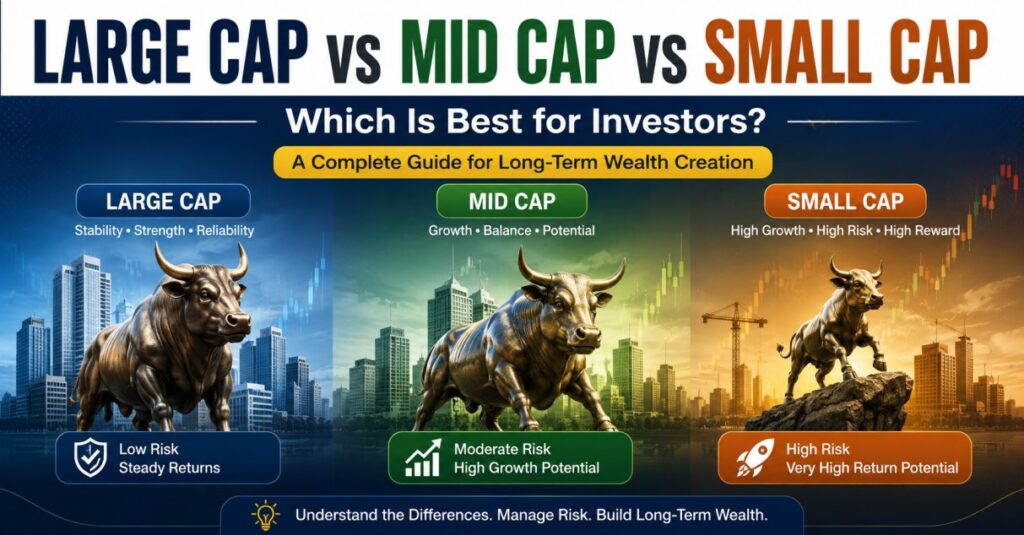
If you’ve recently started investing in the stock market or mutual funds, chances are you’ve heard terms like large cap, mid cap, and small cap everywhere. Large Cap vs Mid Cap vs Small Cap: Which Is Best for Investors? is one of the most common questions among beginners as well as experienced investors trying to build long-term wealth.
Financial influencers talk about them. Mutual fund ads highlight them. YouTube videos compare their returns. But for many investors, especially beginners, the real question remains:
Which is actually better for long-term wealth creation?
Should you invest in stable large cap companies? Fast-growing mid caps? Or high-risk, high-reward small caps?
The answer is not as simple as choosing the category with the highest recent returns. Smart long-term investing is more about balancing growth, risk, patience, and emotional discipline.
In this detailed guide, we’ll break down:
- What large cap, mid cap, and small cap stocks really mean
- Their differences in risk and returns
- Which category performs best in different market conditions
- How long-term investors should allocate money
- Common mistakes investors make
- Which category may suit your financial goals
By the end of this article, you’ll clearly understand where each category fits in your portfolio.
What Are Large Cap, Mid Cap, and Small Cap Stocks?
The terms large cap, mid cap, and small cap are based on a company’s market capitalization.
Market capitalization simply means:
Share Price × Total Number of Outstanding Shares
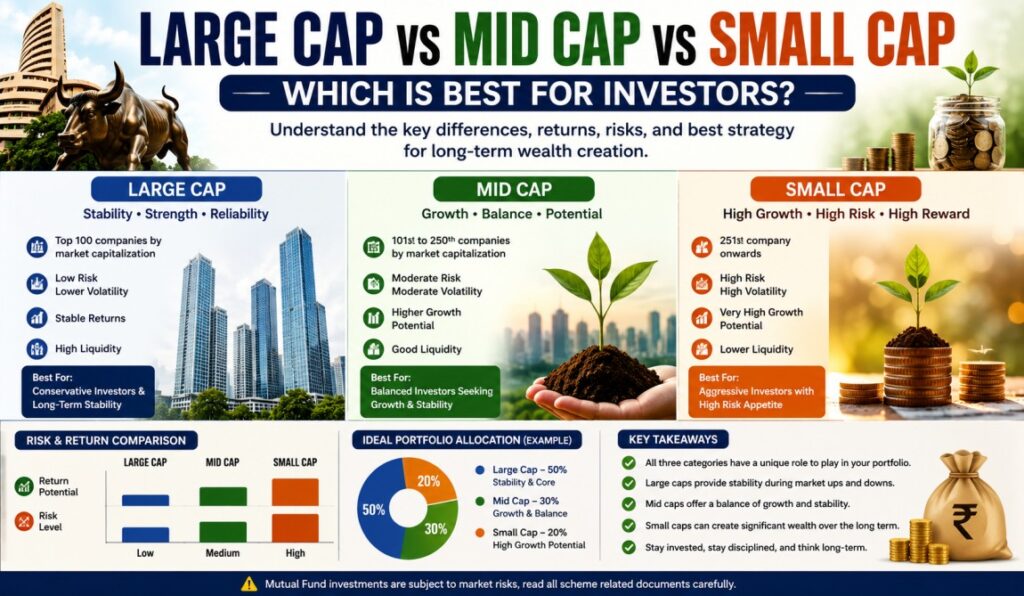
SEBI classifies companies into three categories:
| Category | SEBI Ranking |
|---|---|
| Large Cap | Top 100 companies |
| Mid Cap | 101st to 250th companies |
| Small Cap | 251st company onwards |
The ranking changes over time depending on company growth and market value.
What Are Large Cap Stocks?
Large cap companies are the biggest and most established businesses in the country.
Examples include companies from sectors like banking, IT, energy, FMCG, and telecom.
These companies usually:
- Have stable revenue and profits
- Operate for many years
- Are market leaders
- Have strong brand value
- Survive economic slowdowns better
Characteristics of Large Cap Stocks
1. Lower Risk
Large caps are generally less volatile compared to smaller companies.
2. Stable Growth
Returns may not be explosive, but they are often more consistent.
3. High Liquidity
These stocks are actively traded, making buying and selling easier.
4. Better for Conservative Investors
Ideal for investors seeking long-term wealth creation with lower stress.
Detailed information about Best Large Cap Mutual Funds for Long Term Investment in India 2026
What Are Mid Cap Stocks?
Mid cap companies are businesses that are still growing rapidly but have already crossed the early-stage phase.
They are often considered the “future large caps.”
These companies usually:
- Expand aggressively
- Grow profits faster
- Capture new market opportunities
- Offer higher growth potential
Characteristics of Mid Cap Stocks
1. Higher Growth Potential
Mid caps can grow faster than large caps over long periods.
2. Moderate Risk
They are more volatile than large caps but less risky than small caps.
3. Strong Wealth Creation Potential
Many multibagger stocks started as mid caps.
4. Suitable for Long-Term Investors
Especially attractive for investors with a 7-10 year horizon.
Detailed information about Best Mid Cap Mutual Funds to Invest in 2026 in India
What Are Small Cap Stocks?
Small cap companies are smaller businesses with relatively low market capitalization.
These companies may:
- Be in early growth stages
- Operate in niche sectors
- Expand rapidly
- Have huge upside potential
But they also come with significant risk.
Characteristics of Small Cap Stocks
1. Highest Growth Potential
Small caps can generate massive returns if the company succeeds.
2. High Volatility
Prices can rise or fall sharply within short periods.
3. Liquidity Risk
Buying and selling may become difficult during market panic.
4. Higher Failure Rate
Not all small companies survive long term.
Detailed information about Best Small Cap Mutual Funds for Long Term Investment in India 2026
Large Cap vs Mid Cap vs Small Cap: Quick Comparison
| Feature | Large Cap | Mid Cap | Small Cap |
| Risk | Low | Moderate | High |
| Return Potential | Moderate | High | Very High |
| Stability | High | Medium | Low |
| Volatility | Low | Medium | Very High |
| Liquidity | Excellent | Good | Moderate |
| Best For | Conservative investors | Balanced investors | Aggressive investors |
| Time Horizon | 5+ years | 7+ years | 10+ years |
Which Category Gives Better Returns?
This is where most investors become confused.
Historically:
- Small caps often deliver the highest returns during bull markets
- Mid caps usually outperform large caps over long periods
- Large caps provide more consistent and stable returns
However, higher returns always come with higher risk.
For example:
- During market crashes, small caps can fall 40–60%
- Mid caps may decline 30–45%
- Large caps usually fall less
This means many investors panic and sell small caps at the worst possible time.
The Real Problem Is Investor Psychology
Most investors think they can handle risk until the market actually crashes.
Seeing your portfolio down by 40% is emotionally painful.
This is why many investors:
- Buy small caps in bull markets
- Panic during corrections
- Exit at losses
- Miss long-term compounding
Large caps may not always generate the highest returns, but they are easier to hold during bad times.
And staying invested is one of the biggest secrets of long-term wealth creation.
Why Large Caps Are Important in Every Portfolio
Many investors underestimate the power of stability.
Large cap stocks:
- Protect portfolios during uncertainty
- Provide smoother returns
- Help investors stay disciplined
- Reduce emotional stress
For beginners, large caps are often the best starting point.
Even experienced investors usually keep a significant allocation to large caps because they act as the “foundation” of the portfolio.
Why Mid Caps Are Considered the Sweet Spot
Mid caps are often viewed as the best balance between:
- Growth potential
- Risk management
- Long-term compounding
These companies are already established but still have room to grow rapidly.
Many successful long-term investors prefer mid caps because:
- Growth can be faster than large caps
- Risks are manageable compared to small caps
- Businesses are more mature
For many investors, mid caps become the real wealth creators over time.
Why Small Caps Can Create Massive Wealth
Some of the biggest multibagger stocks in India started as small caps.
If a small company:
- Expands successfully
- Improves profitability
- Gains market share
Its stock price can rise dramatically over 10–15 years.
This is why small caps attract aggressive investors.
But there’s a catch.
Not all small companies succeed.
Some fail completely.
That’s why diversification becomes extremely important in small cap investing.
Large Cap vs Mid Cap vs Small Cap During Market Crashes
One of the biggest differences appears during bear markets.
| Category | Typical Behavior During Crashes |
| Large Cap | Falls less |
| Mid Cap | Falls more |
| Small Cap | Falls the most |
This matters because long-term investing is not only about returns.
It’s also about surviving difficult periods without quitting.
If you cannot emotionally tolerate volatility, aggressive small cap investing may not suit you.
Which Is Best for SIP Investors?
For SIP investors, all three categories can work well depending on risk tolerance.
Large Cap SIP
Best for:
- Beginners
- Conservative investors
- Stable long-term investing
Mid Cap SIP
Best for:
- Moderate risk investors
- Long-term wealth creation
- Higher growth goals
Small Cap SIP
Best for:
- Aggressive investors
- Very long investment horizons
- Investors comfortable with volatility
To calculate SIP Investment, you may use our SIP Calculator
Best Allocation Strategy for Long-Term Investors
Instead of choosing only one category, many experts recommend diversification.
Here’s a practical allocation example:
Conservative Investor
- 70% Large Cap
- 20% Mid Cap
- 10% Small Cap
Moderate Investor
- 50% Large Cap
- 35% Mid Cap
- 15% Small Cap
Aggressive Investor
- 35% Large Cap
- 40% Mid Cap
- 25% Small Cap
The ideal allocation depends on:
- Age
- Risk tolerance
- Financial goals
- Investment horizon
- Emotional discipline
Common Mistakes Investors Make
1. Chasing Recent Returns
Investors often buy whichever category performed best recently.
This usually leads to buying at high valuations.
2. Ignoring Risk Capacity
Many people overestimate their ability to handle volatility.
3. Investing Without Time Horizon
Small caps require patience.
Short-term investors may panic during corrections.
4. Lack of Diversification
Putting all money into one category increases portfolio risk.
Which Is Best for Beginners?
For beginners:
- Large caps are safest
- Mid caps offer balanced growth
- Small caps should be limited initially
A good starting strategy is:
- Build a strong large cap core
- Gradually add mid caps
- Add small caps only after understanding market volatility
Large Cap vs Mid Cap vs Small Cap Mutual Funds
If selecting individual stocks feels difficult, mutual funds can simplify investing.
Large Cap Funds
Focus on top 100 companies.
Mid Cap Funds
Invest mainly in mid-sized growth companies.
Small Cap Funds
Invest in smaller high-growth businesses.
Mutual funds provide:
- Professional management
- Diversification
- Easier investing experience
Which Category Is Best in 2026 and Beyond?
No one can predict short-term market performance consistently.
But India’s long-term economic growth may continue to support:
- Corporate earnings growth
- Rising consumption
- Digital expansion
- Infrastructure development
This creates opportunities across all market cap categories.
The key is not trying to predict the next winning category every year.
The key is remaining invested for long periods.
Final Verdict: Large Cap vs Mid Cap vs Small Cap
So, which is best for long-term investors?
Here’s the simplest answer:
- Large caps provide stability
- Mid caps provide balanced growth
- Small caps provide maximum upside potential
But the smartest portfolios usually contain a combination of all three.
For most investors:
- Large caps build the foundation
- Mid caps drive growth
- Small caps add aggressive upside
The “best” category is ultimately the one you can hold through market volatility without panic selling.
Because in long-term investing:
Consistency matters more than excitement.
Conclusion
Large cap, mid cap, and small cap investing are not competitors.
They are different tools designed for different purposes.
Successful long-term investing is about:
- Managing risk
- Staying disciplined
- Remaining patient
- Avoiding emotional decisions
If you can build a diversified portfolio aligned with your goals and continue investing consistently, all three categories can help create long-term wealth.
The stock market rewards patience far more than prediction.
Frequently Asked Questions (FAQs)
Which is safer: large cap or small cap?
Large cap stocks are generally safer and less volatile than small caps.
Can small caps make you rich?
Yes, small caps have high wealth creation potential, but they also carry high risk.
Are mid caps better than large caps?
Mid caps may offer higher growth potential, but they are more volatile.
Which is best for beginners?
Large caps are usually best for beginners due to lower volatility.
Should I invest in all three categories?
For many investors, a diversified allocation across all three categories works best.
Disclaimer: The content provided is for educational and informational purposes only and should not be considered financial, investment, insurance, or legal advice.




Pingback: Morningstar Rated Mutual Funds in India 2026 Complete Guide
Pingback: Mid Cap Mutual Fund SIP Plans ₹500, ₹1000 & ₹5000