


Last Updated on 25 May 2026
Investing in the stock market for the first time can feel confusing. Thousands of stocks, hundreds of mutual funds, market volatility, news headlines, and social media “experts” often make beginners overthink every decision. That is exactly why index funds have become one of the most recommended investment options for beginners. If you are searching for the best index funds for beginners in India, you are already moving in the right direction.
Index funds are simple, low-cost, diversified, and beginner-friendly. You do not need advanced stock market knowledge to start investing in them. Instead of trying to pick winning stocks, index funds simply track a market index like the Nifty 50 or Sensex.
Over the last few years, passive investing has grown rapidly in India because more investors now realize that consistently beating the market is extremely difficult, even for professional fund managers.
For beginners, this simplicity is a major advantage.
In this detailed guide, we will cover:
- What index funds are
- Why they are ideal for beginners
- Best index funds for beginners in India
- Nifty 50 vs Nifty Next 50
- Expense ratio and tracking error explained
- How to choose the right index fund
- SIP strategy for beginners
- Mistakes to avoid
- Frequently asked questions
By the end of this article, you will clearly understand how to start investing in index funds confidently.
What Are Index Funds?
Index funds are mutual funds that passively track a stock market index.
Instead of actively selecting stocks, the fund simply copies an index.
For example:
- A Nifty 50 index fund invests in the same 50 companies that are part of the Nifty 50 index.
- A Sensex index fund tracks the BSE Sensex.
- A Nifty Next 50 fund tracks the next 50 large companies after the Nifty 50.
This means the fund manager is not trying to “beat the market.”
The goal is simply to match the performance of the index.
That makes index funds:
- Low cost
- Transparent
- Easy to understand
- Less dependent on fund manager decisions
For beginners, these features make investing far less stressful.
Why Index Funds Are Best for Beginners
1. Simple to Understand
Many beginners struggle to understand complex mutual fund categories.
Index funds are straightforward.
If the Nifty 50 rises, your Nifty 50 index fund also rises.
You always know what you are investing in.
2. Low Expense Ratio
One of the biggest advantages of index funds is their low cost.
Since these funds simply track an index, they do not require expensive research teams or active stock picking.
Most good index funds in India have expense ratios between 0.15% to 0.35%.
This may seem like a small difference, but lower costs significantly improve long-term returns.
Example:
If you invest ₹10,000 monthly for 20 years:
| Expense Ratio | Approximate Final Value |
|---|---|
| 0.20% | Higher wealth creation |
| 1.50% | Lower due to higher fees |
Small costs compound massively over long periods.
3. Diversification
A Nifty 50 index fund gives exposure to India’s top 50 companies across sectors.
This reduces the risk of depending on a few individual stocks.
You automatically get exposure to sectors like:
- Banking
- IT
- FMCG
- Pharma
- Energy
- Automobile
- Telecom
Diversification is extremely important for beginners.
4. Lower Risk Compared to Stock Picking
Many beginners lose money because they:
- Chase trending stocks
- Buy based on tips
- Panic during market crashes
- Invest without research
Index funds reduce these mistakes because they follow the overall market.
Instead of worrying about one stock crashing, you participate in India’s long-term economic growth.
5. Great for Long-Term Wealth Creation
India’s economy continues to grow over time.
As businesses grow, stock markets also tend to grow in the long run.
Index funds allow beginners to participate in this growth without constantly tracking markets.
That is why legendary investor Warren Buffett has repeatedly recommended low-cost index funds for most investors.
Best Index Funds for Beginners in India
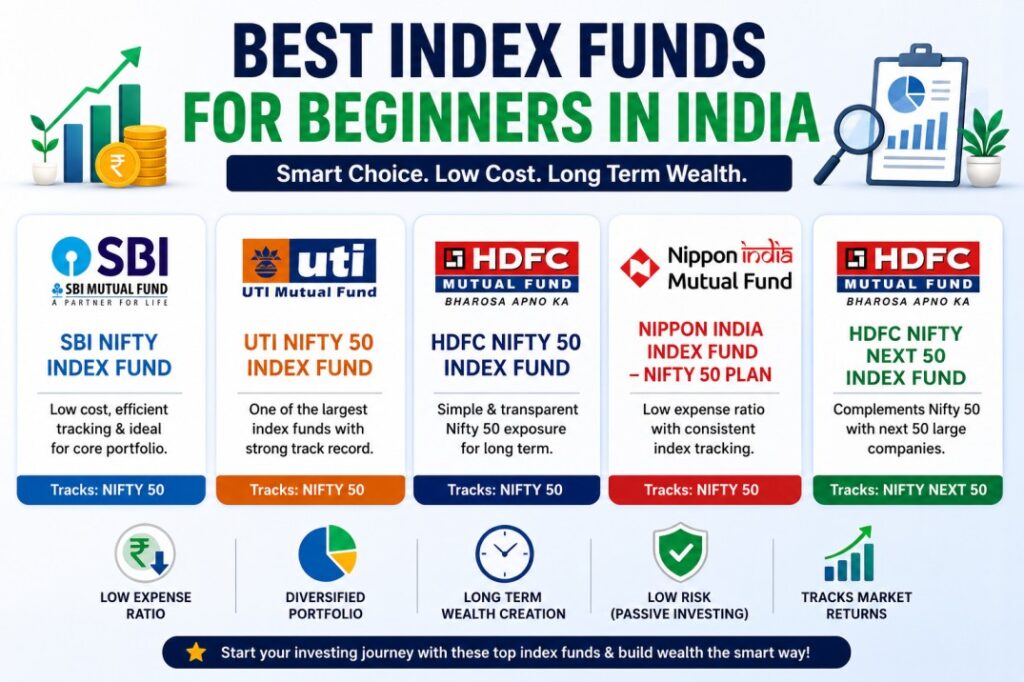
Here are some of the best beginner-friendly index funds in India.
1. UTI Nifty 50 Index Fund
Why Beginners Like It
UTI Nifty 50 Index Fund is one of the oldest and most trusted index funds in India.
It tracks the Nifty 50 and offers simple exposure to India’s top companies.
Key Features
- Tracks: Nifty 50 TRI
- Low expense ratio
- Large AUM
- Good liquidity
- Suitable for SIP investors
Best For
- First-time investors
- Long-term SIP investing
- Low-maintenance portfolios
2. SBI Nifty Index Fund
SBI is one of India’s largest mutual fund houses.
Its Nifty index fund is popular among beginner investors because of its simplicity and low cost.
Key Features
- Competitive expense ratio
- Easy SIP setup
- Strong brand trust
- Beginner friendly
Best For
- Conservative beginners
- Long-term investing
- Monthly SIPs
3. HDFC Nifty 50 Index Fund
HDFC Mutual Fund is known for strong fund management and investor trust.
Its Nifty 50 index fund is suitable for investors looking for stable large-cap exposure.
Key Features
- Broad diversification
- Passive investing strategy
- Good for core portfolio allocation
Best For
- Long-term wealth creation
- Passive investing beginners
4. Nippon India Index Fund – Nifty 50 Plan
This fund is another excellent option for beginners.
It provides direct exposure to India’s largest listed companies.
Key Features
- Tracks Nifty 50
- Low management cost
- Suitable for SIP investing
Best For
- Beginners starting with small SIPs
- Investors wanting simple market exposure
5. HDFC Nifty Next 50 Index Fund
This fund tracks the Nifty Next 50 index.
These are companies ranked just below the Nifty 50.
Compared to Nifty 50 funds, Nifty Next 50 funds may offer higher growth potential but also higher volatility.
Best For
- Young investors
- Aggressive beginners
- Long-term investing horizons
Nifty 50 vs Nifty Next 50: Which Is Better for Beginners?
This is one of the most common questions among new investors.
Nifty 50
The Nifty 50 contains India’s largest and most established companies.
Advantages
- More stable
- Lower volatility
- Better for beginners
- Easier to hold during market crashes
Suitable For
- Conservative investors
- First-time investors
- Long-term SIP investing
Nifty Next 50
The Nifty Next 50 includes the next 50 companies after the Nifty 50.
These companies are still large businesses but may grow faster.
Advantages
- Higher growth potential
- More aggressive returns possible
Disadvantages
- Higher volatility
- Bigger market swings
Suitable For
- Young investors
- Long investment horizon
- Investors comfortable with risk
For detailed information about best S&P 500 Index Fund in India
Best Strategy for Beginners
For most beginners:
Start With:
- Nifty 50 index fund
Later Add:
- Nifty Next 50 index fund
This creates a balanced and beginner-friendly portfolio.
Important Factors to Check Before Investing
Many beginners choose funds only based on returns.
That is a mistake.
Here are the important things to check.
1. Expense Ratio
Expense ratio is the annual fee charged by the fund.
Lower is usually better for index funds.
Since index funds simply track an index, there is no reason to pay very high fees.
Ideal Range
- Below 0.40%
2. Tracking Error
Tracking error shows how closely the fund follows its benchmark index.
Lower tracking error means better performance consistency.
Lower Tracking Error = Better Index Fund
3. AUM (Assets Under Management)
AUM represents the total money invested in the fund.
A larger AUM generally indicates:
- Higher investor trust
- Better liquidity
- Stable operations
However, AUM alone should not decide your investment.
4. Fund House Reputation
Choose trusted AMC brands.
Examples:
- SBI Mutual Fund
- UTI Mutual Fund
- HDFC Mutual Fund
- ICICI Prudential Mutual Fund
- Nippon India Mutual Fund
5. Direct vs Regular Plan
Always prefer:
Direct Plan
Why?
Because direct plans have lower expense ratios.
That means better long-term returns.
How Beginners Can Start Investing in Index Funds
Starting an index fund SIP is easier than many people think.
Step 1: Complete KYC
You can complete KYC online using:
- PAN card
- Aadhaar card
- Mobile number
Step 2: Choose a Platform
Popular platforms include:
- Groww
- Zerodha
- Paytm Money
- Kuvera
- AMC websites
Step 3: Select a Nifty 50 Index Fund
For beginners, one good Nifty 50 fund is enough.
Avoid over-diversification initially.
Step 4: Start SIP
Even ₹500 monthly is enough to begin.
Consistency matters more than amount.
Step 5: Stay Invested
This is the most important step.
Do not panic during market corrections.
Long-term investing rewards patience.
SIP vs Lump Sum: Which Is Better for Beginners?
SIP (Systematic Investment Plan)
Investing a fixed amount regularly.
Advantages
- Reduces timing risk
- Builds discipline
- Beginner friendly
- Easier during volatile markets
Best For
- Salaried individuals
- First-time investors
- Long-term wealth creation
Lump Sum Investing
This means investing a large amount at once.
Best For
- Experienced investors
- Investors with market understanding
For most beginners, SIP is the better option.
Common Mistakes Beginners Should Avoid
1. Chasing High Returns
Do not select funds only because they recently gave high returns.
Past performance does not guarantee future returns.
2. Investing in Too Many Funds
Many beginners buy:
- 5 index funds
- 6 mutual funds
- Multiple overlapping portfolios
This creates confusion.
One or two index funds are enough initially.
3. Panic Selling During Market Crashes
Markets will fall occasionally.
That is normal.
Long-term investors benefit by continuing SIPs during corrections.
4. Ignoring Expense Ratio
High fees reduce long-term wealth.
Always compare expense ratios.
5. Expecting Quick Returns
Index funds are not a get-rich-quick scheme.
They work best over:
- 10 years
- 15 years
- 20 years
Patience is the real advantage.
How Much Should Beginners Invest?
There is no perfect amount.
Start with what you can comfortably continue.
Good Starting SIP Amounts
| Investor Type | Suggested SIP |
|---|---|
| College Student | ₹500 – ₹1,000 |
| Salaried Beginner | ₹2,000 – ₹5,000 |
| Experienced Earner | ₹10,000+ |
The key is consistency.
Increasing SIP yearly can significantly improve wealth creation.
Are Index Funds Safe?
Index funds are market-linked investments.
They are not risk-free.
However, compared to:
- Individual stocks
- Penny stocks
- Intraday trading
- Crypto speculation
Index funds are generally safer because of diversification.
For long-term investing, they are considered one of the most beginner-friendly equity investment options.
Best Index Fund Strategy for Beginners
If you are completely new to investing, keep things simple.
Simple Beginner Portfolio
Option 1
- 100% Nifty 50 Index Fund
Option 2
- 70% Nifty 50
- 30% Nifty Next 50
That is more than enough for most beginners.
Avoid unnecessary complexity.
Why Passive Investing Is Growing in India
Passive investing is becoming popular because:
- Lower costs
- Simplicity
- Consistent market returns
- Transparency
- Difficulty in beating benchmarks consistently
More investors now prefer low-cost wealth creation strategies instead of constantly chasing market trends.
This trend is likely to continue over the next decade.
Frequently Asked Questions (FAQs)
Which is the best index fund for beginners in India?
UTI Nifty 50 Index Fund, SBI Nifty Index Fund, and HDFC Nifty 50 Index Fund are among the best beginner-friendly options.
Can beginners invest in index funds?
Yes.
Index funds are considered one of the easiest and safest ways for beginners to start equity investing.
Is SIP good for index funds?
Yes.
SIP is one of the best ways to invest in index funds because it builds discipline and reduces market timing risk.
How long should I stay invested?
For best results, stay invested for at least 7–10 years.
Longer investment horizons generally improve compounding benefits.
Can index funds beat active funds?
Many active funds fail to consistently beat benchmark indices after costs.
That is one reason passive investing is growing rapidly.
Final Thoughts
Choosing the best index funds for beginners in India does not have to be complicated.
The biggest advantage of index investing is simplicity.
You do not need to predict markets, constantly track stocks, or follow daily financial news.
Instead, you can focus on:
- Regular SIP investing
- Long-term discipline
- Low costs
- Staying invested
For most beginners, a simple Nifty 50 index fund is enough to start building wealth.
Over time, consistency matters far more than trying to find the “perfect” fund.
The earlier you begin, the more powerful compounding becomes.
So instead of waiting for the perfect market condition, the best time to start investing is usually now.
Disclaimer: The content provided is for educational and informational purposes only and should not be considered financial, investment, insurance, or legal advice.




Pingback: Index Funds vs Mutual Funds: Which Is Better for Beginners?
Pingback: Best S&P 500 Index Fund in India (2026) - Top Funds Compared
Pingback: 5000 SIP for Ten Years: Returns, Calculator, Wealth Creation Guide
Pingback: Best Growth Stock Mutual Funds in India 2026 : Top Funds
Pingback: ₹500 Monthly SIP in Nifty 50 Index Fund Returns: To create wealth