


Last Updated on 1 April 2026
Introduction
If you’re looking to diversify beyond developed markets like the U.S. and Europe, emerging markets can be a powerful addition to your portfolio. But here’s the reality – they’re volatile, unpredictable, and often misunderstood.
That’s exactly where the best emerging market value ETFs come into play.
Instead of chasing hype or overvalued growth stocks, value ETFs focus on fundamentally strong companies that are trading below their intrinsic value. Over time, this strategy has proven effective, especially in emerging markets where inefficiencies are more common.
In this guide, we’ll break down the top emerging market value ETFs, compare them side by side, and help you choose the right one for long-term investment.
Why Invest in Emerging Market Value ETFs?
Before jumping into specific ETFs, let’s understand why this category deserves a place in your portfolio.
1. Higher Growth Potential
Emerging economies such as India, China, Brazil, and Indonesia are growing faster than developed markets. This growth can translate into higher long-term returns for investors.
2. Attractive Valuations
Emerging market stocks often trade at lower valuations compared to developed markets. This creates opportunities for value investors to buy quality assets at discounted prices.
3. Diversification Benefits
Investing in emerging markets reduces dependence on a single economy and spreads risk across multiple regions.
4. Market Inefficiencies
These markets are less efficient, meaning pricing errors are more common – which creates opportunities for value-focused strategies.
Best Emerging Market Value ETFs (Top Picks)
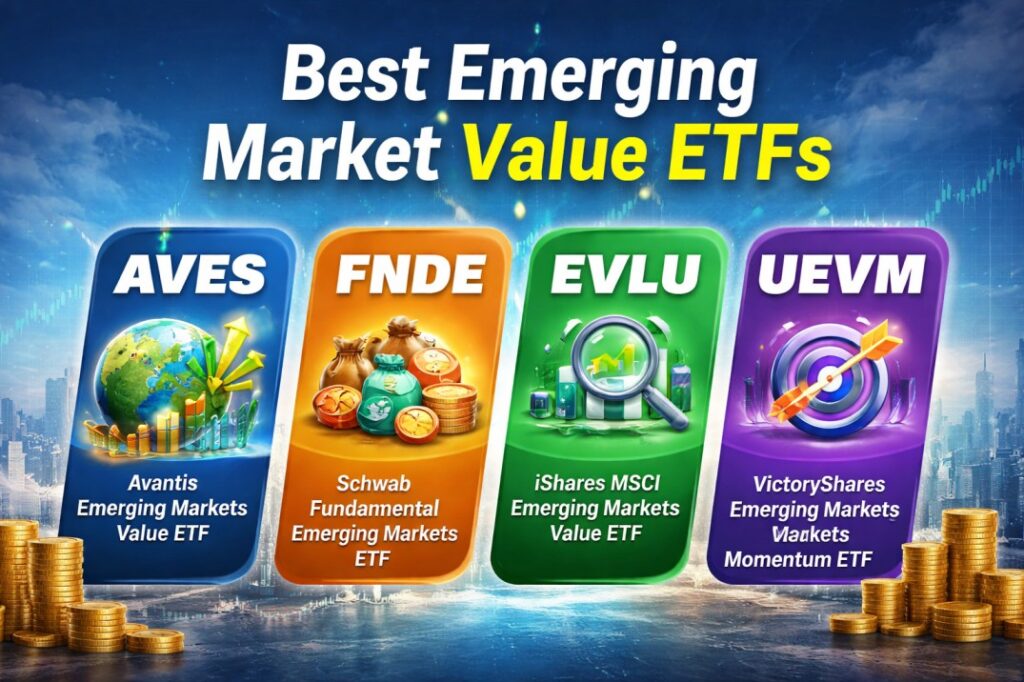
Below are some of the best emerging market value ETFs you can consider for long-term investing.
1. AVES – Avantis Emerging Markets Value ETF
Overview:
- Expense Ratio: 0.36%
- Holdings: 1,700+
- Strategy: Active value investing
- Best For: Long-term core holding
AVES is one of the most well-rounded emerging market value ETFs available today. It uses a data-driven approach to identify undervalued companies with strong fundamentals and profitability.
Key Advantages:
- Highly diversified across countries and sectors
- Strong focus on value + profitability
- Lower risk of value traps
Verdict:
Ideal for investors who want a balanced and long-term emerging markets value ETF.
2. FNDE – Schwab Fundamental Emerging Markets Equity ETF
Overview:
- Expense Ratio: 0.39%
- Assets: $8B+
- Strategy: Fundamental weighting
- Best For: Stability and liquidity
FNDE uses a unique approach by weighting companies based on fundamental factors like revenue, cash flow, and dividends instead of market capitalization.
Key Advantages:
- Large asset base ensures liquidity
- Strong exposure to value and income stocks
- More stable compared to pure value ETFs
Verdict:
A great choice for investors who prefer consistency and reliability.
3. EVLU – iShares MSCI Emerging Markets Value Factor ETF
Overview:
- Expense Ratio: 0.35%
- Holdings: ~275
- Strategy: Pure value factor
- Best For: Factor-focused investors
EVLU targets stocks with strong value characteristics based on traditional valuation metrics such as P/E and P/B ratios.
Key Advantages:
- Clear and transparent methodology
- Strong value tilt
- Backed by a reputable issuer
Limitations:
- Smaller fund size
- Less diversification
Verdict:
Best suited for investors seeking pure value exposure.
4. UEVM – VictoryShares Emerging Markets Value Momentum ETF
Overview:
- Expense Ratio: 0.45%
- Holdings: ~190
- Strategy: Value + momentum
- Best For: Multi-factor investing
UEVM combines value investing with momentum and volatility controls to improve risk-adjusted returns.
Key Advantages:
- Reduces risk of value traps
- Balanced portfolio approach
- Lower volatility strategy
Verdict:
Ideal for investors who want a smarter, diversified factor strategy.
Side-by-Side Comparison
| ETF | Strategy | Expense Ratio | Diversification | Risk Level | Best For |
|---|---|---|---|---|---|
| AVES | Active Value | 0.36% | Very High | Medium | Core long-term holding |
| FNDE | Fundamental | 0.39% | High | Medium-Low | Stability & liquidity |
| EVLU | Pure Value | 0.35% | Medium | High | Factor investing |
| UEVM | Value + Momentum | 0.45% | Medium | Medium | Multi-factor strategy |
Key Insights Most Investors Miss
1. Value Doesn’t Mean Old Companies
In emerging markets, even technology companies can be undervalued. Value investing here is broader than just banks and energy stocks.
2. Diversification is Critical
Emerging markets are influenced by:
- Political changes
- Currency fluctuations
- Commodity cycles
A diversified ETF reduces these risks significantly.
3. Expense Ratio Isn’t the Only Factor
Low fees are good, but:
- Strategy matters more
- Fund structure matters more
- Liquidity matters more
Always look beyond expense ratios.
4. Small ETFs Can Be Risky
Smaller funds may face:
- Low trading volume
- Higher spreads
- Risk of closure
This is an important consideration for long-term investors.
Risks of Emerging Market Value ETFs
Before investing, understand the risks involved:
- High volatility
- Currency fluctuations
- Political instability
- Regulatory uncertainty
- Lower transparency
These ETFs are best suited for long-term investors (5-10 years or more).
How to Choose the Right ETF
Use this simple decision guide:
Select AVES if:
- You want broad exposure
- You prefer a long-term core ETF
- You value diversification
FNDE if:
- You want stability
- You prefer fundamental investing
- You need liquidity
EVLU if:
- You want pure value investing
- You believe in factor strategies
UEVM if:
- You want a balanced approach
- You prefer lower volatility
- You like multi-factor investing
Suggested Portfolio Allocation
Instead of investing all your money in one ETF, consider diversification:
- 60% Developed Markets
- 20–30% Emerging Markets
- 10–20% Emerging Market Value ETFs
This helps balance risk and return.
Final Thoughts
The best emerging market value ETFs are powerful tools for long-term wealth creation – but only if used wisely.
Each ETF serves a different purpose:
- AVES → Best overall
- FNDE → Most stable
- EVLU → Pure value
- UEVM → Smart hybrid
The key is not timing the market but staying invested through volatility.
Disclaimer: The content provided is for educational and informational purposes only and should not be considered financial, investment, insurance, or legal advice.




Pingback: How to Invest in Small Cap World Fund (Step-by-Step Guide 2026)
Pingback: Best Motilal Oswal ETF to Buy in 2026 - Top ETFs Comparison
Pingback: ETF vs Index Fund Which is Better in India? Complete Guide