
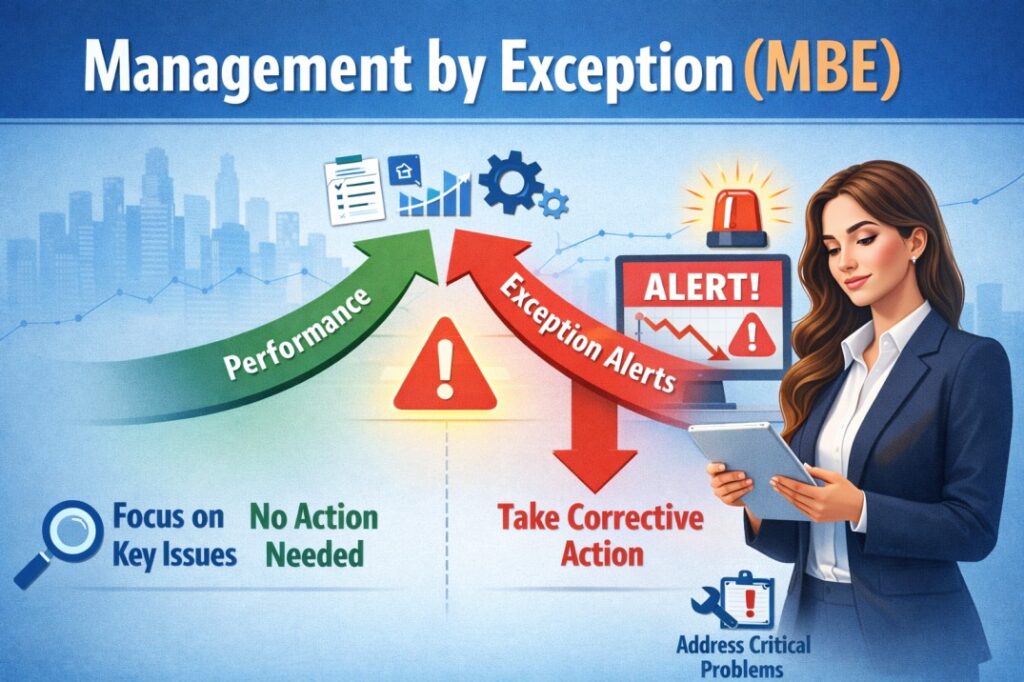

Last Updated on 9 July 2026
Introduction
Every business generates a massive amount of information every day—from sales reports and customer feedback to inventory updates and financial performance. If managers tried to monitor every small detail, they would spend more time reviewing routine activities than making strategic decisions.
This is where Management by Exception (MBE) becomes valuable. Instead of focusing on everything, MBE encourages managers to pay attention only to situations that fall outside predefined standards or expectations. Routine operations continue without interference, while unusual events, significant deviations, or critical problems are escalated for managerial review.
Whether you’re managing a small startup or a multinational corporation, this approach can improve efficiency, save time, and allow leaders to focus on high-impact decisions. However, like any management style, it also has limitations that organizations should understand before implementing it.
In this guide, you’ll learn the meaning of Management by Exception (MBE), how the Management by Exception process works, its principles, benefits, practical applications, and why it remains a widely used management technique across industries.
To know more details about Top Companies With High Market Cap
Why Management by Exception (MBE) Matters
Modern businesses operate in environments where decisions often need to be made quickly. Managers are expected to oversee teams, monitor financial performance, satisfy customers, and identify risks—all at the same time.
Trying to supervise every task personally can lead to:
- Information overload
- Slow decision-making
- Reduced productivity
- Employee micromanagement
- Poor strategic focus
Management by Exception solves these problems by allowing employees to manage routine operations independently while ensuring managers step in only when necessary.
This approach is especially relevant today because many organizations use automation, dashboards, and real-time reporting systems that can instantly alert managers when performance deviates from expected levels.
For detailed information about How the European Investment Fund Supports Startups and SMEs
What is Management by Exception (MBE)?
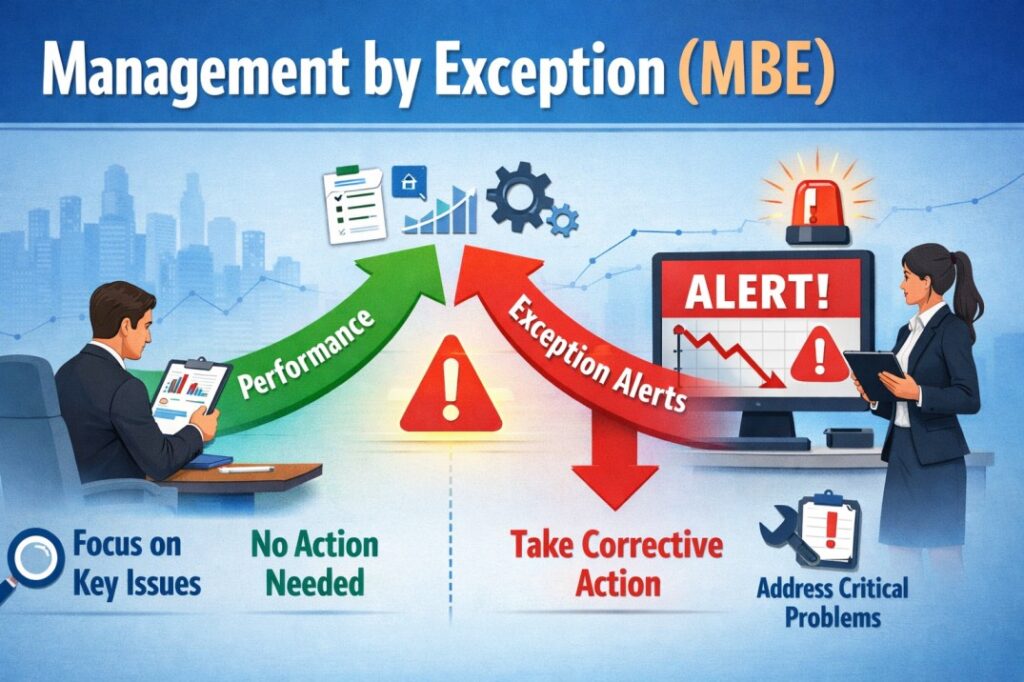
Management by Exception (MBE) is a management principle in which managers intervene only when actual performance differs significantly from planned or expected performance.
Instead of reviewing every activity, managers establish performance standards and allow employees to handle routine work independently. Only when results exceed acceptable limits—or fall below expected standards—does management become involved.
In simple terms:
“If everything is operating normally, employees continue working without intervention. If something unusual happens, managers step in.”
The philosophy behind MBE is straightforward: managerial attention is a limited resource and should be directed toward issues that truly require decision-making.
Simple Definition
Management by Exception is a management system that focuses management attention on important problems rather than routine activities.
Example
Imagine a retail company sets a target that daily sales should remain between $45,000 and $55,000.
Normal Situation
Daily sales:
- Monday: $48,500
- Tuesday: $50,100
- Wednesday: $47,900
Since sales remain within the acceptable range, store employees continue regular operations without management intervention.
Exception
On Thursday, sales suddenly drop to $29,000.
The reporting system automatically flags the issue, notifying the regional manager. The manager investigates and discovers that:
- The payment system experienced technical problems.
- A promotional campaign failed.
- Inventory shortages affected key products.
Instead of reviewing every day’s sales manually, management focuses only on the abnormal situation.
This illustrates how MBE saves time while improving decision quality.
For more information about Step by Step Guide to Getting a Chick-fil-A Franchise
Understanding the Management by Exception Process
The Management by Exception process follows a structured sequence designed to ensure managers concentrate only on significant deviations.
Step 1: Establish Clear Performance Standards
Every organization begins by defining measurable objectives.
Examples include:
- Monthly revenue targets
- Production output
- Customer satisfaction scores
- Budget limits
- Project completion deadlines
- Employee productivity goals
Without clear benchmarks, it becomes impossible to identify exceptions.
Step 2: Delegate Routine Responsibilities
Employees receive authority to handle everyday operations within established guidelines.
Managers avoid unnecessary interference, encouraging employees to solve routine problems independently.
This delegation:
- Builds accountability
- Improves employee confidence
- Reduces micromanagement
- Speeds up daily operations
Step 3: Monitor Performance
Organizations continuously collect operational data using:
- Performance dashboards
- Financial reports
- ERP systems
- CRM software
- KPI tracking tools
- Internal reporting systems
Modern businesses often automate this monitoring process.
Step 4: Identify Exceptions
When actual performance moves outside predefined acceptable limits, the system flags an exception.
Exceptions may include:
- Sales decline beyond acceptable levels
- Budget overruns
- Production delays
- Quality defects
- Customer complaint spikes
- Inventory shortages
Only these situations require management review.
Step 5: Analyze the Root Cause
Managers investigate the underlying reason behind the deviation.
Typical questions include:
- What caused the problem?
- Is it temporary or permanent?
- Does it require immediate action?
- Who is responsible?
- What business impact could occur?
Root cause analysis prevents managers from treating symptoms instead of solving actual problems.
Step 6: Take Corrective Action
Once the issue is understood, management decides on appropriate corrective measures.
Examples include:
- Revising production schedules
- Increasing inventory
- Providing employee training
- Updating operational procedures
- Adjusting budgets
- Improving customer service
Step 7: Review and Improve Standards
Business conditions change over time.
Organizations periodically evaluate whether existing standards remain realistic and update them when necessary.
Continuous improvement ensures MBE remains effective as the business evolves.
More details about How a Business Coach Helps Entrepreneurs Grow Faster, Smarter, and With Less Stress
Flow of the Management by Exception Process
| Step | Description | Primary Objective |
|---|---|---|
| Set Standards | Define measurable goals | Establish expectations |
| Delegate Work | Employees manage routine tasks | Increase efficiency |
| Monitor Results | Track performance continuously | Detect deviations |
| Identify Exceptions | Compare actual vs expected results | Highlight significant issues |
| Investigate | Analyze root causes | Understand the problem |
| Take Action | Implement corrective measures | Restore performance |
| Review Standards | Update goals when needed | Improve future performance |
Core Principles of Management by Exception
Although every organization applies MBE differently, the concept is built on several core principles.
1. Focus on Significant Deviations
Managers should not spend time reviewing every routine activity.
Instead, they concentrate on issues that could materially affect business performance.
Examples include:
- Large cost overruns
- Revenue declines
- Quality failures
- Safety incidents
- Compliance violations
2. Empower Employees
MBE assumes employees are capable of handling routine responsibilities without constant supervision.
This creates:
- Higher ownership
- Faster execution
- Better morale
- Increased confidence
Employees become problem-solvers rather than simply following instructions.
3. Use Objective Performance Standards
Performance should be evaluated using measurable criteria instead of personal opinions.
Common metrics include:
- Revenue
- Profit margins
- Customer satisfaction
- Delivery times
- Defect rates
- Budget variance
Objective standards reduce bias and improve consistency.
4. Efficient Use of Management Time
Senior managers typically have limited time and multiple responsibilities.
MBE helps them prioritize:
- Strategic planning
- Risk management
- Business growth
- Innovation
- Major operational issues
Instead of becoming involved in everyday administrative tasks.
5. Continuous Monitoring
MBE is not a “set it and forget it” system.
Organizations continuously monitor performance to ensure emerging issues are identified promptly before they become larger problems.
Information abut Setting Up a Limited Company Step by Step
Management by Exception (MBE) vs Traditional Management
| Feature | Management by Exception (MBE) | Traditional Management |
|---|---|---|
| Manager Involvement | Only for significant deviations | Continuous supervision |
| Employee Autonomy | High | Lower |
| Decision-Making | Focused on exceptions | Involved in routine decisions |
| Time Efficiency | High | Moderate to Low |
| Micromanagement | Minimal | More common |
| Performance Monitoring | Exception-based | Constant review |
| Suitable For | Large organizations, automated systems, performance-driven teams | Small teams, new employees, highly regulated environments |
| Manager Focus | Strategic issues | Daily operational activities |
Why Many Modern Businesses Prefer MBE
As organizations grow, managers can no longer personally oversee every employee or every process. Advances in business intelligence tools, automation, and real-time analytics make it easier than ever to identify exceptions quickly.
By filtering out routine information, MBE allows leaders to spend more time on activities that create long-term value, such as strategic planning, innovation, risk management, and customer experience. At the same time, employees gain greater ownership of their day-to-day responsibilities, often leading to faster execution and stronger accountability.
Advantages of Management by Exception (MBE)
When implemented correctly, Management by Exception (MBE) can significantly improve organizational efficiency. Instead of spreading management attention across every activity, it ensures leaders focus on areas that have the greatest impact on business performance.
Here are some of the key advantages.
1. Better Use of Management Time
One of the biggest benefits of MBE is that managers spend less time reviewing routine operations.
Rather than checking every report, approving every small decision, or monitoring every employee activity, managers focus only on significant issues that require their expertise.
This allows them to dedicate more time to:
- Strategic planning
- Business expansion
- Customer relationships
- Innovation
- Risk management
- Team development
As a result, management becomes more productive and effective.
2. Reduces Micromanagement
Employees often perform better when they have the freedom to make routine decisions.
MBE encourages managers to avoid unnecessary interference, giving employees greater ownership of their responsibilities.
This creates several positive outcomes:
- Higher employee confidence
- Greater accountability
- Faster problem-solving
- Improved workplace morale
- Stronger decision-making skills
Employees feel trusted rather than constantly monitored.
3. Faster Decision-Making
Since managers deal only with exceptions, they can respond more quickly to critical issues.
For example, instead of reviewing 100 routine transactions, a manager may only investigate the two transactions that exceed predefined limits.
This prioritization helps organizations react faster during:
- Budget overruns
- Equipment failures
- Customer complaints
- Supply chain disruptions
- Revenue declines
4. Improves Operational Efficiency
Routine work continues without waiting for managerial approval.
Employees can complete tasks within established guidelines, reducing delays and improving workflow.
This is particularly beneficial in industries where quick decisions are essential, such as retail, manufacturing, logistics, and customer service.
5. Encourages Accountability
Under MBE, employees understand that routine decisions are their responsibility.
Managers step in only when performance falls outside acceptable limits.
This encourages employees to:
- Take ownership of their work
- Solve problems independently
- Improve productivity
- Develop leadership skills
Over time, organizations build stronger and more capable teams.
6. Helps Identify Major Problems Early
Modern reporting systems can automatically detect unusual performance patterns.
Examples include:
- Sudden decline in sales
- Unexpected increase in production costs
- Inventory shortages
- Rising customer complaints
- Missed project deadlines
By highlighting these exceptions, managers can investigate problems before they become more serious.
7. Supports Data-Driven Decision Making
MBE relies on measurable performance indicators rather than assumptions.
Managers make decisions using objective data such as:
- Revenue
- Profit margins
- Customer satisfaction scores
- Production output
- Budget variance
- Employee productivity
This reduces bias and improves the quality of managerial decisions.
8. Scales Well for Large Organizations
As businesses grow, monitoring every department manually becomes nearly impossible.
MBE allows senior management to oversee multiple teams, branches, or business units by focusing only on significant exceptions reported through dashboards and management information systems.
This makes the approach particularly useful for medium-sized and large enterprises.
To know more about How to Start an Ecommerce Business with Low Investment
Disadvantages of Management by Exception (MBE)
Although MBE offers many benefits, it is not suitable for every situation. Organizations should understand its limitations before adopting it.
1. Small Problems May Go Unnoticed
Not every issue immediately crosses predefined thresholds.
Minor operational problems may remain hidden until they gradually develop into larger challenges.
For example:
- Slight declines in customer satisfaction
- Small increases in production defects
- Gradual employee disengagement
If managers rely only on exceptions, these trends may be overlooked.
2. Depends on Accurate Performance Standards
MBE is only as effective as the standards used to measure performance.
If targets are unrealistic or poorly defined:
- Too many exceptions may occur.
- Important problems may be ignored.
- Employees may become frustrated.
Setting appropriate benchmarks is therefore essential.
3. Requires Reliable Reporting Systems
The approach depends heavily on timely and accurate information.
If reports contain errors or are delayed, managers may:
- Miss critical issues
- Respond too late
- Make poor decisions
Organizations often invest in technology to improve reporting accuracy.
4. May Reduce Managerial Visibility
Managers who focus only on exceptions may lose awareness of routine operations.
They may become disconnected from:
- Employee concerns
- Customer experiences
- Day-to-day workflow
- Process improvements
Periodic reviews remain important even when using MBE.
5. Employees Need Adequate Skills
MBE assumes employees can handle routine responsibilities independently.
If staff members lack:
- Experience
- Training
- Decision-making ability
they may struggle without regular guidance.
For this reason, organizations often combine MBE with employee training and mentoring.
6. Can Delay Corrective Action
An issue may continue growing until it exceeds the predefined exception limit.
For example, if a company investigates only after costs exceed the budget by 15%, smaller inefficiencies may continue for weeks before management intervenes.
7. Not Suitable for Every Organization
Small businesses with only a few employees may benefit more from direct supervision.
Similarly, organizations operating in highly regulated industries may require continuous oversight regardless of whether exceptions occur.
For more information about Business Entrepreneurship: A clear, simple guide to start, grow, and survive
Pros and Cons of Management by Exception (MBE)
| Pros | Cons |
|---|---|
| Saves management time | Minor issues may be overlooked |
| Reduces micromanagement | Depends on accurate performance standards |
| Encourages employee responsibility | Requires reliable reporting systems |
| Improves decision-making efficiency | Managers may lose visibility into daily operations |
| Supports data-driven management | Employees need sufficient training and experience |
| Helps prioritize important issues | Delayed intervention may occur if thresholds are poorly set |
| Works well with automation | Less suitable for small or highly regulated organizations |
Types of Management by Exception (MBE)
Organizations generally apply MBE in two ways depending on how actively managers monitor performance.
1. Active Management by Exception
In Active MBE, managers continuously monitor performance using reports, dashboards, and key performance indicators (KPIs).
Whenever a significant deviation appears, they investigate immediately.
Characteristics
- Regular monitoring
- Automated alerts
- Quick intervention
- Continuous performance tracking
- Preventive management
Example
A logistics company tracks delivery times in real time. If delivery delays exceed two hours, the system automatically alerts the operations manager, who investigates the cause and reallocates resources if necessary.
This proactive approach helps prevent customer dissatisfaction.
2. Passive Management by Exception
In Passive MBE, managers become involved only after employees report significant issues.
There is less continuous monitoring, and management intervention occurs only when exceptions are formally escalated.
Characteristics
- Less frequent monitoring
- Employee-initiated reporting
- Lower administrative effort
- Greater employee independence
Example
A department manager allows team leaders to handle daily operations independently. Only major budget overruns or project delays are reported to senior management.
Active vs Passive Management by Exception
| Feature | Active MBE | Passive MBE |
|---|---|---|
| Monitoring | Continuous | Periodic or on request |
| Manager Involvement | Immediate | After escalation |
| Reporting | Automated dashboards | Employee reports |
| Response Speed | Faster | Relatively slower |
| Best For | Large organizations | Small teams and stable environments |
Real-World Examples of Management by Exception (MBE)
Understanding MBE becomes easier when we see how it works in everyday business situations.
Example 1: Manufacturing Company
A factory produces 10,000 units each day.
The acceptable defect rate is 2%.
As long as defective products remain below that level, supervisors continue normal operations.
One day, the defect rate jumps to 7%.
The quality control system flags the issue, prompting managers to investigate. They discover that a production machine requires maintenance. Repairs are completed before the problem affects more customers.
Example 2: Retail Store
A national retail chain sets a target that each store should maintain inventory accuracy above 98%.
Routine inventory counts remain within acceptable limits for most locations.
However, one branch reports inventory accuracy of only 90%.
Management reviews that store and identifies issues such as incorrect stock entries and delayed warehouse updates. Corrective action is taken at the affected location without disrupting other stores.
Example 3: Banking Sector
Banks monitor thousands of transactions every day.
Instead of reviewing every payment manually, automated systems flag unusual activities, such as:
- Large withdrawals
- Suspicious transfers
- Multiple failed login attempts
- Transactions from unfamiliar locations
Compliance teams then investigate only those flagged transactions, making MBE an important part of fraud detection and risk management.
Example 4: Project Management
A software company expects project milestones to stay within a 5% budget variance.
Routine progress reports show everything is on track until one project exceeds the budget by 18%.
The project manager reviews the situation and finds that unexpected client requirements increased development time. Additional resources are allocated, and the project plan is updated.
Example 5: Customer Service
A company aims to respond to customer inquiries within 24 hours.
As long as response times stay within this target, supervisors do not intervene.
If response times rise to 48 hours, the customer service manager investigates staffing levels, workload distribution, or technical issues causing the delay.
For detailed information about Y Combinator: How the World’s Most Influential Startup
Where Management by Exception is Commonly Used
Because MBE focuses on measurable performance and exception reporting, it is widely adopted across many industries.
Some common applications include:
| Industry | Typical Exceptions Monitored |
|---|---|
| Manufacturing | Defect rates, machine downtime, production delays |
| Banking | Fraud alerts, unusual transactions, compliance breaches |
| Retail | Inventory shortages, sales declines, stock discrepancies |
| Healthcare | Patient safety incidents, medication errors, treatment delays |
| Logistics | Delivery delays, vehicle breakdowns, fuel cost spikes |
| Information Technology | System outages, cybersecurity alerts, server downtime |
| Finance | Budget variances, unexpected expenses, cash flow issues |
| Project Management | Missed milestones, budget overruns, resource shortages |
These examples show that MBE is flexible and can be adapted to organizations of different sizes and industries.
How to Implement Management by Exception (MBE) Successfully
Implementing Management by Exception (MBE) requires more than simply telling managers to focus on problems. Organizations need a structured approach with clearly defined expectations, reliable performance metrics, and effective communication.
Below are the key steps to implement MBE successfully.
1. Define Clear Business Objectives
Start by identifying what success looks like for your organization.
Objectives should be measurable, realistic, and aligned with business goals.
Examples include:
- Monthly sales targets
- Customer satisfaction scores
- Production output
- Delivery timelines
- Budget limits
- Employee productivity
Without clear objectives, it becomes difficult to identify true exceptions.
2. Establish Measurable Performance Standards
Managers should define acceptable performance ranges instead of expecting perfect results.
For example:
| Performance Area | Acceptable Standard |
|---|---|
| Customer satisfaction | 90% or higher |
| Delivery accuracy | 98% or above |
| Production defects | Less than 2% |
| Budget variance | Within ±5% |
| Project completion | Within scheduled deadline |
These benchmarks act as the foundation of the Management by Exception process.
3. Define Exception Thresholds
Not every deviation requires managerial attention.
Organizations should specify when an issue becomes significant enough to escalate.
Examples:
- Sales decline exceeds 10%
- Expenses exceed budget by 8%
- Customer complaints increase by 20%
- Website downtime exceeds one hour
- Inventory falls below minimum stock levels
Clearly defined thresholds reduce confusion and ensure consistent decision-making.
4. Delegate Routine Decision-Making
Employees should be empowered to manage daily operations without waiting for approval for every small task.
Managers should clearly communicate:
- Employee responsibilities
- Decision-making authority
- Escalation procedures
- Reporting requirements
Delegation improves efficiency while maintaining accountability.
5. Use Performance Monitoring Tools
Modern businesses often rely on technology to monitor performance automatically.
Common tools include:
- Business Intelligence (BI) dashboards
- ERP (Enterprise Resource Planning) systems
- CRM (Customer Relationship Management) software
- KPI dashboards
- Financial reporting software
- Inventory management systems
- Project management platforms
Automated alerts help managers identify exceptions quickly and accurately.
6. Investigate Exceptions Promptly
When an exception occurs, avoid making assumptions.
Instead, gather facts by asking questions such as:
- What happened?
- Why did it happen?
- Is it temporary or recurring?
- What is the business impact?
- What corrective action is needed?
This helps address the root cause rather than just the symptoms.
7. Review and Improve the Process
Business conditions change over time.
Organizations should regularly review:
- Performance standards
- Exception thresholds
- Reporting systems
- Employee responsibilities
Continuous improvement keeps MBE effective as the business grows.
Best Practices for Management by Exception
Successful organizations follow several best practices when applying MBE.
Focus on Meaningful Metrics
Avoid measuring everything.
Instead, track key performance indicators (KPIs) that directly influence business outcomes.
Examples include:
- Revenue growth
- Customer retention
- Profit margins
- Quality standards
- Operational efficiency
Encourage Open Communication
Employees should feel comfortable reporting problems before they become major issues.
A supportive work culture reduces the risk of hidden problems.
Avoid Excessive Exception Reports
If every small issue becomes an exception, managers will experience information overload.
Thresholds should be carefully designed so that only significant deviations are reported.
Combine Technology with Human Judgment
Automated reporting systems are helpful, but they cannot replace managerial experience.
Managers should use reports as decision-support tools rather than relying on them blindly.
Review Performance Regularly
Although managers intervene only when exceptions occur, periodic reviews remain important.
Regular discussions help identify trends that may not yet exceed exception limits.
Common Mistakes to Avoid
Many organizations fail to realize the full benefits of MBE because of poor implementation.
Here are some common mistakes.
1. Setting Unrealistic Performance Standards
Targets that are too strict generate unnecessary exceptions.
Targets that are too lenient allow problems to go unnoticed.
Organizations should review standards regularly to ensure they remain practical.
2. Ignoring Small Warning Signs
Minor issues may eventually develop into major problems.
Managers should occasionally review overall business performance, even if no exceptions have been reported.
3. Micromanaging Employees
Some managers continue supervising every task despite adopting MBE.
This defeats the purpose of the approach.
Employees should have enough authority to manage routine work independently.
4. Delaying Corrective Action
Identifying an exception is only the first step.
Managers should respond promptly before problems become more expensive or difficult to solve.
5. Relying Only on Technology
Software can identify numerical deviations but cannot always explain why they occurred.
Human analysis remains essential.
6. Poor Employee Training
Employees must understand:
- Performance standards
- Reporting procedures
- Decision-making authority
- Escalation rules
Without proper training, exceptions may be missed or reported incorrectly.
Management by Exception (MBE) vs Management by Objectives (MBO)
Although both approaches aim to improve organizational performance, they differ in their focus and implementation.
| Feature | Management by Exception (MBE) | Management by Objectives (MBO) |
|---|---|---|
| Primary Focus | Significant deviations | Achievement of agreed objectives |
| Manager Involvement | Only when exceptions occur | Regular goal-setting and performance reviews |
| Employee Autonomy | High | High with continuous feedback |
| Performance Monitoring | Exception-based | Goal-based |
| Decision Style | Reactive to deviations | Proactive planning and execution |
| Best Use Case | Operational control | Employee performance and strategic planning |
Which Is Better?
Neither approach is universally better.
Many organizations combine both methods.
For example:
- Employees receive annual performance goals through Management by Objectives (MBO).
- Managers monitor daily operations using Management by Exception (MBE).
Together, these approaches create a balanced management system.
Management by Exception vs Micromanagement
These two management styles are often viewed as opposites.
| Management by Exception | Micromanagement |
|---|---|
| Focuses on significant problems | Focuses on every task |
| Encourages employee independence | Limits employee autonomy |
| Saves management time | Consumes management time |
| Builds trust | Can reduce employee confidence |
| Strategic involvement | Constant supervision |
Managers practicing MBE trust employees to handle routine responsibilities while remaining available when genuine problems arise.
Practical Business Case Study
Scenario
A U.S.-based e-commerce company processes approximately 20,000 online orders each week.
Management establishes the following standards:
| Metric | Standard |
|---|---|
| Order accuracy | 99% |
| Delivery time | Within 3 days |
| Customer complaints | Less than 2% |
| Return rate | Under 5% |
For several months, all departments perform within these limits.
However, one week:
- Delivery delays increase to 12%.
- Customer complaints double.
- Return rates rise above the acceptable threshold.
Instead of reviewing every order individually, senior management investigates only these exceptions.
The investigation reveals:
- A third-party logistics provider experienced transportation delays.
- Warehouse staffing was insufficient during peak demand.
- Packaging errors caused higher return rates.
Management responds by:
- Hiring temporary warehouse staff.
- Working with the logistics provider to improve scheduling.
- Updating quality control procedures before shipment.
Within a month, key performance indicators return to normal levels.
This example demonstrates how MBE helps organizations allocate management attention where it creates the greatest value.
Frequently Asked Questions (FAQs)
1. What is Management by Exception (MBE)?
Management by Exception (MBE) is a management approach in which managers focus only on significant deviations from predetermined performance standards, while employees handle routine operations independently.
2. What is the main objective of Management by Exception?
The primary objective is to improve efficiency by allowing managers to concentrate on important issues instead of routine daily activities.
3. What is the Management by Exception process?
The Management by Exception process generally includes:
- Setting performance standards
- Monitoring results
- Identifying significant deviations
- Investigating root causes
- Taking corrective action
- Reviewing and improving standards
4. Which industries commonly use MBE?
MBE is widely used in:
- Manufacturing
- Banking
- Retail
- Healthcare
- Information Technology
- Logistics
- Finance
- Project Management
5. Does Management by Exception reduce employee supervision?
Yes. One of the main goals of MBE is to reduce unnecessary supervision while giving employees greater responsibility for routine tasks.
6. Is Management by Exception suitable for small businesses?
Yes, but its effectiveness depends on the size and complexity of the business.
In very small businesses, owners often oversee daily operations directly, making formal MBE less necessary. However, as a business grows, setting performance standards and focusing only on significant exceptions can save time and improve decision-making.
7. What are the disadvantages of Management by Exception?
Some common limitations include:
- Minor problems may go unnoticed until they become significant.
- Success depends on accurate performance standards and reliable data.
- Managers may lose visibility into day-to-day operations.
- Employees need sufficient training and experience to make routine decisions.
- Poorly defined exception thresholds can lead to either too many alerts or missed issues.
8. Is Management by Exception still relevant today?
Yes. In fact, MBE is more relevant than ever because modern businesses use real-time dashboards, analytics, artificial intelligence, and automated reporting systems to monitor performance.
Many organizations receive instant alerts when key metrics move outside acceptable limits, allowing managers to respond quickly without reviewing every routine activity.
9. What is the difference between Management by Exception and delegation?
Although related, they are not the same.
Delegation involves assigning responsibility and authority to employees to perform specific tasks.
Management by Exception is a broader management approach that combines delegation with predefined performance standards, ensuring managers become involved only when significant deviations occur.
Delegation is therefore an important component of MBE, but it is not the entire process.
10. Can Management by Exception improve employee productivity?
Yes, when implemented effectively.
By giving employees greater responsibility for routine work, MBE can:
- Increase accountability
- Improve confidence
- Encourage faster decision-making
- Reduce unnecessary approvals
- Promote problem-solving skills
However, organizations should also provide clear expectations, adequate training, and regular feedback to help employees succeed.
Final Thoughts: Is Management by Exception the Right Approach?
Management by Exception (MBE) is built on a simple but powerful idea: managers should focus their attention where it creates the most value.
Instead of spending time reviewing routine activities, leaders monitor predefined performance standards and step in only when significant deviations occur. This approach allows organizations to use managerial time more efficiently while encouraging employees to take ownership of their day-to-day responsibilities.
When supported by clear goals, reliable reporting systems, and well-trained employees, the Management by Exception process can improve operational efficiency, speed up decision-making, and reduce unnecessary micromanagement.
At the same time, MBE is not a complete replacement for regular communication or periodic performance reviews. Businesses should continue to monitor long-term trends, employee development, customer satisfaction, and emerging risks that may not immediately trigger an exception.
Ultimately, the most successful organizations often combine MBE with other management practices—such as strategic planning, performance coaching, and goal setting—to create a balanced and effective leadership approach.
Conclusion
Management by Exception (MBE) is a practical management philosophy that helps organizations prioritize what matters most. By establishing clear performance standards and focusing on meaningful deviations, managers can dedicate more time to strategic initiatives while empowering employees to handle routine responsibilities.
The approach works particularly well in today’s data-driven business environment, where automated reporting and real-time analytics make it easier to identify exceptions quickly. From manufacturing and banking to healthcare, retail, and project management, MBE has become an important tool for improving efficiency and resource allocation.
However, no management system is perfect. To achieve the best results, businesses should define realistic performance standards, review exception thresholds regularly, maintain open communication, and invest in employee training. Combining MBE with periodic performance reviews helps ensure that both major issues and gradual trends receive appropriate attention.
Whether you’re a business owner, manager, management student, or someone interested in organizational effectiveness, understanding Management by Exception provides valuable insight into how modern organizations balance efficiency, accountability, and strategic decision-making.
Key Takeaways
- Management by Exception (MBE) is a management approach where leaders focus only on significant deviations from established standards.
- Routine tasks remain with employees unless exceptions occur.
- MBE reduces unnecessary supervision and improves managerial efficiency.
- Clear performance standards are essential for successful implementation.
- Technology and automated reporting make MBE more effective in modern organizations.
- The approach works well in manufacturing, finance, healthcare, retail, logistics, IT, and project management.
- While MBE improves productivity, relying on it alone may cause managers to overlook gradual or emerging issues.
Key Reminder
Management by Exception is an educational management concept, not a one-size-fits-all solution. The success of its implementation depends on factors such as organizational culture, employee capabilities, the quality of performance data, and leadership practices. Businesses should adapt the approach to their specific operational needs rather than applying it uniformly.
Author’s Note: I’ve been investing in mutual funds and stocks since 2018 and have practical experience in business and personal finance. While I’m not a licensed financial advisor or investment professional, I write educational content based on years of hands-on investing experience, business knowledge, extensive research, and reliable sources. My goal through TheInvestorStory.com is to simplify investing, personal finance, business, and financial concepts so readers can make more informed financial decisions.
Disclaimer: The content provided is for educational and informational purposes only and should not be considered financial, investment, insurance, or legal advice.