

Last Updated on 3 September 2026
Introduction
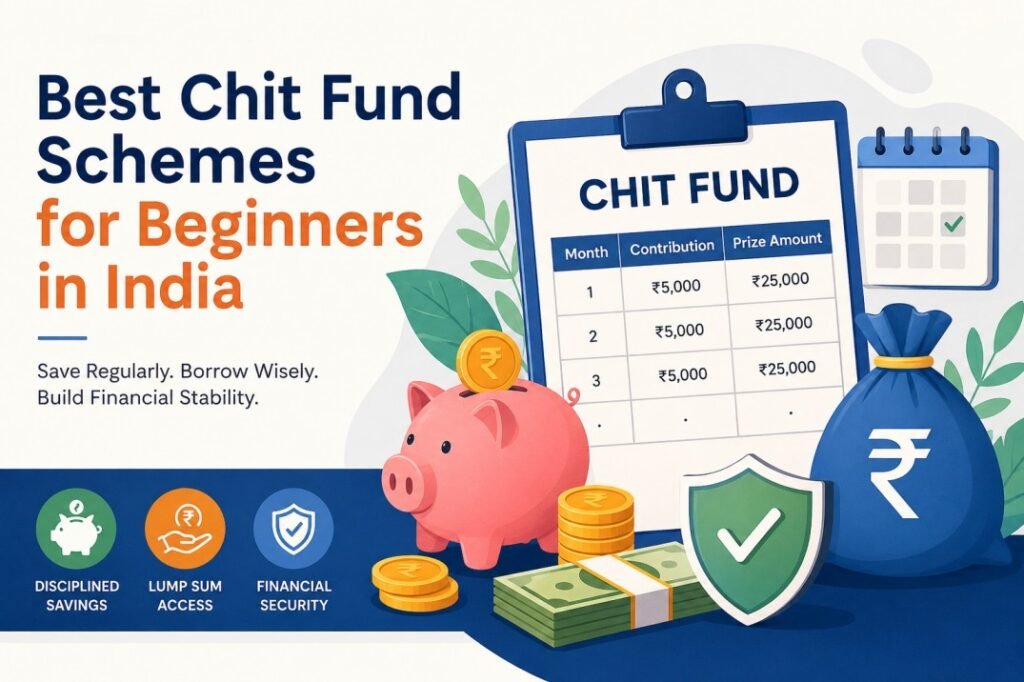
Chit funds have been a part of India’s savings and borrowing culture for decades. For families, small-business owners and salaried individuals, the best chit fund schemes for beginners in India can offer a structured way to save regularly while also providing access to a lump sum when money is needed.
But there is an important distinction beginners should understand.
A legally registered chit fund is not the same thing as an unregulated deposit scheme, Ponzi scheme or an investment promising guaranteed returns. Chit funds are governed by the Chit Funds Act, 1982, with the framework administered by the respective State Governments. The Reserve Bank of India also explains that chit fund companies are regulated by State Governments rather than by RBI for their chit-fund business.
This makes one question particularly important: What are the best chit fund schemes for beginners in India?
The answer is not simply “the company offering the highest payout.” A better approach is to evaluate the legality of the chit, the organiser, the auction process, payment obligations, fees, security requirements, transparency and your own ability to continue paying instalments.
This guide explains how chit funds work, what to look for before joining one, their advantages and risks, and how they compare with mutual funds.
What Is a Chit Fund?
A chit fund is a group-based financial arrangement in which members contribute a fixed amount periodically for a predetermined period.
The total money collected from members is then made available to one member during each cycle, generally through a draw or auction mechanism, depending on the terms of the chit.
In simple words, suppose 20 people agree to contribute ₹5,000 every month.
The monthly gross collection is:
20 × ₹5,000 = ₹1,00,000
One member receives the amount for that month, subject to the rules of the chit. In an auction-based chit, members may compete by accepting a discount on the gross chit amount in exchange for receiving the money earlier.
The remaining amount, after applicable deductions and charges, is distributed according to the rules of the chit.
The process continues until members have received their turn.
The Chit Funds Act, 1982 sets out a legal framework for chits, including requirements concerning sanction, registration and conduct. Section 4 states that a chit cannot be commenced or conducted without the required previous sanction and registration in the relevant state.
How Does a Chit Fund Work?
The easiest way to understand a chit fund is to follow a hypothetical example.
Example of a ₹2 lakh chit
Suppose:
- 20 members participate
- Monthly contribution = ₹10,000
- Duration = 20 months
- Gross chit amount = ₹2 lakh
Every month, all members contribute ₹10,000.
One member receives the monthly prize amount.
Suppose the auction leads the winning member to accept ₹1.70 lakh instead of ₹2 lakh.
The difference of ₹30,000 is the discount under the chit structure. The precise treatment of this discount and the amount distributed among subscribers depends on the chit agreement and applicable rules.
A foreman or organiser may also receive a commission or remuneration permitted under the law and the chit agreement. Following the 2019 amendment, the statutory ceiling for the foreman’s commission under Section 21 was increased from 5% to 7% of the gross chit amount, subject to the applicable agreement and legal framework.
This is why beginners should never judge a chit merely by comparing the monthly instalment with the eventual payout.
You need to understand the full cash-flow structure.
Why Are Chit Funds Popular in India?
Chit funds have historically appealed to people who want a financial arrangement that is more flexible than ordinary saving.
A subscriber may join primarily for disciplined saving, while another member may be interested in receiving a lump sum early.
This creates a system where the same chit can serve both savers and people seeking access to money.
For a small business owner, for example, receiving a lump sum before the end of the chit could help fund working capital. For another subscriber, continuing monthly contributions until the end may suit a saving objective.
This flexibility is one of the main reasons the chit model continues to exist.
However, flexibility does not mean low risk.
What Makes the Best Chit Fund Schemes for Beginners in India?
There is no single chit fund that can objectively be called the “best” for every Indian investor.
The right choice depends on your state, monthly cash flow, purpose, risk tolerance and the specific terms of the chit.
Instead of searching for a popular name, beginners should look for these characteristics.
1. The Chit Should Be Properly Registered
This should be your first filter.
The Chit Funds Act states that chits require previous sanction and registration in the relevant state. The RBI also states that chit funds registered under the applicable law can legally conduct chit-fund business.
Do not rely only on:
- WhatsApp messages
- social-media advertisements
- verbal promises
- screenshots of payments
- claims of “government approved”
- statements such as “everyone in our area is joining”
Ask for documentary evidence of the scheme and verify it through the appropriate state authority.
2. Choose Transparency Over Promised Returns
A genuine chit should be understandable before you sign up.
You should be able to see:
- total chit value
- number of subscribers
- monthly instalment
- duration
- auction or draw procedure
- discount rules
- organiser’s charges
- default rules
- security requirements
- payment procedures
- conditions for receiving the prize amount
A scheme that sounds complicated but relies on “trust us” is a warning sign.
The more difficult it is for you to understand where your money goes, the less comfortable you should be about participating.
3. Check the Chit Agreement Carefully
The agreement is more important than the brochure.
Do not join just because an agent explains the scheme verbally.
Read the written terms relating to:
- instalments
- due dates
- penalties
- auction procedure
- discounts
- security
- late payment
- substitution of subscribers
- early prize receipt
- exit or transfer provisions
- organiser charges
The Act gives subscribers and foremen specific rights and duties, so the agreement should be read together with applicable law and state rules.
4. Make Sure the Monthly Instalment Is Affordable
This is one of the biggest considerations for beginners.
Suppose your take-home salary is ₹50,000 and your proposed chit instalment is ₹15,000.
That may look manageable when you receive a lump sum early in the cycle. But you still have to deal with the future instalments.
A chit is therefore not something you should join merely because the initial contribution appears affordable.
Your monthly payment should leave room for:
- household expenses
- emergency savings
- insurance
- existing EMIs
- essential investments
- unexpected expenses
A missed payment can create penalties and other complications depending on the scheme rules.
5. Understand the Auction Mechanism
Auction-based chit funds can be confusing for beginners.
The member who needs the money urgently may be willing to accept a lower payout. That discount forms part of the economic structure of the chit.
For example, a ₹5 lakh gross chit amount might be auctioned at a discount.
The key question isn’t simply:
“How much money will I receive?”
It is:
“What is the total economic cost of receiving the money early?”
You need to understand what portion of the discount is distributed, what the organiser charges, and what future instalments remain payable.
Types of Chit Funds Beginners May Come Across
Chits can differ significantly in structure.
Auction-Based Chit Funds
The payout is determined through bidding or auction according to the scheme’s rules.
This is the structure many people associate with commercial chit funds.
Draw-Based Arrangements
In some arrangements, the beneficiary for a particular period may be determined through a draw or lot rather than competitive bidding.
The actual mechanism depends on the legal and contractual structure.
Registered Institutional Chits
These are conducted by entities operating under the applicable chit-fund framework and state supervision.
The important point is that institutional appearance alone does not remove the need for due diligence.
Informal Family or Community Chits
People sometimes create small private arrangements among friends, colleagues or relatives.
These may operate very differently from registered commercial chits and can create substantial practical and legal issues if documentation is weak.
A beginner should not assume that a local “committee” or informal savings group offers the same protections as a properly registered chit.

Benefits of Chit Funds
Chit funds can offer genuine advantages when structured and operated properly.
1. Forced Saving Discipline
Some people struggle to save money consistently.
A mandatory monthly contribution can create financial discipline.
Instead of keeping excess cash in a bank account and spending it later, the subscriber commits to a regular contribution.
2. Access to a Lump Sum
Unlike many ordinary savings approaches, a subscriber may receive a relatively large amount before the entire tenure ends, depending on the auction or draw.
This can be useful for:
- business needs
- education expenses
- home-related expenditure
- planned purchases
- other legitimate financial requirements
This is one of the major differences between a chit and a conventional long-term investment.
3. Useful for Some Borrowing Needs
A person needing funds urgently may participate in the bidding process to receive money earlier.
But remember: receiving the prize early does not mean your future obligations disappear.
You generally remain responsible for future instalments according to the scheme rules.
4. Group-Based Financial Model
A chit is based on mutual participation.
Some people find this structure easier to understand than market-linked investments.
However, simplicity of the concept should not be confused with absence of risk.
Risks of Chit Funds
This section is especially important for beginners.
1. Default Risk
The sustainability of the chit depends on subscribers continuing to meet their obligations.
If participants default, it can create operational and financial pressure within the group.
The Act gives the foreman certain rights and duties concerning subscribers, including the ability to demand sufficient security from a prized subscriber for future subscriptions.
2. Fraud Risk
Not every scheme advertised as a “chit fund” is a legally conducted chit.
The Banning of Unregulated Deposit Schemes Act, 2019 distinguishes regulated arrangements from unregulated schemes. A chit conducted with previous state sanction in accordance with the Chit Funds Act is listed among regulated deposit schemes under that legislation.
This is a crucial reason to verify the legal status before paying money.
3. Liquidity Risk
A chit is not the same as a savings account.
You cannot automatically assume that you can stop the arrangement whenever you want and receive your money immediately.
Exit, transfer and settlement rules depend on the agreement and applicable law.
4. Early Payout Can Come at a Cost
A member who wants the money early may have to accept a significant discount in the auction.
Therefore, getting the lump sum early is not equivalent to receiving a guaranteed high return.
5. Penalties for Missed Instalments
A monthly commitment can become difficult during:
- job loss
- medical emergencies
- business slowdown
- unexpected family expenses
- large EMI increases
A chit should therefore never replace your emergency fund.
6. Organiser Risk
Even where a chit is legal, you should still examine the organiser’s track record, transparency and operational practices.
Do not judge a scheme solely by its advertisements or sales representatives.
Chit Fund vs Mutual Fund: Which Is Better?
The question “chit fund vs mutual fund which is better” does not have one answer because the two products serve different purposes.
A mutual fund is an investment vehicle that pools money from investors and invests it according to the scheme’s objective. Mutual fund investments can be in equity, debt, hybrid and other permitted assets. SEBI notes that mutual funds carry investment risk and that past performance does not guarantee future results.
A chit fund, on the other hand, is primarily a structured savings-and-borrowing arrangement.
Chit Fund vs Mutual Fund Comparison
| Feature | Chit Fund | Mutual Fund |
|---|---|---|
| Basic purpose | Savings + access to lump sum | Investing pooled money |
| Structure | Group contribution and payout | Pool invested in securities |
| Returns | Not a fixed investment return | Market-linked |
| Market exposure | Generally not directly linked to stock-market NAV movements | Depends on fund type |
| Monthly contribution | Usually fixed according to chit agreement | SIP can be flexible depending on scheme and platform |
| Early access | Possible according to chit rules | Depends on fund type and redemption rules |
| Long-term wealth creation | Not primarily designed for this | Commonly used for wealth creation |
| Main risk | Default, organiser, scheme and liquidity risks | Market, credit, interest-rate and other investment risks |
| Regulation | Chit Funds Act and State Government framework | SEBI framework |
| Best suited for | Certain savings/borrowing needs | Goal-based investing, depending on fund type |
| Guaranteed return | Should not be assumed | Should not be assumed |
| Transparency | Depends heavily on chit agreement and organiser | Scheme documents, disclosures and regulatory framework |
SEBI’s investor education material emphasises that mutual funds are subject to market risks and that there is no assurance that investment objectives will be achieved.
So, Chit Fund or Mutual Fund?
Think about your objective.
A chit may make more sense when:
You want a structured monthly commitment and may need access to a lump sum during the chit period.
A mutual fund may make more sense when:
Your objective is long-term investing for goals such as:
- retirement
- children’s education
- wealth creation
- long-term financial independence
The two can also have completely different roles in a financial plan.
A chit should not automatically be treated as a replacement for a diversified long-term investment portfolio.
Similarly, a mutual fund cannot necessarily replace a financial arrangement designed around access to a predetermined lump sum.
Practical Example: Choosing Between a Chit and a SIP
Consider Rahul, a 30-year-old salaried employee.
He can save ₹8,000 per month.
He has two possible objectives.
Objective A: He expects that he may need a large amount of money within the next couple of years for a business requirement.
Objective B: He wants to build wealth over 15–20 years.
For Objective A, a properly structured chit may be worth evaluating if its terms and risks suit him.
For Objective B, a suitable mutual fund SIP may be more aligned with a long-term investment objective, subject to his risk profile and financial goals.
The important lesson is that the right financial product starts with the goal, not the product’s popularity.
How to Evaluate a Chit Fund Before Joining
Use this beginner checklist.
Legal Verification
Confirm:
- Is the chit sanctioned and registered as required?
- Which state authority regulates it?
- Is the organiser providing official documentation?
- Can the registration details be independently verified?
Financial Evaluation
Check:
- monthly instalment
- total chit amount
- tenure
- expected auction discount
- organiser’s charges
- penalties
- security requirements
- future instalment obligations
Operational Evaluation
Ask:
- How are auctions conducted?
- How are results documented?
- How quickly is the prize amount paid?
- What happens if a subscriber defaults?
- How are disputes handled?
- What records are provided to subscribers?
Personal Affordability
Ask yourself:
“Can I comfortably continue the instalment even if I do not receive the lump sum when I expect it?”
If the answer is no, the chit may not be suitable.
Red Flags to Avoid
Be extremely cautious when you see phrases such as:
- “Guaranteed 20% return”
- “Double your money”
- “No risk”
- “Government guaranteed”
- “Pay today, receive huge amount next month”
- “No agreement required”
- “Registration details are confidential”
- “Refer five people and earn more”
- “Limited seats, transfer money immediately”
A legitimate financial arrangement should not need exaggerated return promises to attract members.
The RBI explicitly advises the public to verify whether the entity they are investing with is regulated by the relevant financial-sector authority and warns that high-return promises can involve high risk.
Common Mistakes Beginners Make
Joining Only Because a Friend Recommended It
A friend’s experience cannot replace your own due diligence.
The same organiser may offer multiple schemes with different structures and terms.
Looking Only at the Prize Amount
The most important number isn’t necessarily the amount you receive.
Look at the entire cash-flow pattern from the first instalment to the last.
Ignoring Future Instalments
Receiving a lump sum early does not usually end your financial commitment.
Confusing a Chit With an Investment Return
The economic benefit of a chit depends on when you receive the money, discounts, distributions, charges and your opportunity cost.
It should not automatically be compared with an advertised annual investment return.
Using Emergency Money
A financial emergency should not force you into a product whose payment schedule you cannot maintain.
Signing Without Reading
Never sign a long-term financial agreement without understanding the important clauses.
Who Should Consider Chit Funds?
A chit fund may be worth considering for someone who:
- understands how the mechanism works
- can comfortably make regular payments
- has a stable income
- has a clear reason for wanting a lump sum
- understands auction discounts and charges
- has separately maintained an emergency reserve
- is dealing with a properly registered and documented chit
This is not a recommendation to join a chit. It is a checklist for determining whether the structure fits your circumstances.
Who Should Avoid Chit Funds?
A chit may be unsuitable for someone who:
- cannot commit to regular instalments
- needs guaranteed liquidity
- is using their emergency fund to pay instalments
- does not understand the agreement
- is joining solely because someone promised high returns
- expects an investment-like guaranteed annual return
- is already heavily burdened by debt
In these situations, simpler financial products may be easier to manage.
Are Chit Funds Safe?
This is one of the most searched questions by beginners.
The right answer is: legal regulation does not mean zero risk.
A registered chit operates within the applicable legal framework, but participants can still face risks relating to defaults, liquidity, organiser performance and the specific terms of the agreement.
The Chit Funds Act establishes rules around registration and conduct, while the Banning of Unregulated Deposit Schemes Act addresses unregulated deposit schemes.
So instead of asking:
“Is a chit fund 100% safe?”
ask:
“Is this specific chit legally registered, financially manageable and suitable for my objective?”
That is a much better question.
Are Chit Funds Better Than Fixed Deposits?
Not necessarily.
A fixed deposit, chit fund and mutual fund perform different functions.
An FD generally focuses on depositing money for an agreed tenure and earning interest according to its terms.
A chit is a group-based saving and borrowing mechanism.
A mutual fund invests pooled money in financial securities.
The best choice depends on:
- objective
- time horizon
- liquidity requirement
- risk tolerance
- need for predictable cash flows
- tax considerations
- ability to tolerate market or scheme-related risk
Do Chit Funds Give Guaranteed Returns?
You should not treat a chit fund as a guaranteed-return investment.
Its economics depend on the structure, the timing of receiving the prize, auction discounts, charges, distributions and other terms.
Be especially cautious about advertisements promising fixed or extraordinary returns.
The safer approach is to evaluate the actual agreement rather than an advertised “return percentage.”
Chit Fund Taxation: What Beginners Should Know
Tax treatment can depend on the nature of the transaction and the taxpayer’s circumstances.
Do not assume that a chit payout is automatically tax-free simply because it is called a chit fund.
The treatment of income, losses, discounts or related transactions can involve tax rules that may change.
Before making a significant transaction, verify the applicable tax position from current official sources or consult a qualified tax professional.
This is particularly important for business owners and individuals participating in larger chits.
How Much Should a Beginner Put Into a Chit Fund?
There is no universal percentage of income that is appropriate for everyone.
A sensible approach is to first ensure that your basic financial foundation is in place.
Consider having:
- An emergency fund
- Adequate health insurance
- Necessary life insurance where applicable
- Manageable debt
- A clear monthly budget
Only then should you assess how much you can comfortably commit to a chit.
Never choose the maximum instalment an agent says you qualify for.
Choose the amount you can realistically continue paying during a difficult month.
Best Chit Fund Strategy for Beginners
Instead of searching for the “highest return chit,” beginners can follow a safety-first strategy.
Step 1: Define the goal
Why do you want to join?
Saving? Business cash flow? Planned expense? Access to a lump sum?
Step 2: Determine the affordable instalment
Choose a contribution that remains manageable even when expenses increase.
Step 3: Verify registration
Check the relevant State Government authority and documentation.
Step 4: Read the agreement
Do not rely on the sales presentation.
Step 5: Understand the auction
Know exactly how discounts and payouts work.
Step 6: Calculate the full cash flow
Compare what you pay over time with what you receive and when you receive it.
Step 7: Keep emergency savings separate
Do not use the chit itself as your emergency fund.
Step 8: Compare alternatives
Before joining, compare the objective with options such as bank deposits, recurring deposits, mutual funds or other suitable financial products.
Best Chit Funds to Consider in India
When searching for the best chit fund schemes for beginners in India, it is tempting to look for a simple list of companies and pick the one with the highest advertised prize amount.
That is not the safest way to choose a chit.
A better approach is to identify established chit operators and then compare the specific chit group available to you. Chit availability, monthly instalments, duration, auction terms and eligibility can differ by state and branch.
Below are some established operators that beginners can research. This is not a buy recommendation, and inclusion in this list does not mean that every scheme offered by the organisation is suitable for every investor.
1. Shriram Chits
Shriram Chits (India) Pvt. Ltd. is one of the better-known organised chit operators in India. Its official website provides information on chit groups, online payments, auction-related information and subscriber services. The company says it has been operating for nearly 50 years.
One useful feature for beginners is that Shriram publishes available chit groups on its website. The currently listed groups include different chit values and durations, allowing subscribers to compare instalments with their monthly budget. For example, its published list includes groups such as ₹50,000 over 40 months with a ₹1,250 monthly subscription, ₹1 lakh over 40 months with a ₹2,500 subscription, and larger groups extending up to much higher values. These are illustrative listings from the company’s published availability page and should be rechecked before joining because availability can change.
Why beginners may research it:
- Established organised chit operator
- Multiple chit values and durations
- Online payment facilities
- Published information on available groups
- Presence in several states
What to check before joining: Do not choose a group simply because the monthly instalment looks affordable. Study the auction discount, charges, security requirements and future instalments.
2. Kerala State Financial Enterprises (KSFE) Chitty
Kerala State Financial Enterprises Ltd. (KSFE) is a government-owned financial enterprise of Kerala and has a major presence in the state’s chitty business. Its annual report describes the company as being fully owned by the Government of Kerala and notes that it was established partly to provide an alternative to private chit promoters.
KSFE offers different chitty structures, and its official platforms provide information about available chits, security requirements and online services.
For example, the KSFE Pravasi Chit portal currently lists 25-, 30-, 40-, 50- and 60-month chit options with different subscription levels and sala amounts. The portal also provides online registration and auction-related facilities. These specific offerings can change, so readers should verify the latest options directly on the official KSFE platform.
Why beginners may research it:
- Government of Kerala-owned enterprise
- Long operating history
- Multiple chitty structures
- Online services available for eligible subscribers
- Clearly documented security requirements
KSFE also states that security may include personal surety, financial documents, property security and certain other forms depending on the scheme.
Important: Government ownership should not be interpreted as a guarantee that every subscriber will receive a particular return. A specific chitty still needs to be evaluated on its own terms.
3. Muthoottu Mini Chit-Related Financial Services
Muthoottu Mini Financiers has a long history in financial services and describes itself as having originated as a chit-fund company before expanding into other financial activities. Its official website says the group has a presence across multiple Indian states and publishes extensive corporate disclosures and financial information.
For a beginner evaluating any scheme associated with the group, the key exercise is still to verify the current chit product, applicable registration, terms and availability rather than relying on the company’s general reputation.
The company also maintains corporate-governance, risk-management, grievance and other policy disclosures on its website.
Why beginners may research it:
- Long-standing financial-services history
- Published corporate disclosures
- Formal grievance and policy framework
- Presence in multiple states
What to verify: Make sure the particular chit you are considering is currently available, properly documented and legally compliant in the relevant state.
Which Chit Fund Is Best for Beginners?
There is no single answer.
For a beginner, the “best” chit is usually the one that satisfies five conditions:
| Factor | What a Beginner Should Look For |
|---|---|
| Legal status | Proper sanction and registration under the applicable framework |
| Affordability | Monthly instalment comfortably fits the budget |
| Transparency | Clear agreement, auction rules and charges |
| Liquidity | You understand when and how the prize amount can be received |
| Risk management | You understand security and future instalment obligations |
Therefore, Shriram Chits and KSFE are examples of established operators worth researching, while other local or regional operators may also be suitable depending on where you live.
Do not interpret this section as a ranking of safety or returns.
The actual chit group can matter just as much as the name of the operator.
Best Chit Fund Schemes for Different Budgets
Instead of asking which company is universally best, beginners can start by matching the chit amount with their monthly cash flow.
For a ₹2,000–₹5,000 Monthly Budget
A smaller chit may be easier to manage for a beginner who is testing the concept.
Shriram’s published group information, for example, includes several options in this broad instalment range, although exact availability must be checked before joining.
For a ₹5,000–₹10,000 Monthly Budget
A somewhat larger chit may provide access to a larger lump sum while keeping the monthly commitment within a moderate range.
This can be considered by salaried individuals with stable income, provided they have enough cash flow after essential expenses and emergency savings.
For a ₹10,000+ Monthly Budget
At this level, the consequences of choosing an unsuitable chit become greater.
Before joining, calculate your complete monthly financial commitments, including rent, EMIs, insurance, school fees, emergency savings and investments.
A larger prize amount does not automatically make the chit better.
For more information about Best Ultra Short Term Mutual Funds in India 2026
Should You Buy a Chit Fund From an App or Agent?
Be careful with the word “buy.”
You are not buying a stock or mutual fund unit when you join a chit. You are entering into a contractual financial arrangement.
Whether you use an app, website, branch or authorised agent, verify that:
- You are dealing with the actual organiser or authorised representative.
- The chit has the required legal sanction and registration.
- You receive the formal agreement.
- Payments are made through official channels.
- You receive proper receipts and transaction records.
Avoid transferring money to an individual’s personal bank account merely because they claim to be a chit agent.
What Should You Check Before Choosing Shriram Chits or KSFE?
Suppose you have shortlisted two operators.
Do not immediately pick the company with the larger chit value.
Compare:
Monthly instalment: Can you comfortably pay it every month?
Tenure: Is the duration appropriate for your goal?
Auction mechanism: How is the discount determined?
Charges: What commissions or fees apply?
Prize amount: What will you actually receive after applicable deductions?
Security: What security will be required if you become a prized subscriber?
Default rules: What happens if you miss payments?
Exit rules: Can you transfer or exit your position, and under what conditions?
This comparison is far more useful than simply searching for the “highest-return chit fund.”
Also know about How to Start Investing in Stock Market for Beginners in India
Best Chit Funds vs Best Mutual Funds
There is another important distinction for beginners.
Searching for the best chit funds to buy and searching for the best mutual funds to invest in are fundamentally different exercises.
A chit is designed around periodic group contributions and access to a lump sum.
A mutual fund is designed to pool investors’ money and invest it in securities according to its scheme objective. Mutual funds are market-linked and do not provide guaranteed returns.
Therefore:
For a planned lump-sum requirement: a chit may be worth evaluating.
For long-term wealth creation: an appropriately selected mutual fund may be more relevant.
Neither should be selected purely because it appears to offer a higher return.
Our Beginner-Friendly Shortlist
For an article aimed at Indian beginners, this is a safer way to present the shortlist:
| Chit Operator | Best For | Key Point to Verify |
|---|---|---|
| Shriram Chits | Beginners seeking multiple group choices | Exact group, discount, charges and security |
| KSFE Chitty | Eligible subscribers, particularly in Kerala and Pravasi segments | Current scheme, eligibility and security requirements |
| Muthoottu Mini | Readers researching established financial-service operators | Current chit availability and exact scheme documentation |
This table should not be presented as a ranking from safest to riskiest or highest to lowest return.
Final Word on the “Best Chit Fund”
The safest conclusion for a beginner is not:
“Company X is the best chit fund in India.”
It is:
“A properly sanctioned and registered chit with transparent terms and an affordable monthly commitment may be worth considering after comparing the alternatives.”
The organiser matters, but the individual scheme terms matter even more.
Always verify current availability, registration, charges, auction rules and applicable state requirements directly with the relevant authority and the official provider before making a financial commitment.
Key Questions to Ask the Chit Organiser
Before signing, ask for clear answers to these questions:
1. Is the chit officially sanctioned and registered?
2. What is the total chit value?
3. How many subscribers are there?
4. How much is the monthly instalment?
5. How long is the chit?
6. How is the winner selected?
7.How is the auction discount calculated?
8. How much commission or other charges apply?
9. What happens if I miss an instalment?
10 What security is required if I take the prize early?
11. What happens if another subscriber defaults?
12. How can I exit or transfer my ticket?
13. What documents and receipts will I receive?
If the organiser is unwilling to answer basic questions in writing, treat that as a serious warning.
Also know about Best Growth Stock Mutual Funds in India
Frequently Asked Questions
1. What are the best chit fund schemes for beginners in India?
There is no universal best chit fund scheme. For beginners, the more important criteria are legal registration, transparent documentation, reasonable instalments, clear auction rules, understandable charges and a reliable operating framework.
2. Is a chit fund better than a mutual fund?
Not necessarily. They serve different purposes. A chit is primarily a group savings-and-borrowing arrangement, while a mutual fund pools money for investment in securities. Choose based on your financial goal rather than simply comparing the two as competing products.
3. Is a registered chit fund safe?
A registered chit operates under the applicable legal framework, but registration does not eliminate all financial or operational risk. Subscribers should still evaluate the organiser, agreement, payment obligations and liquidity conditions.
4. Are chit funds regulated by RBI?
For chit-fund business, the RBI states that chit fund companies are regulated by the respective State Governments under the Chit Funds Act framework rather than being regulated by RBI as ordinary NBFC business.
5. Can I receive a chit amount before the end of the tenure?
In an auction-based chit, a subscriber may receive the prize amount earlier according to the scheme’s rules. However, receiving the amount early can involve a discount and does not normally remove the obligation to continue future instalments.
6. Do chit funds guarantee returns?
No investor should assume that a chit provides a guaranteed investment return. The financial benefit depends on the scheme mechanics, timing of payout, discounts, charges and other factors.
7. Can I lose money in a chit fund?
There are risks. Defaults, organiser-related problems, liquidity limitations, penalties and unsuitable scheme terms can adversely affect a subscriber.
8. How do I check whether a chit fund is legal?
Check whether the chit has the required sanction and registration with the appropriate State Government authority and request the relevant documentation. The Chit Funds Act prohibits commencing or conducting a chit without the required sanction and registration.
9. Are chit funds good for long-term wealth creation?
They are not primarily designed as market-linked long-term wealth-creation products. Their main structure is based on group savings and access to funds. For long-term wealth creation, investors may separately consider appropriate investment products based on their goals and risk tolerance.
10. Should beginners invest their entire savings in a chit?
Generally, concentrating all your savings in one financial arrangement is not a prudent approach. Maintain emergency reserves and diversify your financial plan according to your needs, risk tolerance and goals.
Final Checklist Before Joining a Chit Fund
Use this quick checklist:
| Question | What to Look For |
|---|---|
| Is it registered? | Verify with the relevant authority |
| Is the agreement available? | Written agreement before payment |
| Is the organiser transparent? | Clear documentation and records |
| Is the instalment affordable? | Comfortable even during difficult months |
| Is the auction clear? | Understand discount and payout mechanism |
| Are charges disclosed? | No unexplained fees |
| Are future payments explained? | Clear obligations after early payout |
| Is emergency money separate? | Yes |
| Are returns being guaranteed? | Treat such claims as a red flag |
| Have alternatives been compared? | Compare with suitable financial products |
Key Takeaways
- A registered chit fund combines regular contributions with a rotating lump-sum payout.
- The best chit fund for a beginner is generally one that is legally sanctioned and registered, transparent and affordable, rather than one advertised with unusually attractive returns.
- Chit funds can be useful when you value access to a lump sum and disciplined saving.
- They are not the same as mutual funds. A mutual fund pools money to invest in securities, while a chit operates through a group contribution and payout mechanism.
- Chit funds can involve auction discounts, organiser charges, future instalment obligations and default risk.
- Never assume that a chit fund gives you a fixed investment return.
- For long-term wealth creation, mutual funds may be more appropriate for many investors, depending on risk tolerance and goals.
- Always check the scheme’s registration, agreement, payment schedule and rules before joining.
Also know about Best Mutual Funds for SIP for Beginners in India
Conclusion
The search for the best chit fund schemes for beginners in India should not begin with a company name.
It should begin with a checklist.
A good chit for a beginner is one that is properly sanctioned and registered, transparently documented, financially manageable and appropriate for the purpose for which you need it.
Chit funds can be useful because they combine periodic saving with the possibility of receiving a lump sum before the full tenure ends. But they also carry risks related to subscriber defaults, organiser performance, liquidity, auction discounts and future payment obligations.
The comparison between chit fund vs mutual fund which is better also becomes easier when you focus on purpose.
A chit is primarily a group-based savings and borrowing mechanism. A mutual fund is an investment vehicle whose value can rise or fall based on its underlying investments. Mutual funds also carry market risk, and SEBI makes clear that past performance does not guarantee future performance.
For beginners, the most important rule is simple:
Do not choose a financial product because someone calls it “best.” Choose it because you understand how it works, can afford it, and it fits your financial goal.
Before committing money, verify the latest registration, legal requirements, charges and scheme terms from official sources. Regulations and commercial terms can change over time.
Author Note: I have been investing in the Indian stock market since 2018, with practical experience in mutual funds and equities. For U.S.-focused articles, I research information from official fund providers, regulatory sources, company filings, and other reliable sources. I also use AI-assisted research and writing tools to help organize and explain information, while reviewing the content for accuracy and clarity before publication. This article is intended for educational purposes and is not personalized financial advice.
Disclaimer: The content provided is for educational and informational purposes only and should not be considered financial, investment, insurance, or legal advice.