
Last Updated on 12 August 2026
Introduction
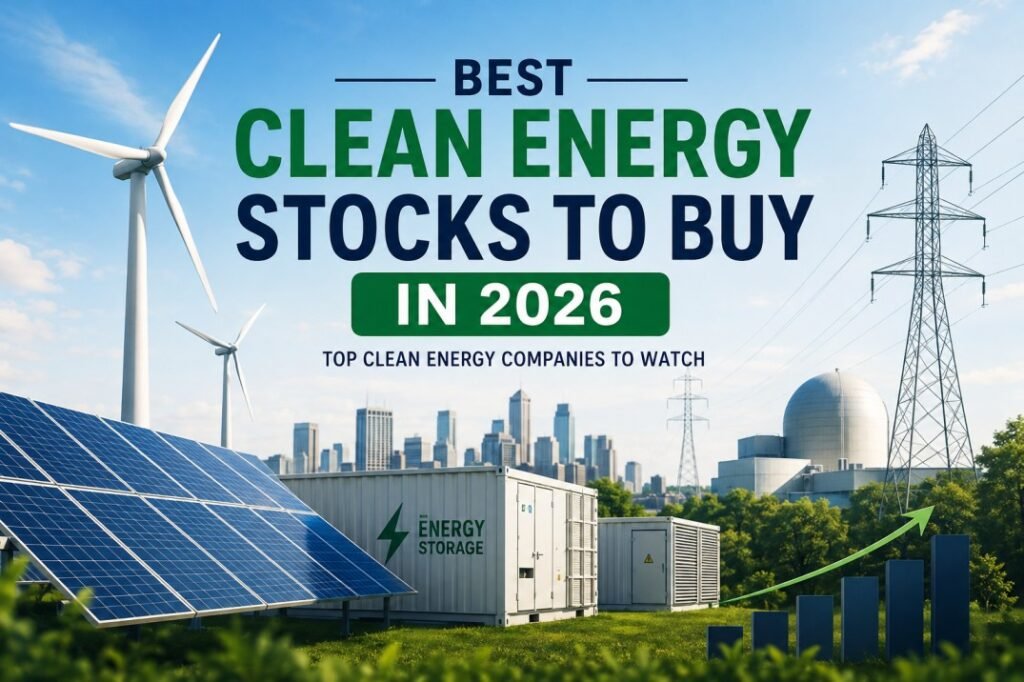
Clean energy has become a much broader investment theme than simply buying solar or wind companies, making the best clean energy stocks to buy an increasingly interesting topic for long-term investors in 2026. The modern energy transition includes utility-scale solar, wind power, battery storage, electricity transmission, nuclear power, grid technology, inverters, and companies that help businesses meet growing electricity demand.
At the same time, artificial intelligence, data centers, manufacturing, and electrification are increasing the need for reliable electricity in the United States. This creates opportunities across different parts of the energy sector, but it also makes clean energy investing more complex.
A company can benefit from rising electricity demand while still facing challenges such as high interest rates, policy changes, tariffs, project delays, competition, and weak demand in particular markets.
This guide examines some of the best clean energy stocks to buy in 2026 from a long-term research perspective. The companies discussed include NextEra Energy, First Solar, Brookfield Renewable, Enphase Energy, and Vistra.
This is not a ranking of stocks that investors should automatically buy. Instead, the goal is to explain why these companies are worth researching, what factors could support their businesses, and what risks investors should consider before making an investment decision.
What Are Clean Energy Stocks?
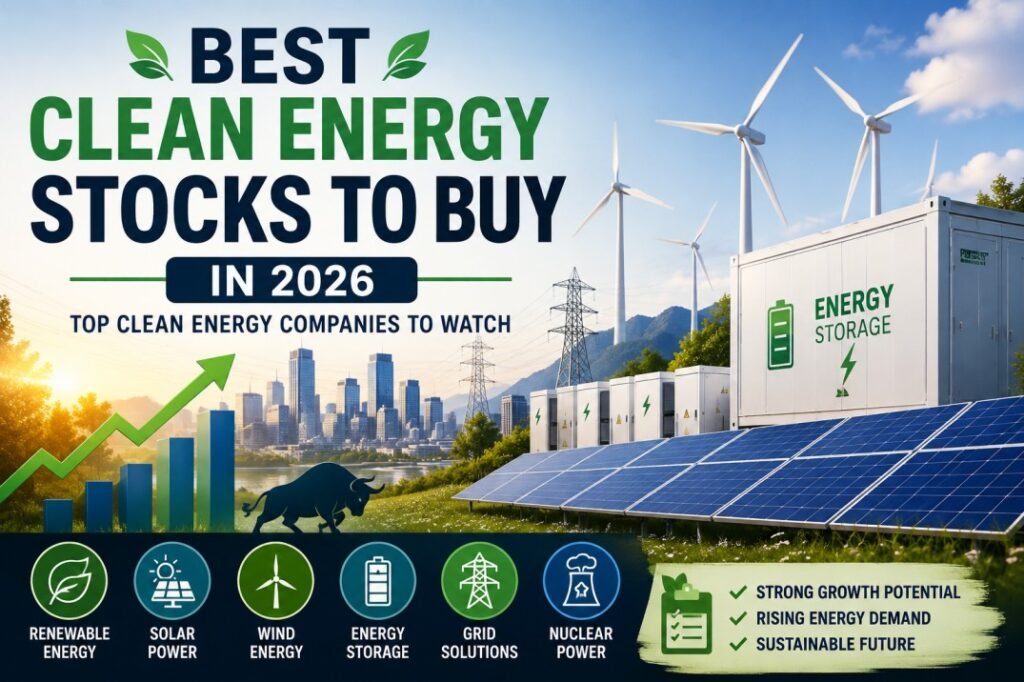
Clean energy stocks are shares of companies that generate, produce, develop, or enable lower-carbon energy.
The category can include several different business models.
Renewable Power Producers
These companies develop or operate renewable electricity projects such as:
- Solar farms
- Wind farms
- Hydroelectric facilities
- Battery storage projects
Their revenues can come from electricity sales, long-term power purchase agreements, renewable-energy contracts, or other arrangements.
Clean Energy Equipment Companies
Some companies don’t generate electricity themselves. Instead, they sell the technology required to produce or manage it.
Examples include:
- Solar modules
- Microinverters
- Battery systems
- Grid equipment
- Energy-management software
This business model can provide significant growth potential, but it may also be more cyclical.
Utilities With Renewable Energy Operations
Large utilities can provide another way to participate in the energy transition.
These businesses may combine traditional regulated electricity operations with investments in:
- Solar
- Wind
- Battery storage
- Transmission
- Natural gas
- Nuclear power
For investors, this can provide more diversification than owning a pure-play solar company.
Why Clean Energy Stocks Matter in 2026
One of the most important changes in the clean-energy investment story is that electricity demand itself is becoming a major theme.
Data centers, manufacturing facilities, electrification, transportation, and population growth can all increase electricity consumption.
NextEra Energy’s second-quarter 2026 results illustrate this trend. Reuters reported that the company benefited from rising electricity demand from data centers, while its renewable-energy business reported substantial growth in net income and its storage backlog expanded to 35.1 GW.
This doesn’t mean every clean-energy company will benefit equally.
Investors still need to determine which businesses have:
- Strong balance sheets
- Competitive technology
- Attractive project economics
- Long-term customer contracts
- Reasonable valuations
- Sustainable cash flow
- A credible path to growth
Best Clean Energy Stocks to Buy in 2026
The following companies represent different parts of the clean-energy ecosystem. They should not be viewed as interchangeable investments.
| Company | Ticker | Clean-energy exposure | Potential strength | Major risk |
|---|---|---|---|---|
| NextEra Energy | NEE | Renewable power, utility, storage | Scale and diversification | Interest rates, regulation, capital needs |
| First Solar | FSLR | Solar manufacturing | U.S. manufacturing position and backlog | Policy, tariffs, solar-cycle risk |
| Brookfield Renewable | BEP | Renewable power and infrastructure | Diversified global assets | Debt, rates, project execution |
| Enphase Energy | ENPH | Solar inverters and storage | Technology and distributed energy | Residential solar demand |
| Vistra | VST | Nuclear, solar, storage, power generation | Electricity demand and diversified generation | Not a pure renewable company; power-market risk |
Company fundamentals, financial figures, valuations, and policies can change. Verify the latest information before making an investment decision.
1. NextEra Energy (NEE)
NextEra Energy is one of the most interesting companies for investors looking for exposure to both renewable energy and the broader U.S. electricity market.
The company has two major businesses: Florida Power & Light, a regulated utility, and NextEra Energy Resources, which develops and operates energy projects.
That combination is important.
Instead of relying entirely on the economics of solar or wind equipment, investors get exposure to a large regulated utility business alongside renewable and energy-storage development.
Why NEE Is Worth Watching
NextEra has substantial scale in renewable energy development.
Its second-quarter 2026 results were released on July 24, 2026, according to the company’s investor-relations site.
The broader electricity-demand story is also becoming increasingly relevant. Data centers and other large electricity users are creating additional demand for new generation and grid infrastructure. Reuters reported that NextEra’s utility business had a significant data-center pipeline and that its renewable-energy unit increased its storage backlog during the second quarter.
Potential Advantages
- Diversified utility and energy businesses
- Large renewable-energy development platform
- Exposure to solar, wind, and storage
- Potential benefit from increasing U.S. electricity demand
- Established operating history
Risks
The biggest issue is that NextEra is not a pure-play clean-energy company.
Its regulated utility operations are influenced by regulation, capital expenditure requirements, interest rates, and Florida economic conditions.
Renewable projects also require significant capital.
For investors, NEE may therefore be more appropriate as a diversified energy-transition investment rather than a pure solar or wind bet.
2. First Solar (FSLR)
First Solar is one of the most closely watched U.S. solar companies.
Unlike renewable power developers, First Solar primarily operates on the manufacturing side of the industry. That gives investors exposure to the equipment side of the solar market.
The company manufactures thin-film photovoltaic modules and has built a significant U.S. manufacturing presence.
Why First Solar Stands Out
First Solar entered 2026 with strong operating momentum.
The company reported first-quarter 2026 net sales of approximately $1.04 billion, up 24% year over year, and net income of $347 million. It also reported a contracted sales backlog of 47.9 GW at March 31, 2026.
Its 2025 full-year results also showed the scale of the business, with full-year net sales of approximately $5.2 billion.
A large contracted backlog can provide visibility into future module demand, although backlog alone does not eliminate execution, pricing, policy, or customer risks.
Potential Advantages
- Major U.S. solar manufacturer
- Large contracted backlog
- Exposure to long-term solar deployment
- U.S. manufacturing footprint
- Potential benefit from domestic-energy policies
Risks
First Solar is highly exposed to government policy and international trade rules.
Tariffs, tax incentives, trade investigations, domestic-content rules, and changes to renewable-energy policy can influence the company’s competitive position.
Solar manufacturing can also be cyclical.
A company can have strong long-term demand but still experience periods of pricing pressure or excess industry capacity.
Therefore, investors should evaluate First Solar’s valuation alongside its backlog, margins, cash position, manufacturing capacity, and policy environment.
3. Brookfield Renewable (BEP)
Brookfield Renewable offers a different way to invest in clean energy.
Rather than focusing on one technology such as solar panels or inverters, Brookfield Renewable provides exposure to a diversified portfolio of renewable-energy assets.
Its business has historically included hydroelectric power, wind, solar, and energy-storage assets.
This diversification can be attractive because different renewable technologies can perform differently depending on weather, electricity prices, and regional conditions.
Why Investors May Consider BEP
One advantage of renewable-power infrastructure businesses is the potential for long-duration assets and contracted cash flows.
A wind farm or solar project can operate for many years after construction.
Long-term contracts can also provide greater revenue visibility than businesses that depend entirely on selling equipment in competitive markets.
However, investors should remember that infrastructure businesses often require substantial amounts of debt and capital.
Potential Advantages
- Diversified renewable-energy portfolio
- Exposure to multiple technologies
- Long-life infrastructure assets
- Potential recurring cash flow
- Global geographic diversification
Risks
Interest rates are particularly important for renewable infrastructure companies.
When borrowing costs rise, financing new projects becomes more expensive, and the valuation of existing long-duration assets can come under pressure.
Investors should therefore pay close attention to:
- Debt levels
- Interest expense
- Cash available for distribution
- Project development spending
- Contract quality
- Distribution sustainability
Brookfield Renewable can be an interesting candidate for investors who prefer renewable infrastructure exposure rather than solar-equipment exposure.
4. Enphase Energy (ENPH)
Enphase Energy represents the technology side of clean energy.
The company is known for its microinverter-based solar systems and energy-storage products.
Its business model is very different from a utility.
Instead of owning large solar farms, Enphase provides technology that can be used in distributed residential and commercial solar installations.
Why ENPH Is Interesting
The long-term trend toward distributed energy is one reason investors continue to watch Enphase.
Solar panels can generate electricity during the day, while batteries can help households use stored electricity when solar production is lower.
That creates opportunities for companies providing solar-plus-storage technology.
However, the residential solar market can be volatile.
Enphase’s 2026 results demonstrate this clearly.
In the second quarter of 2026, the company reported revenue of $291.9 million, compared with $282.9 million in the first quarter. It shipped approximately 1.59 million microinverters and 113.8 MWh of IQ Batteries.
At the same time, the company reported that U.S. revenue declined approximately 3% in Q2, while European revenue increased approximately 35%.
Earlier in 2026, Enphase also reported that U.S. residential solar demand had been affected by the expiration of the federal residential clean-energy tax credit and seasonal factors.
Potential Advantages
- Strong position in solar microinverters
- Exposure to energy storage
- Technology-focused business
- International growth opportunities
- Potential benefit from distributed energy adoption
Risks
ENPH is considerably more volatile than a regulated utility.
Residential solar installations can be affected by:
- Interest rates
- Consumer financing
- Electricity prices
- Government incentives
- Installer health
- Housing activity
The company itself also reported that reciprocal tariffs affected margins in 2026.
This makes Enphase potentially more suitable for investors who understand the higher volatility associated with clean-energy technology stocks.
5. Vistra (VST)
Vistra is not a traditional renewable-energy stock.
However, it is worth considering in a broader clean-energy and power-demand discussion because the company operates nuclear, solar, battery-storage, natural-gas, and other generation assets.
The company describes itself as an integrated retail electricity and power-generation company and says its fleet includes nuclear, solar, battery storage, natural gas, and coal.
Why VST Is Worth Watching
The electricity market is changing.
Data centers and other energy-intensive industries need reliable power around the clock. That creates demand not only for intermittent renewable generation but also for technologies capable of providing dependable electricity.
Nuclear power can therefore become part of the clean-energy investment conversation even though it is not renewable.
Vistra has also continued investing in nuclear, solar, and energy storage. Its earlier company disclosures highlighted projects involving solar-plus-storage and long-term power purchase agreements with large technology companies.
Potential Advantages
- Exposure to nuclear power
- Solar and battery-storage investments
- Electricity-demand growth
- Diversified generation portfolio
- Potential benefit from rising power prices
Risks
Vistra should not be treated as a pure clean-energy stock.
A significant portion of its business involves conventional power generation.
Its earnings can also be affected by wholesale electricity prices, hedging strategies, fuel costs, regulatory developments, and power-market conditions.
For investors seeking a broader electricity-demand and energy-transition thesis, VST may be worth researching.
For detailed information about Best Renewable Energy Stocks to Buy
How to Choose the Best Clean Energy Stocks in 2026
Buying the top clean energy stocks is not simply about finding the company with the biggest renewable-energy pipeline.
Investors should examine the underlying economics.
1. Revenue Growth
Look at whether revenue is growing consistently.
But don’t stop there.
Ask:
- Is growth organic?
- Is it coming from acquisitions?
- Is demand sustainable?
- Are margins improving?
- Is the company generating cash?
High revenue growth without sustainable cash generation can create problems.
2. Balance Sheet
Clean-energy projects can require billions of dollars in capital.
That makes the balance sheet especially important.
Check:
- Total debt
- Cash
- Net debt
- Interest expense
- Debt maturity schedule
- Operating cash flow
A company with too much leverage may struggle if interest rates remain elevated.
3. Backlog and Contracts
For renewable-energy developers and manufacturers, backlog can provide valuable information.
However, investors should understand what the backlog actually means.
A large backlog is more useful when:
- Customers are financially strong
- Contracts are binding
- Pricing is attractive
- Projects are properly financed
- Delivery schedules are realistic
Don’t assume that every announced project will automatically become revenue.
4. Valuation
Even an excellent company can become a poor investment if its stock price already reflects unrealistic expectations.
Useful valuation metrics may include:
- Price-to-earnings ratio
- Forward P/E
- Price-to-sales ratio
- EV/EBITDA
- Free-cash-flow yield
- Price-to-book for certain asset-heavy businesses
Different clean-energy businesses require different valuation methods.
For example, a regulated utility should not necessarily be valued in exactly the same way as a high-growth solar technology company.
5. Government Policy
Clean energy is closely connected to government policy.
Tax credits, tariffs, permitting rules, domestic manufacturing incentives, environmental regulations, and energy policies can all affect profitability.
Investors should never assume that today’s policy environment will remain unchanged indefinitely.
For detailed information about Best Cybersecurity Stocks to Buy
Benefits of Investing in Clean Energy Stocks
Long-Term Energy Demand
Electricity demand could remain an important investment theme as data centers, manufacturing, electrification, and other technologies expand.
Multiple Growth Opportunities
Clean energy is not one industry.
Investors can gain exposure to:
- Solar
- Wind
- Storage
- Nuclear
- Grid infrastructure
- Power generation
- Energy-management technology
Potential Portfolio Diversification
Clean-energy companies can provide exposure to industries that may behave differently from traditional sectors.
However, this does not mean clean-energy stocks are automatically low-risk.
Risks of Clean Energy Stocks
Interest-Rate Risk
Renewable projects often require substantial financing.
Higher interest rates can increase project costs and reduce valuations.
Policy Risk
Government incentives and trade policies can change.
This is particularly important for solar manufacturers.
Technology Risk
Technologies can become outdated.
A company that dominates one technology today may face competition from a cheaper or more efficient alternative tomorrow.
For detailed information about Top Quantum Computing Stocks to Watch in 2026
Commodity and Supply-Chain Risk
Solar, battery, wind, and grid projects depend on complex global supply chains.
Raw-material prices, tariffs, shipping costs, and geopolitical developments can affect profitability.
Stock Valuation Risk
A strong clean-energy industry does not guarantee that every clean-energy stock will outperform.
Investors can lose money even when the underlying industry grows if they pay too high a price for a company’s shares.
Pros and Cons of Investing in Clean Energy Stocks
| Pros | Cons |
|---|---|
| Long-term electricity demand | High capital requirements |
| Growth in renewable deployment | Interest-rate sensitivity |
| Multiple technology opportunities | Policy uncertainty |
| Increasing energy-storage demand | Competition |
| Potential infrastructure income | Valuation volatility |
| Energy-transition theme | Project execution risk |
Who Should Consider Clean Energy Stocks?
Clean-energy stocks may be appropriate for investors who:
- Have a long investment horizon
- Understand stock-market volatility
- Want exposure to the energy transition
- Are comfortable researching individual companies
- Can tolerate periods of underperformance
- Have a diversified portfolio
These stocks may be particularly interesting as a satellite allocation around a diversified core portfolio rather than automatically making up the entire portfolio.
Who Should Avoid Individual Clean Energy Stocks?
Individual clean-energy stocks may not be suitable for investors who:
- Need their money in the short term
- Cannot tolerate significant price volatility
- Expect guaranteed returns
- Do not want to research individual companies
- Have an undiversified portfolio
- Are uncomfortable with regulatory and policy uncertainty
An investor who wants clean-energy exposure without choosing individual companies could also research diversified clean-energy ETFs. ETFs carry their own risks and expenses, so they should still be evaluated carefully.
For detailed information about Best Semiconductor Stocks for Long Term
Practical Example: How a Beginner Could Analyze a Clean Energy Stock
Suppose an investor is considering a solar company.
Instead of asking:
“Will solar energy grow?”
ask five more useful questions:
Step 1: Is the industry growing?
Look at solar installations, electricity demand, storage deployment, and long-term forecasts.
Step 2: Does the company have an advantage?
For example, does it have lower production costs, strong technology, valuable contracts, or a competitive manufacturing position?
Step 3: Is the balance sheet healthy?
Review debt, cash, operating cash flow, and capital expenditure.
Step 4: Is the valuation reasonable?
A great company can still be overpriced.
Step 5: What could go wrong?
Consider tariffs, policy changes, competition, project delays, demand weakness, and financing costs.
This framework is more useful than simply searching for a list of “top clean energy stocks.”
For detailed information about Best Low Cost Mutual Funds for Beginners
Common Mistakes When Investing in Clean Energy Stocks
Mistake 1: Buying Because the Theme Sounds Good
Clean energy may have strong long-term growth potential, but individual companies can still fail to create shareholder value.
Mistake 2: Ignoring Valuation
A good company isn’t automatically a good investment at every price.
Mistake 3: Confusing Backlog With Profit
A large project pipeline doesn’t guarantee strong margins or cash flow.
Mistake 4: Ignoring Debt
Capital-intensive businesses can become vulnerable when borrowing costs rise.
Mistake 5: Treating Every Clean Energy Stock the Same
A utility, solar manufacturer, battery company, and renewable infrastructure operator have completely different economics.
Mistake 6: Putting Too Much Money Into One Theme
Clean energy should generally be considered within a broader diversified investment strategy.
Also know about JEPI Dividend Yield for Beginners
Are Clean Energy Stocks a Good Investment for the Long Term?
They can be, but the answer depends on the company and the price paid.
The long-term case for clean energy is supported by several structural trends, including increasing electricity demand, renewable deployment, energy storage, grid modernization, and the need for additional power generation.
However, structural growth doesn’t automatically translate into stock-market returns.
The best long-term opportunities may ultimately belong to companies that can combine industry growth with:
- Strong balance sheets
- Competitive advantages
- Attractive project economics
- Consistent cash generation
- Disciplined capital allocation
- Reasonable valuations
That’s why investors should analyze individual businesses rather than simply buying a basket of stocks because they have “clean energy” in their description.
Frequently Asked Questions
1. What are the best clean energy stocks to buy in 2026?
Companies worth researching include NextEra Energy, First Solar, Brookfield Renewable, Enphase Energy, and Vistra. They represent different areas of the energy transition, so investors should compare their business models, financial strength, valuations, and risks rather than assuming one is universally the best.
2. What is the best clean energy stock for beginners?
There is no single best stock for every beginner. A diversified utility such as NextEra Energy may be easier to understand than a highly cyclical solar technology company, but beginners should still research valuation and risk before investing.
3. Is First Solar a clean energy stock?
Yes. First Solar is a solar technology and manufacturing company. Its business gives investors exposure to the solar-equipment side of the clean-energy industry rather than directly owning renewable power plants.
4. Is NextEra Energy a renewable energy company?
NextEra Energy is broader than a pure renewable-energy company. It operates a large regulated utility business through Florida Power & Light and also has a major renewable-energy development business through NextEra Energy Resources.
5. Is Enphase Energy a good long-term clean energy stock?
Enphase can be an interesting company to research because of its position in solar microinverters and energy storage. However, its results can be sensitive to residential solar demand, financing conditions, policy changes, tariffs, and competition.
6. Are clean energy stocks risky?
Yes. Clean-energy stocks can be volatile because their businesses are often sensitive to interest rates, government policy, commodity costs, technology changes, competition, and project financing.
7. Should I buy individual clean energy stocks or an ETF?
That depends on your investment approach. Individual stocks can provide greater exposure to specific companies but also carry company-specific risk. An ETF can provide diversification across multiple companies but may have management fees and may include businesses you don’t specifically want to own.
8. What should I check before buying a clean energy stock?
At minimum, examine revenue growth, profitability, operating cash flow, debt, cash reserves, valuation, project backlog, competitive advantages, management strategy, and regulatory exposure.
9. Can clean energy stocks pay dividends?
Some do. Utilities and renewable infrastructure companies are more likely to pay regular dividends or distributions than early-stage clean-energy technology companies. Investors should evaluate whether the payout is supported by sustainable cash flow rather than focusing only on dividend yield.
10. Will clean energy stocks go up in 2026?
Nobody can reliably predict individual stock prices. Even if renewable-energy demand increases, individual stocks can decline because of valuation, economic conditions, interest rates, company-specific problems, or changes in investor sentiment.
Key Takeaways
- Clean energy investing now extends beyond traditional solar and wind companies.
- NextEra Energy (NEE) offers exposure to regulated utility operations as well as renewable energy development.
- First Solar (FSLR) is an important U.S. solar manufacturing company with a large contracted backlog.
- Brookfield Renewable (BEP) provides exposure to a diversified portfolio of renewable power assets.
- Enphase Energy (ENPH) gives investors exposure to residential solar, batteries, and energy-management technology.
- Vistra (VST) is a broader power company with nuclear, solar, battery storage, and other generation assets rather than a pure-play renewable company.
- Clean energy stocks can be highly sensitive to interest rates, government policy, commodity prices, tariffs, electricity prices, and project financing.
- Investors should evaluate valuation and financial strength rather than buying a stock simply because the clean-energy industry is growing.
Conclusion
The search for the best clean energy stocks to buy in 2026 should begin with the business, not the stock chart.
NextEra Energy offers a combination of regulated utility operations and renewable-energy development. First Solar provides exposure to solar manufacturing. Brookfield Renewable focuses on renewable infrastructure. Enphase Energy represents solar and energy-storage technology, while Vistra offers broader exposure to electricity generation, including nuclear, solar, and battery storage.
These companies have very different risk profiles.
That distinction matters. A clean-energy stock isn’t automatically a good investment simply because renewable energy is expected to grow.
For long-term investors, the more useful approach is to look for companies with durable competitive advantages, manageable debt, strong cash-generation potential, attractive project economics, and valuations that leave room for future growth.
Clean energy could remain a major investment theme for years, but successful investing still requires diversification, patience, valuation discipline, and independent research.
Before buying any individual stock, review the company’s latest financial statements and SEC filings, understand the major risks, and consider how the investment fits into your overall portfolio and time horizon.
Author’s Note: I’ve been investing in mutual funds and stocks since 2018 and have practical experience in business and personal finance. While I’m not a licensed financial advisor or investment professional, I write educational content based on years of hands-on investing experience, business knowledge, extensive research, and reliable sources. My goal through TheInvestorStory.com is to simplify investing, personal finance, business, and financial concepts so readers can make more informed financial decisions.
Disclaimer: The content provided is for educational and informational purposes only and should not be considered financial, investment, insurance, or legal advice.