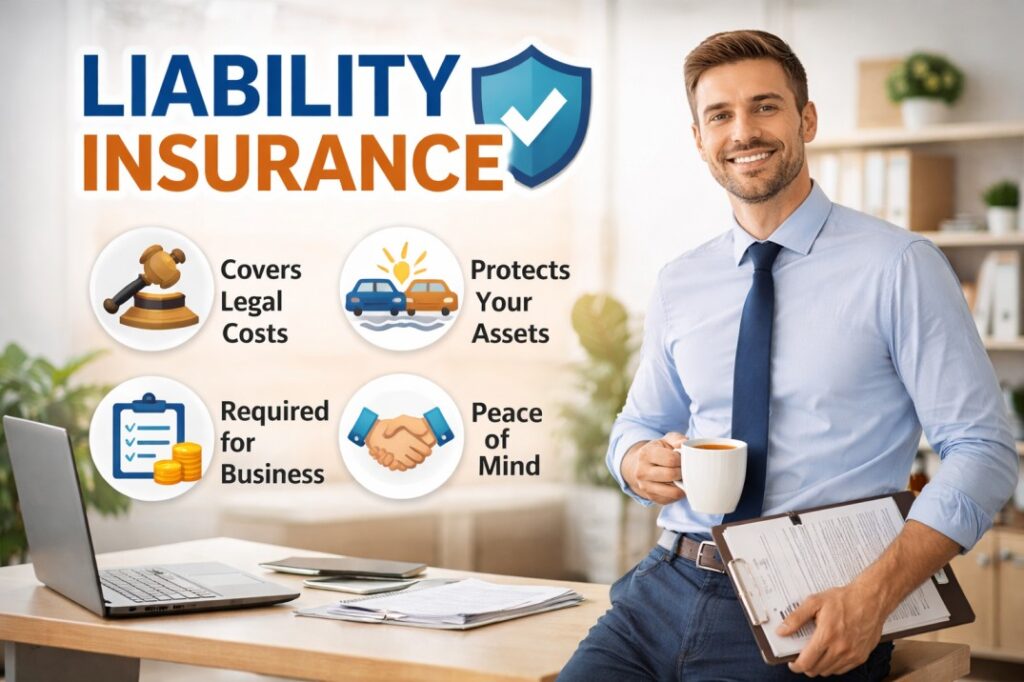

Imagine you accidentally leave a ladder leaning against a neighbor’s window, the ladder slips, the window breaks, and someone slips on the glass and gets hurt. Who pays for the hospital bills, repairs, and legal fees if they sue? That’s where liability insurance steps in: it helps cover the costs when you are legally responsible for harm to someone else. In short, liability insurance protects your wallet—and sometimes your business reputation—when third parties suffer injury, property damage, or financial loss because of you. III+1
Definition
Liability insurance is a type of insurance that pays to defend and, if necessary, to pay damages to a third party for which the insured is legally responsible—such as bodily injury, property damage, or personal/advertising injury. It generally covers legal defense costs, settlements, and judgments up to the policy limits (but not intentional wrongdoing). III+1
Why liability insurance matters
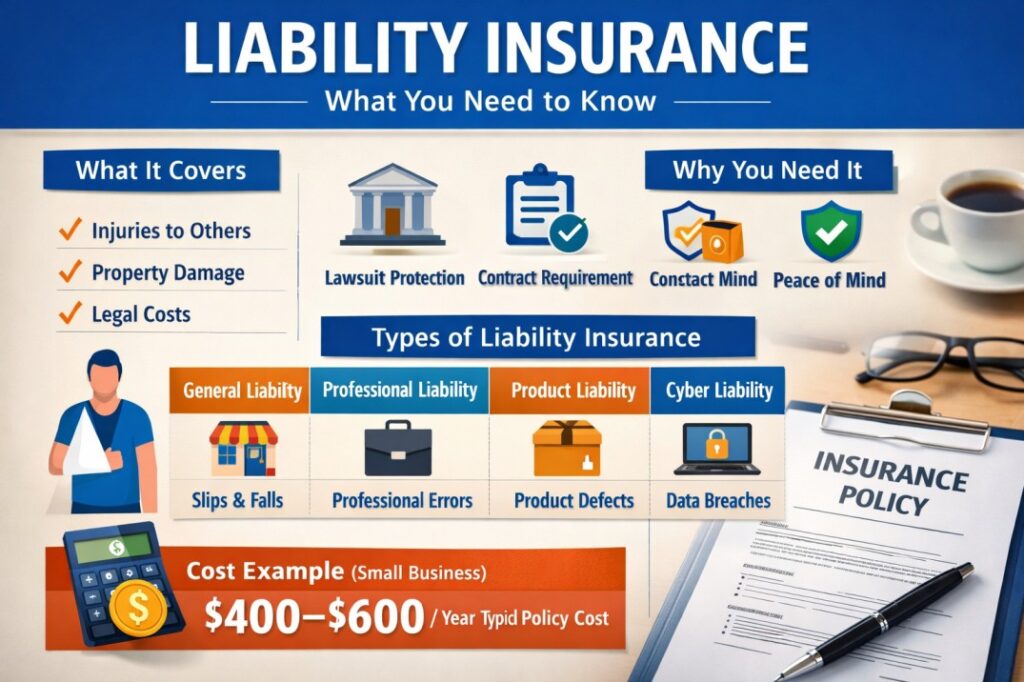
- Lawsuits are expensive. Legal defence alone can bankrupt small businesses or drain personal savings-even if the claim is later dismissed. Liability insurance covers defense and settlement costs. III
- You can be sued by customers, clients, or bystanders. A slip at your café, a negligent professional opinion, or a product that harms a buyer can all trigger claims. Different liability policies exist because different exposures exist. Investopedia+1
- It’s often contractually required. Landlords, clients, or regulators may require proof of coverage before they do business with you.
- Peace of mind = better focus. Knowing you won’t lose everything over one accident helps you run your life or business without constant fear.
Types of liability insurance – a simple comparison table
| Type | Who needs it | What it covers (in plain terms) | Typical exclusions |
|---|---|---|---|
| General Liability (CGL) | Most businesses with customers or walk-in traffic | Bodily injury, property damage, advertising injury (e.g., slander) caused by business operations or premises. | Professional errors, employee injuries, intentional acts. III |
| Professional Liability / Errors & Omissions (E&O) | Consultants, accountants, real estate agents, designers, doctors (often called malpractice) | Financial loss suffered by clients because of mistakes, negligence, or poor advice. Often “claims-made.” Investopedia | Bodily injury (unless linked), intentional wrongdoing. |
| Product Liability | Manufacturers, packagers, sellers of products | Injuries or damage caused by a product defect. | Misuse of product, contractual liabilities. IRDAI |
| Employer’s Liability / Workers’ Comp | Employers | Employee injuries at work (varies by country). Workers’ comp often required by law. | Independent contractors may be excluded. |
| Cyber / Data Breach Liability | Any business that stores client/customer data | Costs of data breaches: notification, legal, regulatory fines (where insurable), plus reputational services. | Criminal acts, intentional breaches. |
| Directors & Officers (D&O) | Boards and senior executives | Claims alleging mismanagement, breach of duty, or bad governance. | Fraud/intentional illegality. |
(Use this table as a checklist when thinking about which risks you face—different activities call for different policies.) Investopedia+1
How liability insurance actually works – the mechanics
- Someone gets hurt or suffers loss. They allege it was your fault.
- They make a claim or file a lawsuit. You notify your insurer.
- Insurer defends you. Most liability policies pay legal defense costs first.
- Settlement or judgment. The insurer pays up to policy limits; you may owe deductibles.
- Subrogation. If someone else was actually at fault, the insurer may pursue recovery from them.
Important nuance: Many professional liability policies are written on a claims-made basis (they cover claims made while the policy is in force). Others (like some general liability policies) use an occurrence trigger (they cover incidents that happen during the policy period even if the claim comes later). Read the policy wording carefully. Investopedia
How much does liability insurance cost? (real figures and what affects price)
Costs vary hugely by country, industry, risk profile, and coverage limits. As examples from recent market overviews:
- For many U.S. small businesses, general liability averages roughly $360–$500 per year depending on business type and limits. Some providers report averages near $42/month ($500/year) for general liability. For broader small-business insurance packages (BOPs), costs might be $684/year on average. Feather Insurance+1
- Specialty coverages (professional liability, cyber, D&O) often cost more—professional liability premiums can range from several hundred to thousands yearly based on profession and claims history. Investopedia
Key cost drivers:
- Industry risk (construction vs. tutoring)
- Revenue / payroll / employee count
- Claims history / loss ratio
- Limits and deductibles chosen
- Geographic location and regulatory environment
Tip: Shop multiple carriers and consider bundling (Business Owner’s Policy) if it fits—bundles can lower overall cost. Insureon
Common misunderstandings (and how to avoid them)
- “My homeowners policy will cover everything.” Not true for many business activities. Home insurance may offer limited liability but often excludes regular business activities or professional services. Consider a business policy or endorsements for home-based businesses. Investopedia
- “I don’t need it—nobody will sue me.” People sue more often than we think; legal costs—not just payouts—make uninsured claims dangerous.
- “Cheapest policy is fine.” Lowest price may mean gaps in coverage or low limits. Cost vs. risk: what would you lose if a major claim occurred?
- “It covers intentional acts.” Liability insurance usually excludes intentional wrongdoing and criminal acts.
Choosing the right coverage – short checklist
- Identify your exposures: customers, clients, employees, products, digital data.
- Prioritize coverages: general liability for customer-facing businesses; professional liability for advice/services; cyber for data-heavy operations. III+1
- Compare limits: Common small business limits are $1M per occurrence / $2M aggregate; adjust if contracts or risk suggest higher.
- Read exclusions carefully. Ask for written explanations of anything unclear.
- Consider an umbrella liability policy if you want higher limits above primary policies.
- Talk to a licensed broker who understands your industry—generic agents may miss niche exposures.
A short real-world example
I know a small interior-design consultancy that mostly did freelance projects from home. They relied on a basic homeowner’s policy and thought they were low-risk. A client claimed that poor structural advice led to a costly cabinet collapse that damaged flooring and the client’s property. The client sued for repair costs and lost business. Legal defense and settlement offers quickly exceeded the homeowner policy’s business-related exclusions. The designer ended up switching to a BOP plus professional liability lesson: when you provide professional advice or have clients on-site, a standard home policy often isn’t enough. (This kind of professional exposure is exactly why E&O/professional liability exists.) Investopedia+1
Liability insurance around the world
India has its own product liability and public liability frameworks and insurers offering tailored liability covers for businesses and MSMEs. The Insurance Regulatory and Development Authority of India (IRDAI) publishes model product liability documents and public liability policy terms—so Indian businesses should check IRDAI guidance and local insurers when buying cover. IRDAI+1
Market trend – premiums and pricing (short outlook)
After pandemic volatility and high-profile litigation in certain sectors, liability pricing has been generally firm in recent years. Reports indicate periodical increases in liability pricing in markets like the U.S., even while some global segments eased slightly. That means buyers should expect premiums to reflect current claims trends for their industry and may face higher renewal prices in some sectors. Alexander Insurance+1
Quick decision flow: Do I need liability insurance?
- Do you have customers/clients or frequent visitors? → Yes → General liability likely needed.
- Do you give professional advice, prepare plans, or promise outcomes? → Yes → Professional/E&O recommended.
- Do you make or sell physical products? → Yes → Product liability needed.
- Do you keep customer data (emails, payment details)? → Yes → Cyber liability worth considering.
If any answer is “yes,” get quotes and speak to a broker—don’t rely on guesswork.
Final takeaway
Liability insurance isn’t about being paranoid—it’s about financial resilience. One accident, one claim, or one unhappy client can create bills and legal fights that wipe out years of savings or hard-earned business value. Match coverage to the real risks you face (not the ones you hope you’ll never encounter). Treat liability insurance as a business and life essential: cheaper than bankruptcy, and invaluable when the unexpected happens.
Disclaimer: The content provided is for educational and informational purposes only and should not be considered financial, investment, insurance, or legal advice.