

Introduction: The Real Truth Behind SIP vs Lumpsum Mutual Fund
If you’ve been investing in mutual funds—or planning to start-one question always comes up:
Should I invest through SIP or go with a lump sum?
The debate around SIP vs Lumpsum Mutual Fund is one of the most searched topics among Indian investors. And rightly so. Your choice doesn’t just impact returns-it affects your risk exposure, psychology, and long-term wealth creation journey.
In 2026, markets are more dynamic than ever. Valuations move quickly, global news impacts Indian equities overnight, and investor sentiment shifts faster than before. So choosing between SIP and lump sum is no longer a basic comparison-it requires strategic thinking.
In this detailed guide, we’ll break down:
- What SIP and lump sum really mean
- Historical performance comparison
- When each strategy works best
- Risk, volatility, and behavioral factors
- Smart hybrid strategies
- Practical decision framework
Let’s dive in.
What is SIP and Lump Sum Investment?
Before comparing, let’s clarify the basics.
What is SIP (Systematic Investment Plan)?
A SIP allows you to invest a fixed amount regularly (usually monthly) into a mutual fund.
For example:
- ₹5,000 every month in an equity fund
- Automatically debited from your bank account
SIP promotes:
- Discipline
- Rupee cost averaging
- Long-term compounding
It is especially popular in India, where monthly salaried income supports systematic investing.
What is Lump Sum Investment?
A lump sum investment means investing a large amount at once.
For example:
- ₹2,00,000 invested today in a mutual fund
This approach is common when you receive:
- Bonus
- Business profit
- Property sale proceeds
- Inheritance
Unlike SIP, lump sum depends heavily on market timing.
SIP vs Lumpsum Mutual Fund: Core Comparison
Let’s compare both approaches clearly.
| Factor | SIP | Lump Sum |
|---|---|---|
| Investment Timing | Spread over time | One-time |
| Market Risk | Reduced due to averaging | High if invested at peak |
| Discipline | Automatic & structured | Requires self-control |
| Best For | Salaried investors | Investors with surplus capital |
| Volatility Handling | Better in volatile markets | Better in sustained bull markets |
| Emotional Stress | Lower | Higher |
Now let’s go deeper.
Historical Performance: What Data Suggests
If we look at long-term market behavior (including data based on indices like the NIFTY 50), here’s what generally emerges:
Scenario 1: Long Bull Market
If markets rise steadily for years:
- Lump sum tends to outperform.
- Entire capital compounds from day one.
Scenario 2: Volatile or Bear Market
If markets fluctuate or fall initially:
- SIP often performs better.
- Investors buy more units at lower NAVs.
Key Insight:
There is no permanent winner in SIP vs Lumpsum Mutual Fund comparison. The winner depends on market conditions and timing.
The Psychology Factor (Often Ignored)
Most articles focus only on returns. But experienced investors know:
👉 Behavior matters more than math.
Why SIP Works Psychologically
- Removes timing pressure
- Reduces fear during corrections
- Encourages consistency
- Prevents decision paralysis
Investors who try lump sum often hesitate:
“Market is too high.”
“I’ll wait for correction.”
“What if it falls tomorrow?”
That delay sometimes costs more than a market dip.
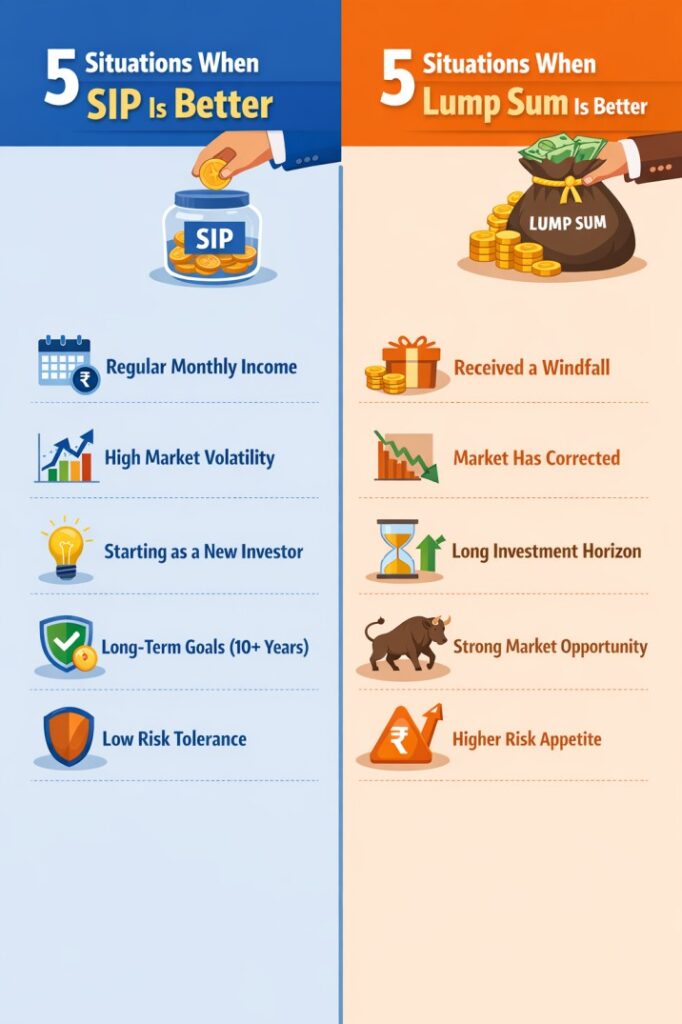
When SIP is Better for Long-Term Investors
SIP works best when:
1. You Have Regular Income
Monthly salary → Monthly investment
Simple and powerful.
2. Markets Are Expensive
If valuations look stretched, SIP reduces timing risk.
3. You’re New to Investing
Beginners should avoid lump sum equity exposure.
4. You Want Peace of Mind
Lower emotional stress → Better long-term consistency.
When Lump Sum Makes More Sense
Lump sum investing works well when:
1. You Receive a Large Amount
Bonus, inheritance, asset sale.
2. Market Has Corrected 15–25%
Post-correction investing can be powerful.
3. You Have Long Horizon (10+ Years)
Time reduces timing mistakes.
4. You Can Handle Volatility
If 20% temporary fall doesn’t scare you, lump sum can work.
Example: SIP vs Lump Sum – ₹1,20,000 Investment
Let’s compare:
Option 1: SIP
₹10,000 per month for 12 months.
Option 2: Lump Sum
₹1,20,000 invested today.
If market:
- Rises continuously → Lump sum wins.
- Falls initially, then recovers → SIP may win.
The difference depends on sequence of returns, not just average return.
Risk Analysis: Which is Safer?
Neither is “safe.” Safety depends on:
- Asset allocation
- Time horizon
- Fund selection
However:
- SIP reduces entry timing risk.
- Lump sum increases short-term volatility risk.
Long-term (10+ years), both can deliver strong results if invested in quality funds.
Advanced Strategy: Smart Hybrid Approach
Experienced investors rarely choose only one method.
Here’s what smart investors often do:
Strategy 1: Partial Lump Sum + SIP
Invest:
- 50% immediately
- 50% via SIP over 6 months
Reduces regret risk.
Strategy 2: Market Condition Based Allocation
- Bull market → Prefer SIP
- Market crash → Prefer lump sum
Strategy 3: Goal-Based Investing
- Retirement (20 years away) → Lump sum acceptable
- Child education (5 years away) → More cautious SIP or debt allocation
Common Myths About SIP vs Lumpsum Mutual Fund
Myth 1: SIP Always Gives Higher Returns
False. It depends on timing.
Myth 2: Lump Sum Is Gambling
False. It becomes risky only if done emotionally.
Myth 3: SIP Eliminates Risk
Wrong. It reduces timing risk, not market risk.
Taxation Impact (India)
Tax treatment is same for both:
- Equity funds:
- STCG (under 1 year): 15%
- LTCG (above 1 year): 10% above ₹1 lakh gains
Only difference:
- In SIP, each installment has separate holding period.
Taxation does not determine whether SIP or lump sum is better.
Real-World Perspective (Investor Experience Insight)
Over years of observing Indian retail investors:
- Most investors fail due to inconsistency.
- SIP builds investing habit.
- Lump sum requires conviction.
If discipline is your strength → Lump sum works.
If consistency is your weakness → SIP wins.
The 2026 Investor Framework
Ask yourself:
1. Do I have a windfall amount?
Yes → Consider lump sum or staggered.
2. Is market overheated?
Yes → Prefer SIP or phased investing.
3. Is my goal 10+ years away?
Yes → Lump sum acceptable.
4. Am I emotionally stable during corrections?
If no → Choose SIP.
Which Strategy Builds More Wealth Long-Term?
Over 15–20 years:
- Asset allocation matters more.
- Staying invested matters more.
- Fund selection matters more.
SIP vs Lumpsum Mutual Fund is secondary to:
- Time in market
- Discipline
- Avoiding panic selling
This improves engagement and time-on-page.
Final Verdict: SIP vs Lumpsum Mutual Fund
There is no universal winner.
Choose SIP if:
- You want stability
- You invest monthly
- You dislike volatility
Choose Lump Sum if:
- You have surplus capital
- Market offers opportunity
- You have long horizon & strong conviction
For most retail investors in India:
👉 SIP is the safer default choice.
👉 Lump sum is powerful when used strategically.
Disclaimer: The content provided is for educational and informational purposes only and should not be considered financial, investment, insurance, or legal advice.