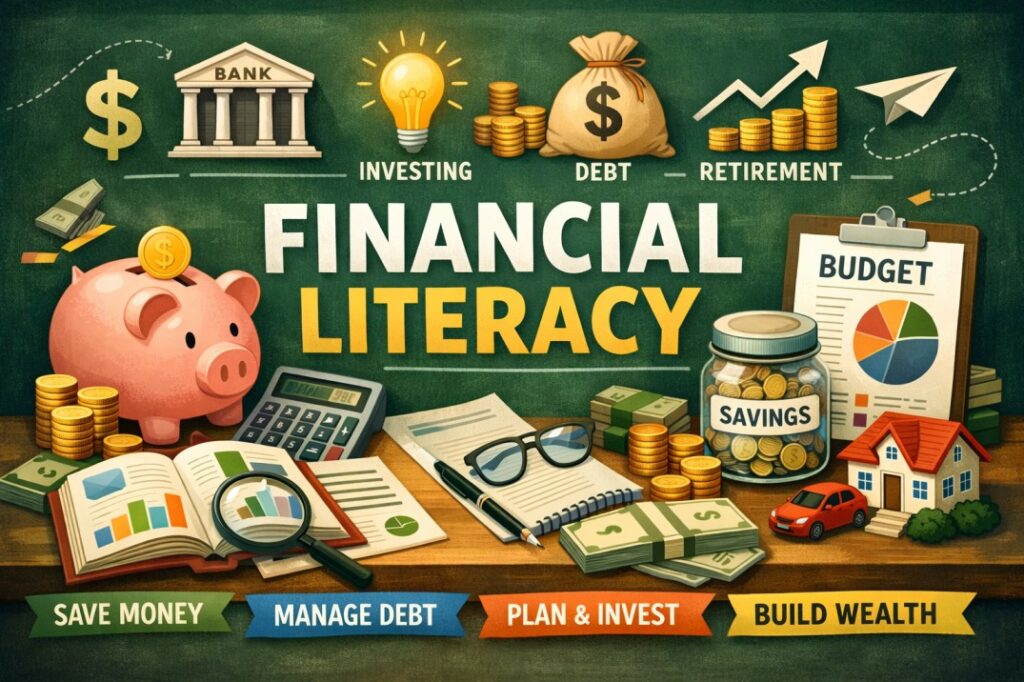

Introduction – Why personal financial literacy matters more than you think
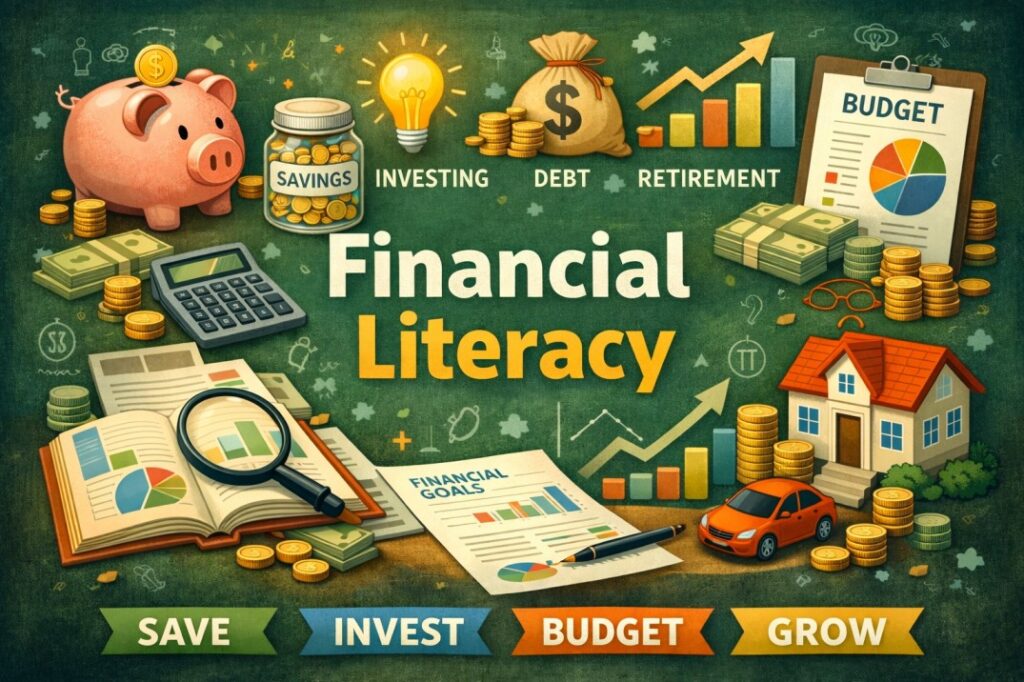
If you’ve ever felt anxious opening a bank statement, avoided retirement planning, or wondered why saving “later” never happens – you’re not alone. Personal financial literacy is the set of skills and knowledge that help people make smart money decisions: budgeting, borrowing, saving, investing, and protecting assets. It’s the difference between reacting to money crises and planning for the life you want. The good news? It’s learnable – and the payoff is huge. World Bank
Quick reality check: Where the world stands
- Global surveys find wide variation in financial knowledge, behaviour and attitudes — even in high-income countries. Many people score low on core concepts like inflation, diversification, and interest compounding. OECD
- In the U.S., long-running studies show persistent gaps in capability: knowledge may be stable, but satisfaction with personal finances and resilience is often low. Finra Foundation+1
- In India, national assessments show that only a minority have adequate financial knowledge — highlighting a strong need for targeted education. NCFE+1
These facts aren’t meant to shame – they show opportunity. Systems and products are complex; structured learning makes a real difference. World Bank
Comparison: Financial knowledge vs. financial capability
| Aspect | Financial knowledge | Financial capability |
|---|---|---|
| What it measures | Facts and concepts (inflation, interest) | Ability to apply knowledge in real life (budgeting, choosing products) |
| Outcome | Understanding | Behavior and decisions – e.g., saving, avoiding predatory credit |
| Example | Knows what compound interest is | Chooses the right savings vehicle and invests regularly |
Both matter – you need knowledge and practice. The World Bank and OECD emphasise capability (knowledge + behaviour) as the policy goal. World Bank+1
Key insights (research-backed and actionable)
1) Start with the simplest metric: your cashflow
Most financial trouble begins with negative or unpredictable cashflow. Track every rupee/dollar for 30 days. Use a simple three-bucket rule:
- Essentials (bills, food, transport)
- Savings (emergency fund + goals)
- Discretionary (fun — yes, include it)
An honest tracking habit reveals where small changes can free up meaningful savings. Research shows behaviour (tracking and planning) correlates with better outcomes. Finra Foundation
2) Emergency fund = financial hygiene
Aim for 3-6 months of essential expenses. If you’re a freelancer or in an uncertain job, edge toward 6-9 months. Having this buffer reduces the chance you’ll sell investments at the worst time or rely on costly credit.
3) Debt strategy: prioritize rate and risk
Not all debt is equal. Sort debts by interest rate and urgency:
- High-rate unsecured (credit cards) → priority
- Medium-rate (personal loans) → next
- Low-rate, tax-advantaged (some mortgages, student loans) → consider longer-term strategy
Behavioural tip: When possible, automate an extra payment once a month — small extra amounts shorten payoff time drastically.
4) Investing: compounding beats timing
Time in the market matters more than timing the market. Start with low-cost, diversified funds (index funds or broadly diversified ETFs) and increase contributions over time. For goal planning, match vehicle to horizon (liquid savings for 1–3 years, equities for 5+ years). OECD and investor-education studies emphasize the role of diversification and cost awareness. OECD+1
5) Financial literacy is also emotional literacy
Money decisions are weighted by fear, shame, and optimism bias. Building simple systems (automation, accountability partners, check-ins) reduces emotional mistakes. Education programs that pair concepts with practice (simulations, real small steps) are far more effective than lectures alone. World Bank
A short, practical 6-week plan to improve your financial literacy
6 week plan is below:
1 – Baseline: Track 30 days of spending; identify one leak to stop.
2 – Buffer: Open a dedicated emergency account and set an automated weekly transfer.
3 – Debt: List debts with rates; make a plan to tackle the highest-rate debt first.
4 – Investing basics: Read about indexing and compounding; start a small automated investment (SIP/auto-debit).
5 – Protection: Review insurance (health, life if dependents) and secure necessary cover.
6 – Plan: Write a one-page “money manifesto” — three short-term goals, three long-term goals, and monthly steps.
This plan trades lofty goals for concrete habits — and habits build capability.
Common traps and how to avoid them
- Trap: Chasing “hot” investment tips. → Fix: Build a core of low-cost diversification.
- Trap: Ignoring small recurring expenses. → Fix: Quarterly subscription audit.
- Trap: Waiting for the “perfect” time to start. → Fix: Start tiny and automate.
Research shows incremental habits beat dramatic “resets.” Commit to one tiny change and make it automatic. Finra Foundation
Example – A short true vignette
When I started, I emptied my wallet into three jars for a month (bills, save, fun). It made invisible trade-offs visible – suddenly lunch and rideshares felt like choices, not background noise. That visibility helped me automate 10% of my income into a savings account and a small monthly index fund SIP. Six months later, the emergency fund existed; 18 months later, I had a “free money” buffer that made job transitions far less stressful. Real learning was in the habit, not the theory.
Conclusion Personal financial literacy is a journey, not a badge
Knowledge, practice, and systems together create capability. Use proven frameworks: track first, build a buffer, reduce high-rate debt, automate investing, and protect against catastrophic loss. National and international studies show that these behaviours-not only facts-predict better outcomes. Start small, measure, iterate, and share what you learn.
Disclaimer: The content provided is for educational and informational purposes only and should not be considered financial, investment, insurance, or legal advice.