
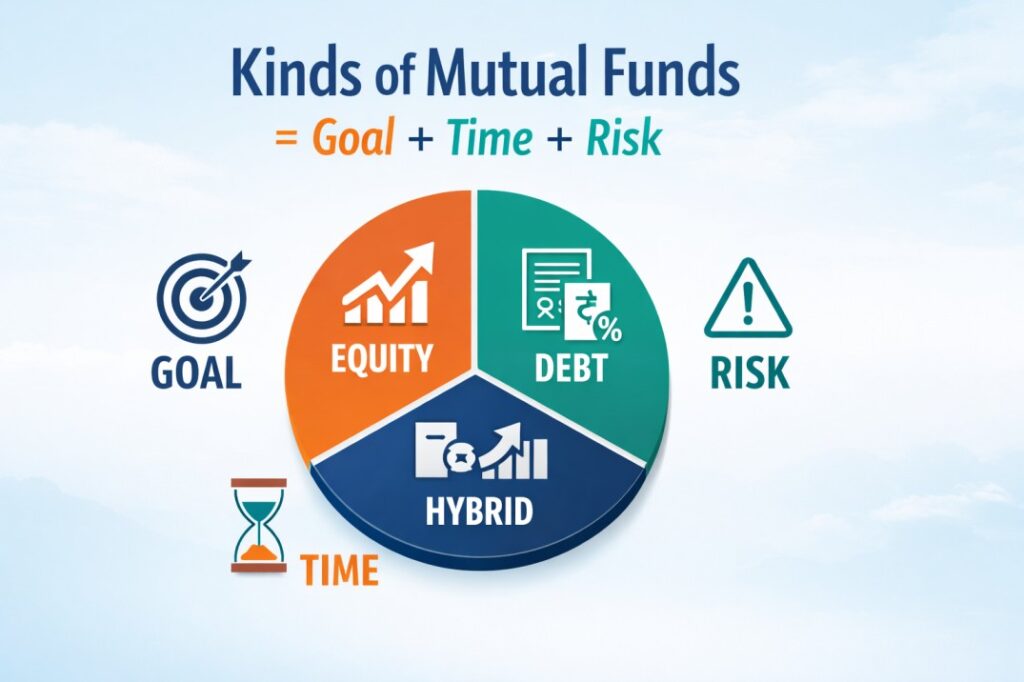

Mutual funds can feel like a jungle at first – so many names, acronyms, and promises. But once you understand the core kinds of mutual funds, you’ll see they’re really just different tools built for different goals: growth, income, stability, or a mix. This post breaks those tools down plainly, compares them side-by-side, and gives you practical signposts to pick the right one for your goal.
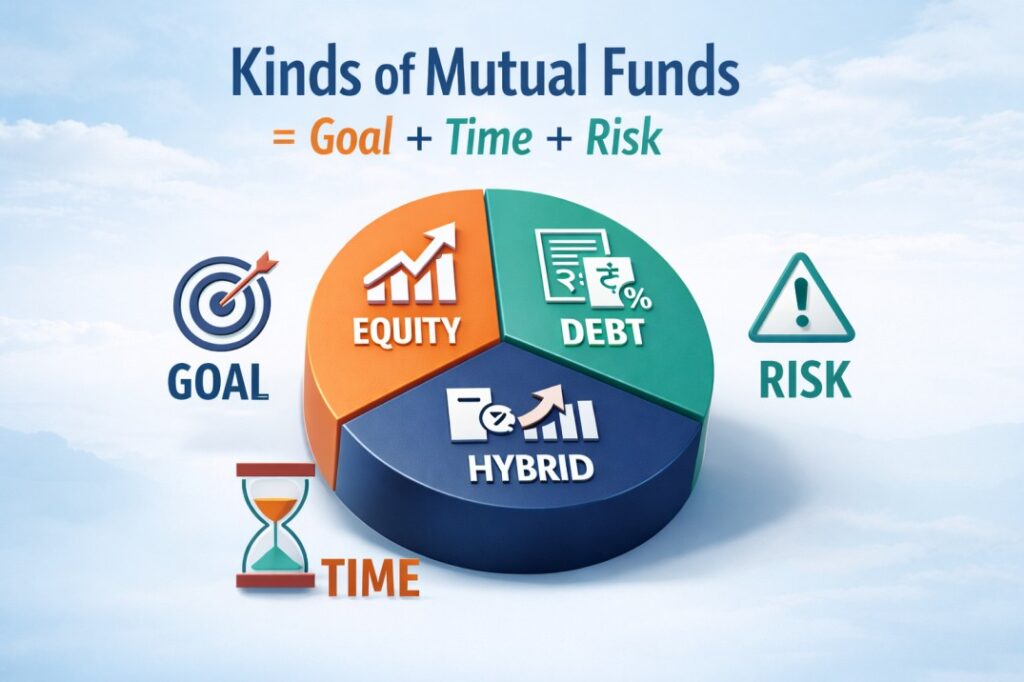
Why categorization matters
Regulators and industry groups classify funds to help investors compare “like with like.” In India, SEBI’s 2017 rationalization and categorization is the baseline used by asset managers and platforms; AMFI also lists scheme categories used by mutual funds. Internationally, providers such as Vanguard and data firms like Morningstar use their own-but consistent-classification systems to help investors compare peers. Securities and Exchange Board of India+2AMFI India+2
The main kinds of mutual funds
1. Equity (Stock) Funds
What they are: Funds that primarily invest in shares. Subtypes include large-cap, mid-cap, small-cap, sector/thematic funds, value/growth, and ELSS (tax-saving) funds.
Best for: Long-term capital growth (typically 5+ years).
Pros: Highest long-term return potential; variety for tactical choices (sector, cap-size).
Cons: High volatility; may not suit short-term needs.
Note: Equity categories are extensive-Morningstar and other data providers break them into many subcategories to allow apples-to-apples comparisons. awgmain.morningstar.com+1
2. Debt (Bond) Funds
What they are: Funds investing in fixed-income instruments – government bonds, corporate bonds, money market instruments. Subtypes: ultra-short, short-duration, medium/long-duration, gilt funds, dynamic bond funds, etc.
Best for: Income, capital preservation, and diversifying equity risk.
Pros: Lower volatility than equities; predictable income in many cases.
Cons: Interest-rate risk (prices fall when rates rise) and credit risk (for corporate bonds). Use duration as your risk dial. AMFI India
3. Hybrid (Balanced) Funds
What they are: Funds that hold both equities and debt in varying proportions (conservative to aggressive). Examples: conservative hybrid (more debt), aggressive hybrid (more equity), multi-asset funds.
Best for: Investors seeking a single product that balances growth and stability.
Pros: Built-in diversification; easier single-fund solution for goal-based investing.
Cons: The balance may not match your personal risk appetite; fees vary. AMFI India
4. Index Funds & ETFs
What they are: Passive funds that track an index (e.g., Nifty 50, S&P 500). ETFs are similar but trade on exchanges.
Best for: Low-cost, long-term investors who believe in market returns and want minimal active risk.
Pros: Low expense ratios; transparent holdings; tax-efficient in some jurisdictions.
Cons: No chance to “beat the market” (by design). Vanguard+1
5. Solution-Oriented / Goal-Based Funds
What they are: Funds structured for specific objectives like retirement or children’s education (often have lock-in periods).
Best for: Investors who want a product tied to a life goal and behavioral nudges to stay invested.
Pros: Automatic discipline, often suitable for long-term goals.
Cons: Less flexibility; may have sub-optimal asset mixes at times. AMFI India
6. Fund-of-Funds (FoF) & Others
What they are: Funds that invest in other mutual funds (domestic or international). Also includes arbitrage funds, liquid/money market funds, FMPs (fixed maturity plans).
Best for: Diversification, access to strategies otherwise hard to reach (like overseas funds).
Pros: Access and diversification.
Cons: Layered fees (fund + underlying funds). AMFI India+1
Quick comparison table: core features at a glance
| Fund type | Typical objective | Risk level | Time horizon | When to use |
|---|---|---|---|---|
| Equity | Growth | High | 5+ years | Long-term wealth creation |
| Debt | Income / preservation | Low–Medium | 1–5 years (varies) | Stability, emergency corpus |
| Hybrid | Mix of growth & income | Medium | 3–7 years | Investors who want one-stop allocation |
| Index / ETF | Market return | Medium–High (market swings) | 5+ years | Cost-conscious investors |
| Solution-oriented | Goal-driven | Depends on mandate | Long-term (often locked) | Retirement/child’s education |
| FoF / Others | Diversification / strategy access | Varies | Varies | Specialist allocation needs |
Key insights investors often miss
- “Type” ≠ “Quality.” A fund’s category doesn’t guarantee performance. Two mid-cap funds can have very different stock picks and risk profiles – compare holdings and manager style. Morningstar categories help compare peers. awgmain.morningstar.com
- Costs matter – especially for passive strategies. Expense ratio differences compound over decades; for index funds, lower cost almost always helps. Vanguard’s emphasis on low cost is the reason many passive investors prefer their funds. Vanguard
- Tax and holding period change outcomes. Equity funds get favorable long-term capital gains taxation in many countries once held over specified periods; debt funds are taxed differently. Know your jurisdiction’s tax rules before deciding. (Check local tax guidance for specifics.)
- Categorization can change. Regulators and AMCs periodically reclassify schemes to reduce investor confusion — read the scheme fact sheet and offer document instead of relying purely on the category name. SEBI’s rationalization aimed to standardize this process. Securities and Exchange Board of India+1
- A single “best” fund rarely exists. Your goals, timeline, and behaviour (do you panic-sell?) determine what’s best. Solution-oriented funds help those who need discipline; index funds suit those comfortable with market swings.
How to pick the right kind of mutual fund (simple 4-step process)
- Define the goal & timeline. Short (<3 yrs) = debt/liquid. Medium (3-7 yrs) = hybrid or mix. Long (5+ yrs) = equity/index.
- Assess risk tolerance. Use your emotional tolerance, not just theoretical risk. If volatility makes you sell, prefer more conservative allocations.
- Choose the product type that maps to (1) & (2). For example, if you want growth but low involvement: a multi-asset or balanced advantage fund may fit. If cost is critical: consider index funds/ETFs.
- Compare funds within the category. Look at holdings, expense ratio, consistency of manager style, and rolling returns vs. category peers. Use Morningstar/Vanguard/SEBI resources to compare. awgmain.morningstar.com+1
Conclusion
Understanding the kinds of mutual funds gives you control – not because it guarantees returns, but because it lets you match a tool to your life plan. Start with your goal, pick the fund type that aligns with your risk and timeline, and then choose the best fund within that category using costs, holdings, and consistency as your filters.
Disclaimer: The content provided is for educational and informational purposes only and should not be considered financial, investment, insurance, or legal advice.



Pingback: Mutual Funds vs Stocks: Smart Invest guide for Long-Term Wealth