

If you’ve ever bought a stock because “everyone was talking about it,” you’re not alone. Many investors enter the market with excitement—but without a structured plan. The difference between long-term wealth builders and short-term gamblers often comes down to one skill: learn how to analyze stocks before investing.
Stock analysis isn’t complicated-but it requires discipline, clarity, and a repeatable framework.
In this complete guide, you’ll learn:
- A practical stock analysis framework
- How to evaluate company fundamentals
- How to measure valuation properly
- How to reduce risk before buying
- A printable checklist you can use every time
Let’s build your investor mindset the right way.
Why Learning How to Analyze Stocks Before Investing Is Critical
The stock market rewards preparation and punishes emotional decisions.
When you analyze properly:
- You avoid overpaying for hype stocks
- You identify financially strong companies
- You reduce downside risk
- You invest with confidence, not fear
Without analysis, investing becomes speculation.
The good news? You don’t need to be a Wall Street analyst. You just need a structured process.
Step 1: Understand the Business First (Not the Stock Price)
Before looking at charts or ratios, ask:
- What does this company actually do?
- How does it make money?
- Who are its customers?
- Is demand growing?
This is called qualitative analysis.
Key Questions to Ask:
- Is the industry growing or shrinking?
- Does the company have a competitive advantage (moat)?
- Are there strong competitors?
- Is the business model sustainable?
If you cannot explain the company’s business in simple terms, you should not invest in it.
Step 2: Analyze Financial Statements (The Foundation of Stock Analysis)
If you want to master how to analyze stocks before investing, you must understand three financial statements:
1. Income Statement
Shows profitability.
Look at:
- Revenue growth (5-year trend)
- Net profit margin
- Earnings per share (EPS)
- Operating margin
Strong sign: Consistent revenue and profit growth.
2. Balance Sheet
Shows financial strength.
Check:
- Total debt
- Cash reserves
- Debt-to-equity ratio
- Current ratio
Red flag: High debt with low cash.
A strong balance sheet gives companies survival power during economic downturns.
3. Cash Flow Statement
Cash is more important than profit.
Look at:
- Free Cash Flow (FCF)
- Operating cash flow trend
- Capital expenditure levels
Positive and growing free cash flow is a major green flag.
Step 3: Key Financial Ratios Every Investor Must Know
Here’s a simple comparison table you can include in WordPress:
| Ratio | What It Measures | Ideal Range |
|---|---|---|
| P/E Ratio | Valuation | Lower than industry average |
| ROE | Profitability | 15%+ |
| Debt-to-Equity | Financial risk | Below 1 (varies by industry) |
| Current Ratio | Liquidity | Above 1.5 |
| ROIC | Capital efficiency | 12%+ |
Let’s break these down.
Price-to-Earnings (P/E) Ratio
Shows how much investors are willing to pay per ₹1 of earnings.
- High P/E → Growth expectations
- Low P/E → Possibly undervalued (or struggling)
Never analyze P/E in isolation. Compare with industry peers.
Return on Equity (ROE)
Measures how effectively management uses shareholder money.
High ROE over many years = strong business quality.
Debt-to-Equity Ratio
Too much debt increases risk.
During recessions, high-debt companies suffer most.
Step 4: Evaluate Competitive Advantage (Economic Moat)
Great companies stay great because they have advantages.
Types of moats:
- Strong brand
- Network effect
- Cost advantage
- Regulatory protection
- High switching costs
Ask yourself:
Can competitors easily copy this business?
If yes, long-term growth may be limited.
Step 5: Analyze Growth Potential
Growth drives stock returns.
Look for:
- Revenue growth rate (5-year CAGR)
- Industry expansion
- New product launches
- International expansion
- Innovation pipeline
But remember:
Growth without profits can be dangerous.
Step 6: Valuation – Are You Paying a Fair Price?
Even a great company can be a bad investment if bought at a very high price.
Two main methods:
1. Relative Valuation
Compare:
- P/E vs competitors
- P/S ratio vs industry
- EV/EBITDA multiples
If the company trades significantly above peers, it must justify that premium.
2. Discounted Cash Flow (DCF) Analysis
DCF estimates intrinsic value based on future cash flows.
Basic idea:
- Forecast future cash flows
- Discount them back to today’s value
- Compare intrinsic value with current price
If intrinsic value > market price → Potential opportunity.
If intrinsic value < market price → Overvalued.
Step 7: Technical Analysis (Timing Your Entry)
Fundamentals tell you what to buy.
Technical analysis helps decide when to buy.
Basic indicators:
- 50-day & 200-day moving averages
- Support and resistance levels
- Volume spikes
- RSI (Relative Strength Index)
For long-term investors, use technicals to avoid buying during heavy downtrends.
Step 8: Check Management Quality
Bad management can destroy good businesses.
Look at:
- CEO track record
- Insider ownership
- Capital allocation history
- Transparency in earnings calls
Management integrity matters more than short-term profits.
Step 9: Risk Assessment (Often Ignored by Beginners)
Before investing, ask:
- What could go wrong?
- Is revenue dependent on one product?
- Is there regulatory risk?
- Is the company exposed to currency or commodity volatility?
Smart investors focus more on risk than returns.
Step 10: Macroeconomic and Sector Analysis
Economic factors affect stocks:
- Interest rates
- Inflation
- GDP growth
- Government policies
For example:
- Rising rates hurt high-growth tech stocks.
- Economic expansion benefits cyclical sectors.
Always analyze the broader environment.
Fundamental vs Technical Analysis (Quick Comparison)
| Factor | Fundamental Analysis | Technical Analysis |
|---|---|---|
| Focus | Company value | Price trends |
| Time Horizon | Long-term | Short/Medium |
| Tools | Financial statements | Charts & indicators |
| Goal | Identify undervalued stocks | Time entry & exit |
Best approach? Use both.
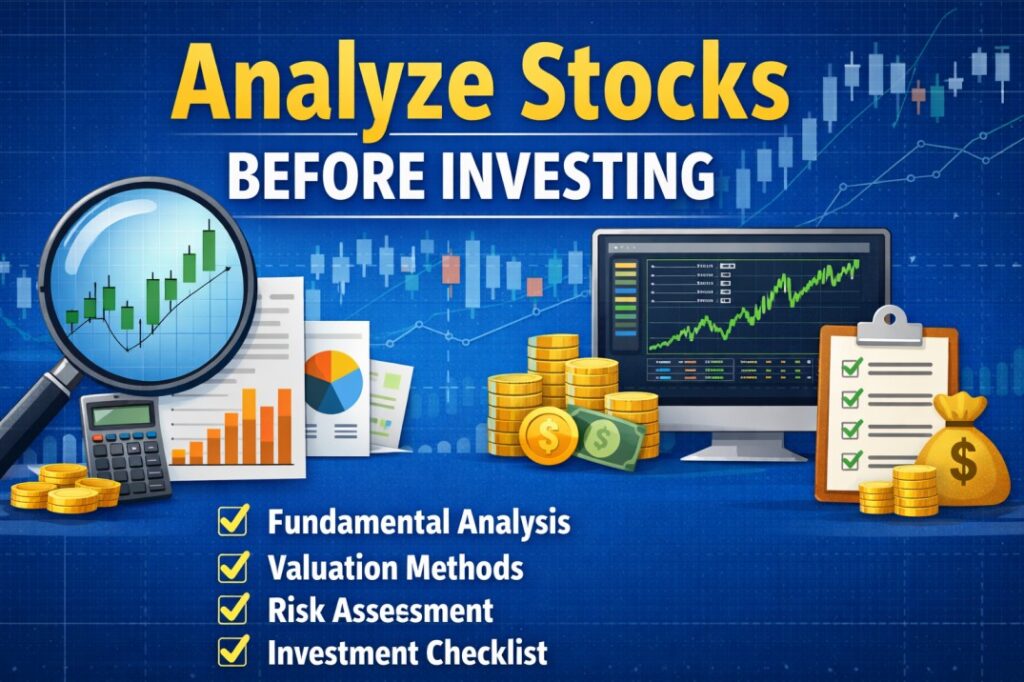
A Complete Stock Analysis Checklist
Before you invest, confirm:
✔ Business model is clear
✔ Revenue & profits growing
✔ Strong cash flow
✔ Manageable debt
✔ Fair valuation
✔ Competitive advantage
✔ Competent management
✔ Risks identified
✔ Entry timing reasonable
If most boxes are checked, you have done solid analysis.
Common Mistakes to Avoid
- Buying based on news headlines
- Ignoring valuation
- Following social media hype
- Not diversifying
- Investing without research
The stock market rewards patience, not impulse.
Real-World Example of Smart Stock Analysis
Imagine analyzing a growing technology company:
- Revenue growing 20% annually
- ROE at 22%
- Low debt
- Strong free cash flow
- Industry expanding
- Trading slightly below peer P/E
That combination signals potential opportunity.
But if the same company had:
- Declining margins
- Rising debt
- Overvalued P/E
You would wait.
Analysis protects capital.
How Long Should Stock Analysis Take?
For serious investing:
- Initial research: 3-5 hours
- Financial deep dive: 2–3 hours
- Valuation modeling: 1–2 hours
Yes, it takes time. But you are investing your money.
Tools to Help You Analyze Stocks
You can use:
- Annual reports
- Investor presentations
- Earnings call transcripts
- Financial data platforms
- Stock screeners
Free tools are enough if used properly.
Long-Term Investing Mindset
Mastering how to analyze stocks before investing is not about predicting tomorrow’s price.
It’s about:
- Understanding businesses
- Managing risk
- Paying fair prices
- Staying patient
Compounding works only when you avoid big mistakes.
Final Thoughts
Stock analysis is a skill that improves with practice.
If you follow a structured approach:
- Understand the business
- Analyze financials
- Check valuation
- Evaluate risks
- Use technical timing
- Stay disciplined
You dramatically increase your chances of success.
The stock market is not a casino.
It’s a place where informed investors build long-term wealth.
Frequently Asked Questions (FAQ)
How do beginners analyze stocks?
Start with business understanding, check financial statements, review key ratios, and compare valuation with competitors.
What is the most important metric in stock analysis?
Free cash flow and return on equity are strong indicators of business quality.
Should I use technical analysis?
Yes, for entry timing. But fundamentals should guide long-term decisions.
How often should I review my stocks?
Quarterly review is sufficient for long-term investors.
Disclaimer: The content provided is for educational and informational purposes only and should not be considered financial, investment, insurance, or legal advice.