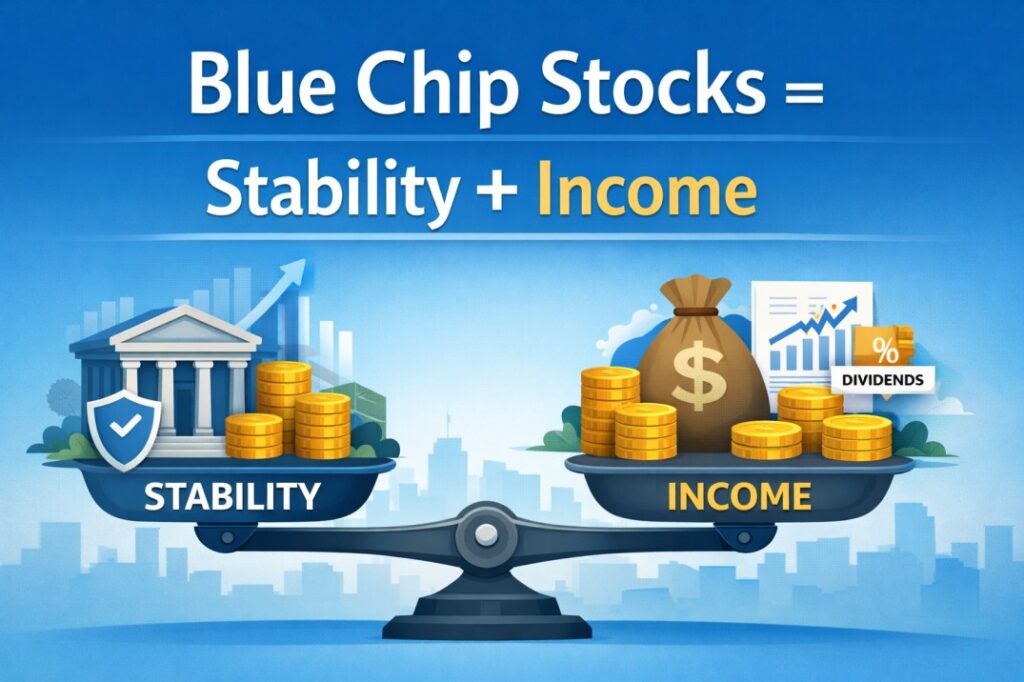

Introduction – a simple promise for nervous investors
If you want investing to feel less like riding a roller coaster and more like driving a reliable car, blue chip stocks are the vehicle most people reach for. These are the large, well-capitalized companies with long track records, strong brands and – often – reliable dividends. They aren’t the fastest growers, but they’re the businesses that tend to be standing when the dust settles. Investopedia
What exactly are “blue chip stocks”?
A blue chip stock is a share in a large, established company with a history of stable earnings, strong balance sheets, and market leadership. These firms are frequently members of major indices like the S&P 500 or the Dow and are commonly used as core holdings in conservative or mixed portfolios. Think of them as the “backbone” names investors add for durability and income, not pure rocket-fuel growth. Investopedia+1
Blue chip vs. growth: a quick comparison table
| Feature | Blue chip stocks | Growth stocks |
|---|---|---|
| Typical market cap | Large / mega-cap | Mid to large, often fast-growing |
| Volatility | Lower | Higher |
| Dividends | Often pay and raise dividends | Often little or no dividends |
| Best for | Income + stability, portfolio core | Capital appreciation, higher risk |
| Examples | Coca-Cola, Microsoft, Procter & Gamble | Fast-growing tech or biotech names |
(For typical examples and lists of modern blue-chip names, see MarketBeat and Motley Fool’s roundups.) MarketBeat+1
Why investors keep blue chips at the center of portfolios (3 big reasons)
1. Durability in downturns
Blue chips are often leaders in durable industries (consumer staples, healthcare, financials, tech giants) and can weather recessions better than smaller peers. That resilience helps reduce portfolio drawdowns and provides a psychological anchor when markets swing. Investopedia
2. Income through dividends (and the power of compounding)
Many blue chips pay dividends and have long histories of increases; programs like the S&P 500 Dividend Aristocrats track companies that have raised dividends for 25+ consecutive years. Consistent dividend growth compounds over decades and smooths overall returns. If you’re building income or a conservative retirement bucket, this matters. S&P Global+1
3. Liquidity & low execution friction
Large market caps mean deep liquidity – you can buy or sell meaningful positions without moving the market. That’s useful both for DIY investors and advisors managing large portfolios. Investopedia
How blue chips fit into different investor plans (practical frameworks)
For beginners: the core-and-satellite approach
- Core: 50–80% in diversified large-cap ETFs (S&P 500, Dow, or large-cap index funds) that contain blue chips.
- Satellite: 20–50% in growth, international, small-cap, or sector bets.
This uses blue chips as the steady “core” while letting smaller positions chase higher growth.
For income investors
Tilt toward blue chips with consistent dividend growth-look at Dividend Aristocrats and Dividend Kings lists as starting filters. Reinvest dividends into the same names or ETFs for long-term compounding. S&P Global+1
For active value investors
Use blue chips selectively: if a high-quality blue chip trades at a valuation discount to history and its fundamentals are sound, it can be a lower-risk way to capture upside.
Common misconceptions (and the reality)
Misconception: Blue chips are “boring” – they don’t grow.
Reality: Many blue chips (think Microsoft, Apple) have produced enormous long-term gains. “Blue chip” describes stability and market leadership, not a cap on upside. The Motley Fool+1
Misconception: All dividend-high stocks are blue chips.
Reality: Some high-yield names are risky (financial trouble or cyclical declines). Always check payout ratios, cash flow and the sustainability of the business model. Recent market shifts show high yields can be a red flag if unsupported by fundamentals. Barron’s
A short, practical checklist before you buy a blue chip stock
- Competitive moat: Does the company have brands, scale or regulatory advantages?
- Cash flow & balance sheet strength: Can it fund dividends and capex without stress?
- Dividend history (if income matters): Have payouts been steady or growing?
- Valuation: Even great companies can be poor buys at extreme prices. Compare P/E, free-cash-flow yield and historical ranges.
- Business health beyond the headline: Read the latest quarterly commentary for signs of demand shifts or margin pressure.
Use reputable sources like company filings, S&P research, Morningstar or the company investor relations page to validate. morningstar.com+1
Real-world context: what 2024–2025 taught investors about blue chips
The rotation into lower-volatility, dividend-paying names during bouts of market turbulence in 2024–2025 showed that investors still value stability when growth expectations wobble. ETFs focused on low-volatility and dividend aristocrats outperformed in certain months, highlighting the role blue chips play as safe havens in rough patches. That doesn’t mean blue chips always win short-term — they underperform during strong growth rallies – but they have proven value in risk management. Barron’s+1
Examples investors often consider (not an endorsement – do your homework)
- Microsoft, Apple – tech giants that are also large-cap staples in many portfolios. The Motley Fool+1
- Procter & Gamble, Coca-Cola – classic consumer staples with durable brands. MarketBeat
- Johnson & Johnson, UnitedHealth – healthcare names with diversified revenue streams. MarketBeat
Table: simple starter screen for blue-chip candidates
| Ticker | Sector | Why it might qualify | What to check next |
|---|---|---|---|
| MSFT | Technology | Market leader, strong free cash flow | Valuation vs. growth, cloud margins |
| PG | Consumer Staples | Portfolio of trusted brands | Organic growth rate, margin trends |
| JNJ | Healthcare | Diversified pharma & devices | Pipeline health, litigation risks |
How to convert knowledge into action (three concrete moves)
- Start with an ETF if you’re new. Broad large-cap ETFs give instant diversification and exposure to many blue chips.
- Dollar-cost average into positions. It reduces timing risk and smooths purchase price over volatility cycles.
- Reinvest dividends (unless you need income). Reinvesting accelerates compounding.
Conclusion – the balanced case for blue-chip stocks
Blue chip stocks won’t make you rich overnight, but they are an essential instrument for sensible, long-term portfolios: durable, liquid, and often income-producing. Use them as a core, not a shortcut – pair them with growth and international sleeves to capture upside while keeping risk manageable. If you remember one thing: blue chips buy you time – time for compounding, for dividends to roll in, and for your plan to survive market storms.
Disclaimer: The content provided is for educational and informational purposes only and should not be considered financial, investment, insurance, or legal advice.