


Last Updated on 12 May 2026
Introduction
Investing becomes easier when your portfolio does not depend on a single asset class. That is exactly why the demand for the best multi asset allocation fund has increased rapidly among Indian investors in recent years.
Many investors struggle with one common problem – when equity markets fall sharply, panic begins. During debt market uncertainty, confidence drops again. Gold rallies during some periods and stays flat during others. Managing all these asset classes separately requires time, research, and emotional discipline.
A multi asset allocation fund solves this issue by combining different asset classes like equity, debt, gold, silver, and sometimes international exposure into a single investment product.
Instead of trying to predict whether stocks, bonds, or gold will outperform next year, these funds diversify automatically.
For long-term investors, this approach can reduce volatility while still creating wealth steadily over time.
In this detailed guide, we will explore:
- What multi asset allocation funds are
- How they work
- Their advantages and risks
- The best multi asset allocation fund options in India
- Which fund may suit different types of investors
- Important mistakes to avoid
If you want a “set-it-and-forget-it” style investment strategy for long-term wealth creation, this article may help you choose wisely.
What is a Multi Asset Allocation Fund?
A multi asset allocation fund is a category of hybrid mutual fund that invests in at least three asset classes.
According to SEBI regulations, the fund must maintain a minimum allocation of 10% in at least three asset classes.
Typically, these include:
- Equity
- Debt instruments
- Gold or commodity-related investments
Some funds also invest in:
- Silver ETFs
- International equities
- REITs & InvITs
- Arbitrage positions
- Commodity ETFs
The biggest advantage is diversification.
When one asset class underperforms, another may help stabilize the portfolio.
For example:
| Market Condition | Equity | Debt | Gold |
|---|---|---|---|
| Bull Market | Strong | Moderate | Weak |
| Recession Fear | Weak | Stable | Strong |
| High Inflation | Mixed | Weak | Strong |
| Falling Interest Rates | Strong | Strong | Moderate |
This balance makes multi asset funds suitable for long-term investors who want lower stress compared to pure equity investing.
Why Investors are Choosing Multi Asset Funds in 2026
The Indian investment landscape has changed significantly.
Investors today face:
- Market volatility
- Global uncertainty
- Inflation concerns
- Interest rate cycles
- Geopolitical risks
Pure equity investing can generate high returns, but it also creates emotional pressure during corrections.
Many investors sell during crashes and buy during euphoria – exactly the opposite of successful investing.
This is where multi asset allocation funds become powerful.
These funds automatically rebalance portfolios across assets.
Instead of making emotional decisions, the fund manager adjusts allocations depending on valuations and market conditions.
That disciplined rebalancing can improve long-term investing behavior.
Key Benefits of Multi Asset Allocation Funds
1. Better Diversification
Diversification is the biggest advantage.
A good multi asset fund combines:
- Growth potential from equity
- Stability from debt
- Inflation hedge from gold
This reduces dependence on one market.
2. Lower Volatility
Compared to pure equity funds, multi asset funds usually experience lower volatility during market corrections.
This helps investors stay invested longer.
And staying invested is one of the most important factors in wealth creation.
3. Automatic Rebalancing
Most investors do not rebalance their portfolios regularly.
A multi asset fund does that automatically.
When equity rises sharply, the fund may reduce exposure and increase debt or gold allocation.
This creates disciplined investing.
4. One Fund Solution
Instead of managing:
- Equity funds
- Gold ETFs
- Debt funds
You get everything inside one product.
That makes portfolio management simpler.
5. Suitable for SIP Investors
Multi asset allocation funds work very well with SIP investing because they reduce timing risk.
Investors can continue investing through different market cycles without worrying too much about asset allocation.
Who Should Invest in Multi Asset Allocation Funds?
These funds are ideal for:
Conservative Equity Investors
People who want equity exposure but cannot handle extreme volatility.
First-Time Investors
Investors who want diversification without building multiple portfolios.
Long-Term SIP Investors
People investing for:
- Retirement
- Financial freedom
- Children’s education
- Wealth creation
Busy Professionals
Those who do not have time to actively manage investments.
Who Should Avoid These Funds?
Multi asset allocation funds may not suit:
- Aggressive investors seeking maximum equity returns
- Traders
- Short-term investors
- Investors expecting quick gains
Because these funds prioritize stability alongside growth, returns may be lower than pure equity funds during strong bull markets.
Best Multi Asset Allocation Fund in India (2026)
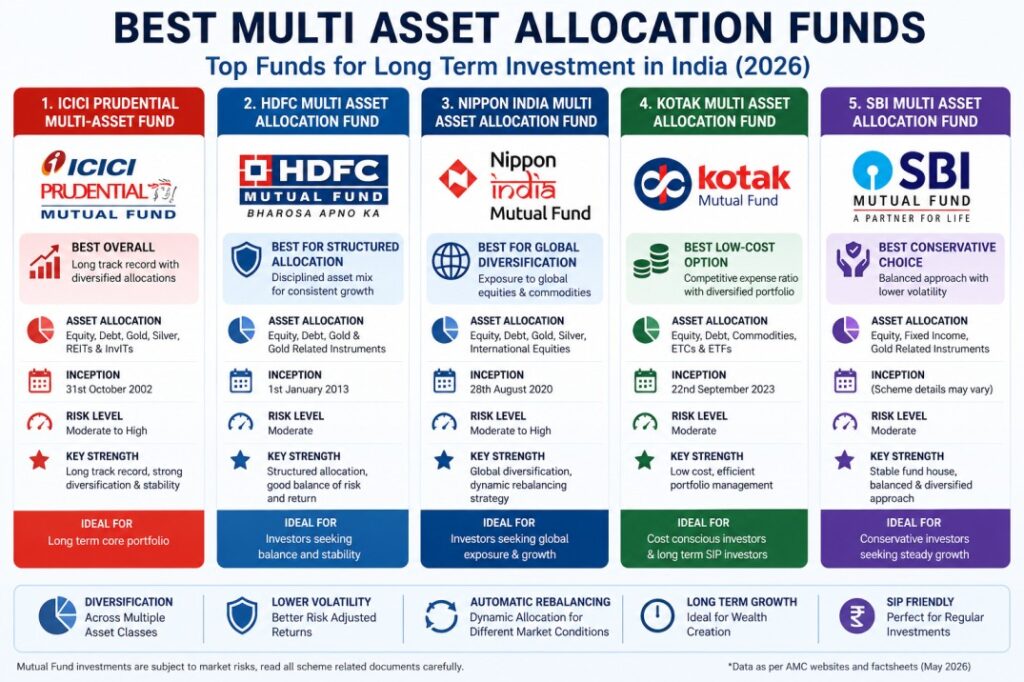
Here are some of the top options available for long-term investing.
1. ICICI Prudential Multi-Asset Fund
Why It Stands Out
If I had to choose the best multi asset allocation fund overall, ICICI Prudential Multi-Asset Fund would be one of the strongest contenders.
This fund has one major advantage:
Long Track Record
Many newer funds look attractive during bull markets, but long-term investing requires consistency across multiple cycles.
ICICI Prudential has managed different market environments over decades.
That matters.
Key Highlights
| Feature | Details |
|---|---|
| Fund Type | Multi Asset Allocation |
| Asset Mix | Equity, Debt, Gold, REITs |
| Ideal For | Long-term core investing |
| Risk Level | Moderate to High |
| Best Feature | Diversified strategy |
Why Long-Term Investors Like It
The fund invests across:
- Equity
- Debt
- Gold ETFs
- Silver ETFs
- REITs & InvITs
This creates a well-balanced portfolio structure.
The fund is suitable for investors who want:
- Stability
- Diversification
- Long-term wealth creation
without actively managing allocations themselves.
2. HDFC Multi Asset Allocation Fund
Best for Structured Allocation Strategy
HDFC’s multi asset fund is popular among investors who prefer disciplined asset allocation.
The fund generally maintains allocations across:
- Equity
- Debt
- Gold-related instruments
This structured framework reduces emotional investing.
Why Investors Prefer It
Strong Equity Component
The fund usually maintains meaningful equity exposure for long-term growth.
Gold Allocation
Gold acts as a hedge during uncertainty and inflationary periods.
Stability from Debt
Debt exposure helps reduce downside volatility.
Best Suitable For
- Moderate risk investors
- SIP investors
- Long-term wealth builders
3. Nippon India Multi Asset Allocation Fund
Best for Global Diversification
This fund stands out because it includes international diversification alongside Indian assets.
That means investors gain exposure to:
- Indian equities
- Debt
- Gold
- Silver
- Global equities
Why This Matters
Many Indian investors are heavily dependent on the domestic economy.
Global diversification can reduce concentration risk.
If international markets outperform Indian markets during some periods, the portfolio may benefit.
Best Suitable For
- Investors seeking broader diversification
- Long-term investors comfortable with global exposure
- Investors looking beyond traditional allocation models
4. Kotak Multi Asset Allocation Fund
Best Low-Cost Multi Asset Fund
Expense ratio matters significantly in long-term investing.
Even small differences can impact long-term compounding.
Kotak’s fund stands out for its competitive expense ratio.
Key Strengths
- Lower costs
- Diversified allocation
- Equity + debt + commodity exposure
This makes it attractive for cost-conscious investors.
Ideal For
- Long-term SIP investors
- Investors focused on cost efficiency
- Beginners building diversified portfolios
5. SBI Multi Asset Allocation Fund
Best for Conservative Long-Term Investors
SBI Mutual Fund has strong brand trust among Indian retail investors.
Its multi asset allocation fund focuses on balanced exposure across:
- Equity
- Fixed income
- Gold-related instruments
Why It Appeals to Investors
Many conservative investors feel more comfortable investing through established fund houses.
This fund is suitable for investors seeking:
- Diversification
- Stability
- Simpler long-term investing
Comparison of Best Multi Asset Allocation Funds
| Fund | Best For | Risk Level | Diversification | Expense Focus |
|---|---|---|---|---|
| ICICI Prudential Multi-Asset Fund | Overall long-term investing | Moderate-High | Excellent | Moderate |
| HDFC Multi Asset Allocation Fund | Structured allocation | Moderate | Very Good | Moderate |
| Nippon India Multi Asset Allocation Fund | Global diversification | Moderate-High | Excellent | Moderate |
| Kotak Multi Asset Allocation Fund | Low-cost investing | Moderate | Good | Excellent |
| SBI Multi Asset Allocation Fund | Conservative investors | Moderate | Good | Moderate |
How to Choose the Best Multi Asset Allocation Fund
1. Check Asset Allocation Philosophy
Not all multi asset funds behave similarly.
Some are equity-heavy.
Others prioritize stability.
Choose based on your risk tolerance.
2. Look Beyond Past Returns
Do not chase only recent performance.
A fund that performed well in one year may underperform later.
Instead, evaluate:
- Portfolio quality
- Risk management
- Diversification
- Long-term consistency
3. Understand Risk Profile
Even though these are diversified funds, they still carry market risk.
Equity exposure can create temporary volatility.
4. Compare Expense Ratios
Lower costs help long-term compounding.
Expense ratio becomes extremely important over 10–20 years.
5. Evaluate Fund House Reputation
Strong fund management and disciplined investing processes matter.
Large, experienced AMCs often manage risk better during difficult market conditions.
SIP vs Lump Sum: Which is Better?
SIP Investing
Best for:
- Salaried investors
- Beginners
- Long-term wealth creation
Advantages:
- Rupee cost averaging
- Lower timing risk
- Disciplined investing
Lump Sum Investing
Best for:
- Investors with large available capital
- Long-term investors during market corrections
However, lump sum investing requires emotional discipline.
Common Mistakes Investors Make
1. Expecting Equity-Like Returns Every Year
Multi asset funds prioritize balance, not maximum aggression.
During strong bull markets, pure equity funds may outperform.
2. Exiting During Underperformance
Different asset classes outperform at different times.
Patience is essential.
3. Comparing Only Recent Returns
Many investors compare:
- 1-year returns
- Recent rankings
That is not enough.
Long-term portfolio construction matters more.
4. Investing Without Goals
Always connect investments to goals like:
- Retirement
- Education
- Financial independence
Are Multi Asset Allocation Funds Tax Efficient?
Taxation depends on the portfolio structure.
Some funds maintain higher equity exposure and may qualify for equity taxation.
Others may follow debt taxation rules depending on allocation.
Investors should always verify the latest taxation structure before investing because taxation rules may change over time.
Consult a financial advisor or tax professional for personalized guidance.
My Personal View on Multi Asset Investing
One important lesson many investors learn late is this:
High returns alone do not create wealth.
Consistency does.
Most investors fail not because markets are bad, but because emotions destroy discipline.
Multi asset allocation funds reduce emotional pressure.
When equity crashes:
- Debt provides stability
- Gold may outperform
This balance helps investors stay invested.
And staying invested for 10–20 years is often more powerful than chasing the hottest fund every year.
That is why I believe multi asset allocation funds deserve a place in many long-term portfolios.
Final Verdict: Which is the Best Multi Asset Allocation Fund?
There is no universal answer because every investor has different goals and risk tolerance.
However:
Best Overall
ICICI Prudential Multi-Asset Fund
Best for Structured Allocation
HDFC Multi Asset Allocation Fund
Best for Global Diversification
Nippon India Multi Asset Allocation Fund
Best Low-Cost Option
Kotak Multi Asset Allocation Fund
Best Conservative Choice
SBI Multi Asset Allocation Fund
For most long-term investors seeking diversification and lower stress, ICICI Prudential Multi-Asset Fund remains one of the strongest all-round options.
For detailed information about Best Large Cap Mutual Funds
Conclusion
Choosing the best multi asset allocation fund is not about finding the fund with the highest short-term return.
It is about selecting a fund that:
- Helps you stay invested
- Manages volatility
- Diversifies intelligently
- Supports long-term wealth creation
Multi asset allocation funds simplify investing by combining equity, debt, gold, and other assets into one portfolio.
For investors who want balanced long-term investing with less emotional stress, these funds can be extremely effective.
The key is patience.
Because in long-term investing, consistency often beats excitement.
For detailed information about Best Small Cap Mutual Funds
Frequently Asked Questions (FAQs)
Which is the best multi asset allocation fund in India?
ICICI Prudential Multi-Asset Fund is considered one of the strongest overall options due to its long track record and diversified strategy.
Are multi asset allocation funds safe?
They are generally less volatile than pure equity funds because they diversify across multiple asset classes. However, they still carry market risk.
Can I invest in multi asset funds through SIP?
Yes, SIP investing works very well for multi asset allocation funds and helps reduce market timing risk.
Are multi asset funds good for long-term investment?
Yes, they are suitable for long-term investors seeking diversification, balanced growth, and lower volatility.
How many years should I stay invested?
A minimum investment horizon of 5-7 years is generally recommended for better long-term results.
For detailed information about Best Mid Cap Mutual Funds
Disclaimer: The content provided is for educational and informational purposes only and should not be considered financial, investment, insurance, or legal advice.