


Last Updated on 17 July 2026
Why Warren Buffett Investments Approach Still Matters in Today’s Chaotic Market
If you’ve ever felt overwhelmed by the chaos of the stock market-the hot takes on social media, the “next big thing” hype, or the fear of missing out-then Warren Buffett’s philosophy is a refreshing reset.
In fact, exploring Warren Buffett investments feels like stepping into a calmer, more rational world—one rooted in patience, discipline, value, and long-term thinking.
But what makes his approach so enduring? Why do his annual letters still guide millions of investors? And more importantly, how can everyday investors apply these principles to navigate an increasingly complex market?
This post dives deep—not just into the quotes you’ve seen a hundred times, but into the logic behind Buffett’s decisions, the psychology that shapes his strategy, and the lessons modern investors can apply today.
The Buffett Way Is Simpler-And More Misunderstood-Than Most People Realize
Buffett’s wisdom is simple enough to fit on sticky notes, yet misunderstood often enough to fill libraries.
Many assume he’s a bargain hunter, chasing “cheap” stocks. Others think he only buys safe, boring companies. Some believe he spends all day buried in spreadsheets.
The truth?
Buffett is driven by a single principle:
Understand a business deeply enough to trust it for decades—not months.
His philosophy combines rationality, patience, emotional discipline, and a focus on fundamentals. Unlike short-term strategies that depend on predicting market movements, Warren Buffett investments thrive even during irrational markets—precisely because they don’t rely on luck or forecasts.
How Warren Buffett Investments Compare to Modern Investing Trends
Buffett’s approach stands in stark contrast to the fast-paced, trend-driven investing culture dominating 2025. Below is a quick comparison.
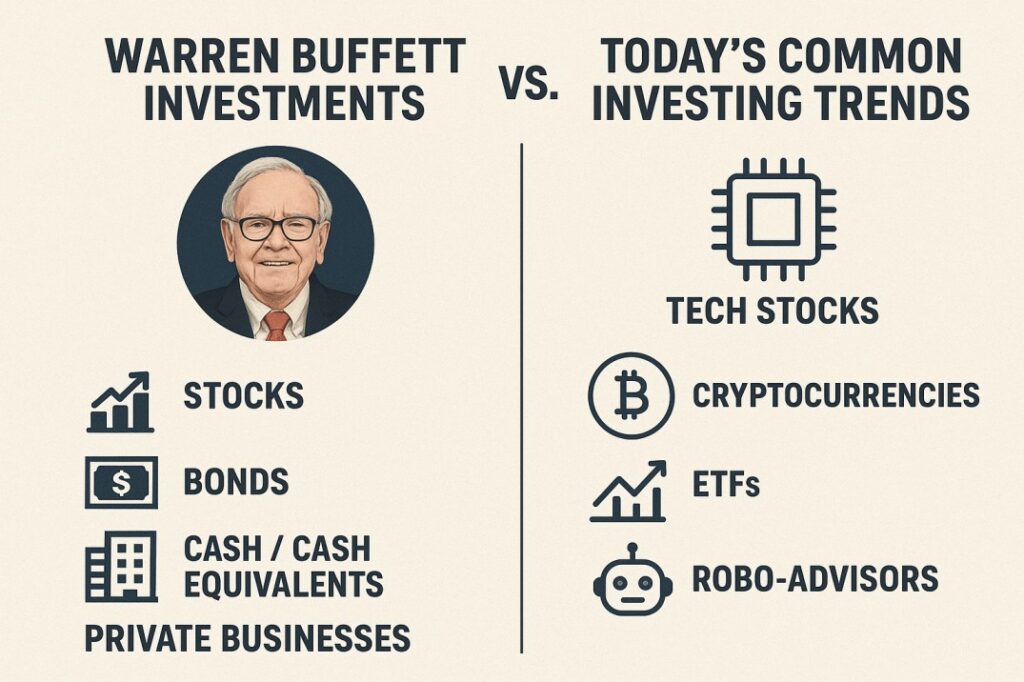
Table: Warren Buffett Investments vs. Today’s Common Investing Trends
| Investing Style | Warren Buffett’s Approach | Modern Trend |
|---|---|---|
| Time Horizon | Decades | Weeks or months |
| Primary Research | Annual reports, intrinsic value, business fundamentals | Social media, influencer opinions, short-term news |
| Core Philosophy | Buy great businesses at fair prices | Chase what’s trending |
| Emotional Style | Patience, objectivity | FOMO, panic selling |
| Portfolio Structure | Concentrated investments | Highly diversified or chaotic |
| View on Volatility | Opportunity | Threat |
Buffett isn’t rejecting technology or modern tools—he’s rejecting emotional decision-making, which remains the biggest threat to long-term wealth.
Timeless Wealth Strategies Inspired by Warren Buffett’s Investment Philosophy
Even in 2025—an era of AI-driven analytics, viral stock tips, and algorithmic trading—Buffett’s principles remain unmatched. Here’s why they still matter:
1. Human Psychology Doesn’t Change
Markets evolve, but human behavior doesn’t. Fear, greed, impatience—these emotional forces drive most investment mistakes. Warren Buffett investments succeed because they neutralize these emotions.
2. Durable Businesses Outlive Trends
Trendy companies come and go. But Buffett-backed companies—Apple, Coca-Cola, American Express—create lasting demand and predictable cash flows.
3. Simplicity Outperforms Complexity
Buffett believes complexity hides risk. Most investors overcomplicate everything; he does the opposite.
Key Insights From Warren Buffett Investments Strategy
Below are the core principles that define Buffett’s approach—paired with fresh, real-world perspectives.
Buy Businesses, Not Stocks — A Core Warren Buffett Investments Mindset
Buffett famously says he buys businesses as if the stock market might close for the next 10 years.
This mindset forces you to answer real questions:
- Will people still need this product decades from now?
- Does the company have a moat that protects profits?
- Would I want to own this business privately?
This shift changed my own investing journey. When I began evaluating companies like real businesses—not ticker symbols—daily price swings felt irrelevant. I started studying revenue models, customer loyalty, and competitive edges instead of reacting to market noise.
Stick to Your Circle of Competence
Buffett avoids industries he doesn’t understand. That’s why he stayed away from early tech—and only invested once companies like Apple became predictable and consumer-driven.
How to apply this:
- Invest only in industries you can explain simply
- Avoid hype-driven sectors you don’t truly understand
- Go deeper into fewer companies instead of spreading yourself thin
Your investing edge comes from clarity, not complexity.
Look for Durable Competitive Advantages (Moats)
A moat is a sustainable advantage that protects long-term profits.
Examples Buffett loves:
- Apple: ecosystem lock-in, brand loyalty
- Coca-Cola: global distribution, emotional brand identity
- American Express: merchant network, trust, prestige
Evaluate moats by asking:
What stops competitors from stealing this company’s customers?
Companies without moats are vulnerable—no matter how exciting they look today.
Be Greedy When Others Are Fearful – A Classic Buffett Principle
Buffett doesn’t fear market crashes—he prepares for them. Berkshire holds billions in cash to deploy when great businesses go on sale.
In simpler terms:
- Market declines = buying opportunity
- Panic selling = discounted assets
- Investor fear = long-term bargains
During the 2020 crash, most investors panicked. Buffett stayed calm and focused on value-proving once again that emotions kill returns more than market downturns do.
Hold Long Enough for Compounding to Work
Buffett built most of his wealth after age 50—not because he got lucky, but because compounding needs time.
His rule is simple:
Buy great businesses and hold them for as long as they stay great.
If you constantly switch investments, you’re fighting compounding—not benefitting from it.
How These Principles Shape Warren Buffett Investments Today
Despite modern disruptions—AI, crypto, geopolitical tension—Buffett’s portfolio remains consistent:
- High-conviction bets (Apple is still massive)
- Cash-rich, predictable businesses
- Minimal speculation
- Patience over performance-chasing
Buffett avoids trends not because he’s old-fashioned, but because trends fade while fundamentals endure.
Practical Ways You Can Apply Buffett’s Wisdom (Starting Today)
Here’s how to turn theory into action:
1. Create a “Never Sell” List
Choose 3–5 companies you believe will dominate their industries long-term.
2. Read annual reports, not headlines
Buffett’s letters are free:
https://www.berkshirehathaway.com/letters/letters.html
3. Maintain a cash buffer
Downturns become opportunities—not threats.
4. Track business performance—not stock price
Focus on:
- Revenue growth
- Margin trends
- Moats
- Customer loyalty
5. Think in decades, not days
Future-you will thank present-you.
Conclusion: Warren Buffett Investments Work Because They Are Human, Not Technical
The power of Warren Buffett investments doesn’t come from special formulas or secret insights. It comes from understanding people, businesses, and behavior.
His philosophy is timeless because it aligns with how great companies grow—and how rational investors think.
If you’re tired of noise, hype, and market panic, Buffett’s approach is more than advice—it’s a path to clarity, calmness, and long-lasting wealth.
Disclaimer: The content provided is for educational and informational purposes only and should not be considered financial, investment, insurance, or legal advice.



Pingback: S&P 500 Fund : Most Trusted Index for Long-Term Investing