

Last Updated on 29 September 2026
Introduction
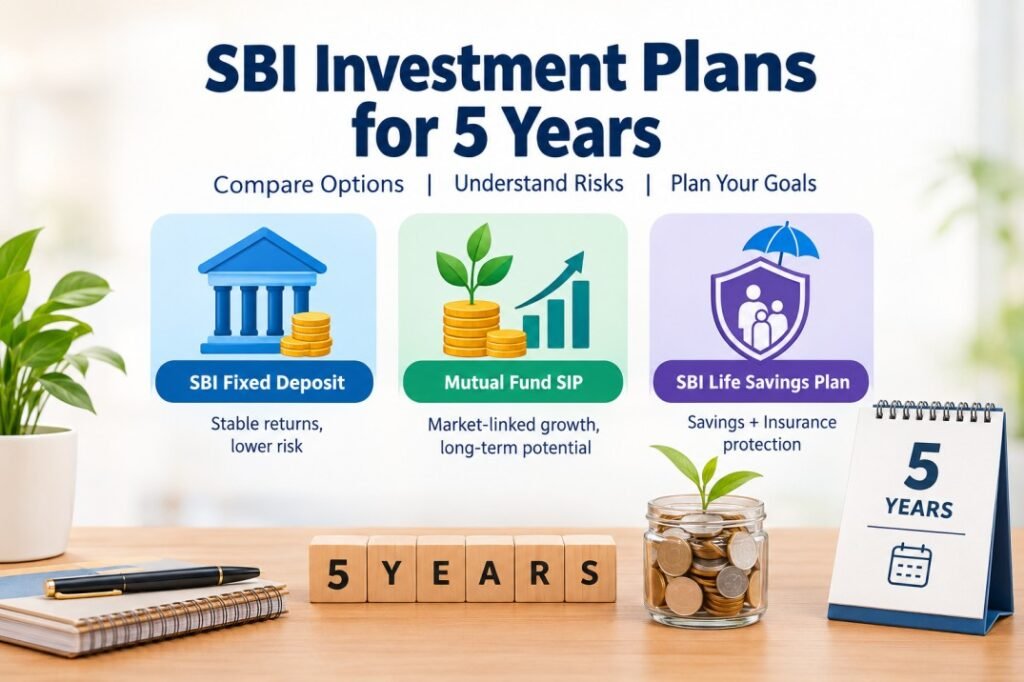
If you have money to invest for exactly five years, choosing the right investment can be surprisingly difficult. You may come across SBI fixed deposits, SBI Mutual Fund schemes, SIPs, and SBI Life savings plans while searching for SBI investment plans for 5 years. However, these products are not designed for the same purpose.
A fixed deposit is primarily designed for predictable interest income and capital preservation. A mutual fund invests in market-linked securities, so its value can rise or fall. An insurance savings plan combines insurance with savings and can have a much longer policy structure than five years.
Therefore, the right question is not simply, “Which SBI plan gives the highest return?”
A better question is:
What do I need this money for after five years, and how much risk can I accept before I need it?
This article explains the major SBI investment options that may be relevant to a five-year horizon, their advantages and disadvantages, taxation considerations, liquidity, and the mistakes beginners should avoid.
What Are SBI Investment Plans for 5 Years?
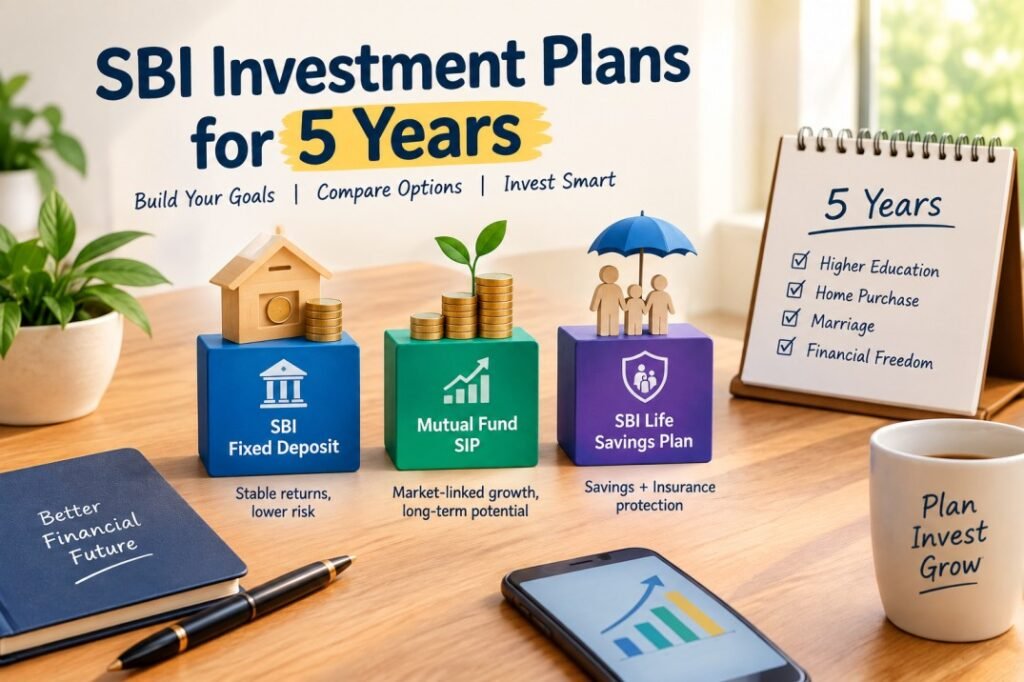
The phrase “SBI investment plans” can refer to different financial products associated with the SBI group.
For a five-year goal, the main categories a beginner may encounter are:
- SBI Bank Fixed Deposits
- SBI Mutual Funds
- SBI Mutual Fund SIPs
- SBI Life savings and insurance plans
- Goal-based combinations of different investments
These products differ significantly.
For example, an SBI FD generally provides a predetermined interest rate for the selected deposit tenure. A mutual fund does not promise a predetermined return because its value depends on the underlying securities.
Similarly, an SBI Life savings policy may provide insurance benefits alongside savings, but it should be evaluated using its policy terms rather than being treated simply as an alternative to an FD.
The five-year period is therefore only one part of the decision.
For detailed information about SBI Retirement Benefit Fund Aggressive Plan Review
Why Does a Five-Year Investment Horizon Matter?
Time horizon is one of the most important factors in financial planning.
Suppose you need ₹5 lakh exactly five years from now for a house-related payment. You cannot necessarily take the same amount of investment risk as someone saving for retirement 20 years away.
Market-linked investments can experience temporary or prolonged declines.
If your goal date is approaching and your investment has fallen significantly, you may not have enough time to wait for a recovery.
This is why the investment horizon and risk level should be considered together.
A simple way to think about it
| Goal | Approximate Horizon | Main Consideration |
|---|---|---|
| Emergency fund | Immediate | Liquidity |
| Short-term purchase | 1–3 years | Capital stability |
| Five-year financial goal | Around 5 years | Balance of risk and stability |
| Retirement | 10+ years | Long-term growth and diversification |
| Child’s long-term education | 10+ years | Inflation and growth |
There is no universal investment that is automatically suitable for everyone with a five-year horizon.
For detailed information about SBI Small Cap Fund Review
Major SBI Investment Options for 5 Years
1. SBI Fixed Deposit
An SBI fixed deposit is one of the simplest options for investors who want a bank deposit with a predetermined interest rate for the chosen tenure.
The interest rate depends on the deposit period and applicable customer category. SBI publishes its applicable domestic term-deposit rates, and these should be checked before opening a new FD because rates can change.
An FD can be useful when your primary objective is relatively predictable accumulation rather than market-linked growth.
How does an SBI FD work?
Suppose you deposit ₹1,00,000 for five years at an assumed annual interest rate of 6.5%.
A simplified annual-compounding illustration would be:
₹1,00,000 × (1.065)^5 ≈ ₹1,37,009
This is only an illustration, not a current SBI maturity quote. Actual maturity depends on the applicable interest rate, compounding method, deposit type, payout option and other terms.
Advantages of SBI FD
- Easy to understand
- Predetermined interest rate for the selected deposit
- Not directly linked to stock-market movements
- Suitable for investors who prefer predictable returns
- Can be useful for defined financial goals
Risks and limitations
An FD is not completely risk-free in the broader financial-planning sense.
The major issues include:
- Inflation can reduce the real purchasing power of your maturity amount.
- Interest income is taxable according to applicable tax rules.
- Premature withdrawal may involve a penalty or reduced interest.
- Reinvestment risk exists when the deposit matures and future interest rates are lower.
For example, earning 6.5% does not mean your real wealth automatically increases by 6.5% after considering inflation and taxes.
2. SBI Mutual Funds
SBI Mutual Fund offers multiple categories of mutual funds, including equity, debt, hybrid, passive and solution-oriented schemes.
The suitability of a mutual fund for five years depends heavily on its category and the specific scheme.
SBI Mutual Fund itself describes equity mutual funds as investments for long-term capital growth with a 5+ year horizon, while hybrid funds are presented around a 3–5 year horizon.
This does not mean every equity fund is suitable for exactly five years.
Five years should generally be viewed as a minimum-type horizon for some equity-oriented investments rather than a guarantee that the investment will produce a positive return at the end of year five.
Equity mutual funds
Equity funds invest substantially in shares.
They can provide long-term capital-growth potential, but their NAV can fluctuate considerably.
For someone who absolutely needs a predetermined amount on a fixed date five years from now, equity exposure requires careful consideration.
Debt mutual funds
Debt funds invest primarily in fixed-income securities.
They may have lower equity-market exposure, but they are not the same as bank FDs and do not offer the same type of predetermined maturity return.
Debt funds can also experience changes in NAV because of interest-rate movements, credit events and changes in the value of their underlying securities.
Hybrid mutual funds
Hybrid funds combine asset classes, commonly equity and debt.
The objective is generally to balance growth potential and stability, although the exact allocation differs by scheme.
For a five-year horizon, a hybrid fund may be considered by investors who want some equity exposure but do not want a pure-equity portfolio.
However, the exact risk level must be checked from the scheme’s current documents.
3. SBI SIP for a Five-Year Goal
A Systematic Investment Plan, or SIP, is a method of investing a fixed amount periodically into a mutual fund.
It is not a separate asset class.
This distinction is important.
For example, investing ₹5,000 every month through SIP into an equity mutual fund does not make the investment low-risk. The risk depends primarily on the mutual fund scheme in which the SIP is made.
SBI Mutual Fund provides SIP facilities and investment options that can be structured for periods such as three, five, ten or fifteen years.
Example of a five-year SIP
Suppose an investor invests:
₹5,000 per month × 60 months = ₹3,00,000
If the investment hypothetically earns 8% annualised over the entire period, the approximate accumulated value could be around ₹3.70 lakh.
If the assumed return were 10%, the illustration would be approximately ₹3.90 lakh.
These figures are mathematical illustrations, not expected or guaranteed returns.
Actual mutual fund returns can be significantly higher or lower.
Why investors use SIPs
SIPs can help investors:
- Develop investment discipline
- Spread purchases over time
- Avoid the need to invest the entire amount at once
- Build a portfolio gradually
- Align investing with monthly salary income
However, SIPs do not eliminate market risk.
4. SBI Life Savings and Insurance Plans
SBI Life offers savings-oriented insurance products that combine life insurance with savings or income features.
These products should be evaluated differently from mutual funds and FDs.
For example, SBI Life’s Smart Platina Plus is presented as a savings product with insurance protection, guaranteed-return features and different premium/payout choices, subject to the policy’s terms and conditions.
The important point is that an insurance product is not simply an investment product.
When evaluating one, you should examine:
- Premium payment term
- Policy term
- Death benefit
- Maturity benefit
- Guaranteed and non-guaranteed benefits
- Surrender conditions
- Liquidity
- Applicable charges
- Tax treatment
- Insurance coverage
Some savings insurance products may have policy structures extending well beyond five years.
Therefore, someone searching for a five-year investment should not assume that an SBI Life policy is automatically a five-year investment simply because it contains a savings component.
For detailed information about Top Performing SBI Mutual Funds in India Last 10 Years
SBI Investment Plans for 5 Years: Comparison
| Feature | SBI FD | SBI Debt Mutual Fund | SBI Hybrid Mutual Fund | SBI Equity Mutual Fund | SBI Life Savings Plan |
|---|---|---|---|---|---|
| Return type | Interest-based | Market-linked | Market-linked | Market-linked | Depends on policy |
| Market volatility | Low relative to mutual funds | Present | Moderate to high depending on scheme | High | Different risk structure |
| Capital guarantee | Subject to applicable bank deposit terms; not an investment-return guarantee | No | No | No | Depends on specific policy benefits |
| Five-year suitability | Can suit stability-focused goals | May suit certain goals | May suit moderate-risk investors | Usually needs longer perspective | Depends heavily on policy |
| Liquidity | Generally moderate | Generally relatively accessible | Generally accessible subject to scheme terms | Generally accessible subject to scheme terms | Often more restrictive |
| Insurance | No | No | No | No | Yes |
| Return certainty | Relatively predictable | Not predetermined | Not predetermined | Not predetermined | Depends on guaranteed/non-guaranteed benefits |
| Main risk | Inflation/reinvestment/tax | Interest-rate/credit/market-related risks | Market and asset-allocation risks | Equity-market risk | Lock-in, policy structure and opportunity cost |
Important: The table is a general educational comparison. Individual products can have different conditions, exit loads, lock-ins, charges and risk characteristics.
Which SBI Investment Option Can Suit Different Five-Year Goals?
Instead of asking which product is “best,” start with your goal.
If capital stability is your priority
An SBI FD may be worth examining.
This can be particularly relevant when you have a known future expense and do not want the value of your investment to fluctuate with the stock market.
If you want market-linked growth
A mutual fund may be considered, but the fund category becomes critical.
A five-year horizon can be relevant for some hybrid or equity-oriented investments, but you should not assume that five years eliminates equity risk.
If you want to invest from your salary
An SIP can be convenient.
You can decide on an amount that fits your monthly budget and invest regularly.
If you need insurance as well
An SBI Life insurance savings product may be relevant for some investors.
But compare the insurance need and investment objective separately rather than buying a policy only because it is described as an investment or savings plan.
Benefits of Using SBI Investment Products
SBI’s ecosystem provides investors with access to several types of financial products.
1. Multiple risk categories
Investors can find relatively stable deposit products as well as market-linked mutual fund products.
2. Goal-based investing
SBI Mutual Fund provides goal-planning tools for objectives such as retirement, home purchase, education and other financial goals.
3. SIP facility
SIP investing can make regular investing easier for salaried individuals and working professionals.
4. Different investment horizons
Different SBI-related products can be structured around different time horizons.
5. Familiar financial institutions
Many Indian investors are already familiar with SBI and its associated financial businesses.
However, familiarity should not replace product-level research.
Risks of SBI Investment Plans for 5 Years
No investment should be judged only by the institution’s name.
Market risk
Mutual funds can lose value when markets decline.
Inflation risk
A product that grows slower than inflation may reduce your purchasing power in real terms.
Interest-rate risk
Debt investments can be affected by changes in interest rates.
Credit risk
Some debt instruments carry the possibility that an issuer may face financial difficulties.
Liquidity risk
Certain products may not allow easy withdrawal without consequences.
Reinvestment risk
When an FD matures, future interest rates may be lower.
Product-complexity risk
Insurance savings products can contain multiple features that make direct comparisons with FDs or mutual funds difficult.
For detailed information about Axis Small Cap Fund Review
Pros and Cons
Pros
- Several SBI-related financial products are available.
- Investors can choose between deposits, mutual funds and insurance-linked savings products.
- SIPs allow gradual investing.
- Different risk profiles can be accommodated.
- Goal-based planning tools are available.
Cons
- There is no single SBI product suitable for every five-year goal.
- Mutual funds are market-linked.
- FD interest is taxable under applicable rules.
- Insurance savings products can have longer commitments.
- Historical mutual fund performance does not guarantee future performance.
- Comparing products only on headline returns can lead to poor decisions.
Who Should Consider These Options?
SBI investment products may be worth researching if you:
- Have a clearly defined five-year financial goal.
- Want to invest through a familiar financial institution.
- Prefer a structured investment approach.
- Want to choose between fixed-income and market-linked options.
- Want to invest regularly through SIPs.
- Understand that different products carry different risks.
The exact product should depend on the goal rather than the SBI brand alone.
Who Should Avoid a Five-Year Investment Commitment?
You should be cautious about locking money into a product if:
- You may need the money unexpectedly.
- You do not have an emergency fund.
- You have expensive high-interest debt.
- You are uncomfortable with market fluctuations.
- You have not understood the product’s exit or surrender rules.
- You are investing only because someone promised high returns.
Before investing for a five-year goal, first make sure your basic financial foundation is in place.
For detailed information about Nippon India Small Cap Fund Review
Practical Example: Planning ₹5 Lakh in Five Years
Suppose Rahul wants approximately ₹5 lakh after five years for a planned financial goal.
He has ₹2 lakh available today and can invest another ₹5,000 every month.
Instead of automatically selecting a product, he could first ask:
Step 1: How important is the five-year date?
If the money is needed on a fixed date, protecting the goal becomes more important as the date approaches.
Step 2: How much temporary loss can he tolerate?
If a 20% decline in market value would cause him to panic, a high-equity allocation may not be comfortable.
Step 3: Does he need liquidity?
If he might need the money before five years, a highly restrictive product may not be appropriate.
Step 4: What is the tax impact?
The post-tax amount matters, not merely the advertised interest or historical return.
Step 5: Can the investment be reviewed periodically?
A five-year plan should not necessarily mean buying something and forgetting about it.
This process is more useful than simply searching for the “highest-return SBI plan.”
For detailed information about Best Index Funds for Beginners in India
How to Choose SBI Investment Plans for 5 Years
Use the following checklist before investing.
1. Define the target amount
Instead of saying, “I want to invest for five years,” write:
“I need ₹X after five years.”
This makes the planning process much clearer.
2. Decide whether the goal date is flexible
If you can postpone the goal by several years, you may have more flexibility to handle market volatility.
If the date is fixed, risk management becomes more important.
3. Determine your risk tolerance
Ask yourself how you would react if your investment temporarily fell by 10%, 20% or more.
4. Compare post-tax outcomes
A higher pre-tax return does not automatically mean a higher amount in your hands.
5. Check liquidity
Read the premature withdrawal, exit-load, surrender and lock-in provisions before investing.
6. Check current costs
For mutual funds, check the current expense ratio and other applicable scheme-level information.
For insurance products, review charges, benefits and policy conditions.
7. Read official documents
Do not rely only on advertisements, social-media videos or historical-return screenshots.
Tax Considerations
Taxation is an important part of five-year investment planning.
Interest from bank deposits is generally taxable according to the applicable income-tax rules and the investor’s circumstances.
Mutual fund taxation depends on the type of fund, date of acquisition/redemption and applicable tax rules.
For example, current tax rules provide specific treatment for equity-oriented mutual fund capital gains, while certain non-equity or specified mutual fund categories can be subject to different rules. AMFI’s current tax information notes that long-term capital gains on qualifying equity-oriented funds transferred on or after July 23, 2024 are generally taxed at 12.5% above the applicable annual exemption threshold, subject to the conditions of the tax law.
Tax rules can change.
Therefore, investors should verify the latest Income Tax Department and scheme-specific information before making a decision.
For the current tax regime, the Income Tax Department also publishes the applicable individual tax slabs and related provisions.
Common Mistakes to Avoid
Mistake 1: Looking only at returns
A product showing a high historical return may also carry higher risk.
Mistake 2: Treating SIP as risk-free
SIP changes the investment method, not the underlying asset risk.
Mistake 3: Comparing FD and mutual funds purely on percentage return
The products have different risk, taxation, liquidity and return structures.
Mistake 4: Buying insurance purely for investment returns
Insurance and investment serve different purposes.
Mistake 5: Ignoring inflation
₹5 lakh five years from now will not have the same purchasing power as ₹5 lakh today.
Mistake 6: Ignoring the goal date
If you need money on a specific date, taking excessive market risk near that date can create unnecessary uncertainty.
Mistake 7: Not checking updated rates and charges
FD rates, fund expense ratios, exit loads, tax rules and insurance terms can change.
Mistake 8: Following historical performance blindly
Past performance is not a promise of future performance.
How Much Should You Invest Every Month?
The required SIP depends on your target amount, existing investment, expected return assumption and time horizon.
For example, if you want to accumulate ₹5 lakh over five years entirely through monthly investing, the required amount would vary significantly depending on the assumed return.
At a hypothetical 8% annualised return, a monthly SIP of roughly ₹6,800 would be needed to reach around ₹5 lakh.
At a hypothetical 10% annualised return, the required amount would be somewhat lower.
But these are planning assumptions, not guaranteed returns.
For a goal with a fixed deadline, it is often sensible to avoid building the entire plan around an optimistic return assumption.
Should You Invest a Lump Sum or Through SIP?
Both approaches can have a place.
Lump sum
A lump sum can make sense when you already have the money available and the chosen product matches your risk profile and goal.
SIP
A SIP may be more convenient when your money comes from monthly salary income.
For example:
₹10,000 per month × 60 months = ₹6 lakh invested
The final value will depend on the performance of the chosen investment.
There is no guaranteed difference in outcome simply because one method is called SIP.
SBI’s Goal-Based Investment Approach
SBI Mutual Fund also provides goal-planning and portfolio-building tools.
Its investment solutions include goal-oriented approaches for objectives such as retirement, home purchase, education and other financial goals.
This highlights an important principle:
Investment selection should start with the goal, not the product.
If the goal is five years away, determine the required amount, assess risk tolerance, and then examine the products that fit those requirements.
Frequently Asked Questions
1. Which SBI investment is suitable for five years?
There is no single option suitable for every investor. SBI FD, debt funds, hybrid funds, equity funds and SBI Life products have different risk, liquidity and return characteristics. The appropriate option depends on your goal and risk tolerance.
2. Is SBI FD good for five years?
An SBI FD can be considered by investors who prioritise predictable interest and relatively lower market volatility. However, investors should compare the current rate, taxation, premature-withdrawal conditions and inflation before investing.
3. Can I invest in an SBI mutual fund for five years?
Yes. Mutual funds can be held for five years or longer. However, suitability depends on the category and scheme. Equity funds can fluctuate significantly even after a five-year holding period.
4. Is an SBI SIP for five years safe?
A SIP itself is not a guarantee of safety. The risk depends on the mutual fund in which you invest. A SIP in an equity fund remains exposed to equity-market fluctuations.
5. Can I get guaranteed returns from SBI for five years?
Certain SBI bank deposit products provide predetermined interest under their applicable terms, while some SBI Life products contain guaranteed benefits. Market-linked mutual funds do not guarantee returns. Always check the current product documentation.
6. Is SBI Life better than SBI FD for five years?
These products serve different purposes and should not be labelled as universally better or worse. An FD is a bank deposit, while an SBI Life savings policy can combine insurance and savings. Compare liquidity, guarantees, costs, insurance coverage, taxation and commitment period.
7. What is the minimum amount needed to start an SBI SIP?
The minimum investment varies by mutual fund scheme and investment route. Investors should check the current scheme documents or SBI Mutual Fund’s official website before starting a SIP.
8. Can I withdraw my SBI mutual fund investment before five years?
Generally, open-ended mutual fund units can be redeemed according to scheme terms, but an exit load or other conditions may apply. Some schemes may also have lock-in periods. Always check the specific scheme’s current documents.
9. Are SBI mutual fund returns guaranteed?
No. Mutual fund returns are market-linked and are not guaranteed. SBI Mutual Fund itself states that mutual fund investments are subject to market risk.
10. Should I invest all my five-year savings in one SBI product?
Not necessarily. Concentrating all your money in one product may not match your liquidity, risk and goal requirements. Asset allocation should be based on your circumstances rather than the brand name.
Key Takeaways
- SBI offers several investment routes, and they have different objectives.
- SBI fixed deposits may suit investors who prioritise predictable returns and relatively lower market risk.
- SBI Mutual Fund debt and hybrid categories may be relevant when the investment horizon is around three to five years, depending on the specific scheme.
- Equity mutual funds are generally more appropriate for longer horizons rather than a strict five-year requirement.
- A SIP can be used to invest gradually over five years, but the investment itself is still subject to the risk of the underlying mutual fund.
- SBI Life savings plans should not be compared directly with an FD or mutual fund because insurance protection and policy conditions are part of the product.
- Do not select a product solely because its historical return was high.
- Interest rates, expense ratios, taxation, exit loads and policy terms can change, so verify current details before investing.
Conclusion
Choosing among SBI investment plans for 5 years requires more than comparing advertised returns.
An SBI FD may appeal to investors who prioritise predictable interest and relatively lower market volatility. SBI Mutual Funds provide market-linked options across debt, hybrid and equity categories, while SIPs offer a disciplined way to invest regularly. SBI Life offers insurance-linked savings products that need to be evaluated using policy benefits, costs and long-term commitments.
The most important step is to identify the purpose of the money.
If the five-year goal has a fixed deadline, consider how much risk you can realistically tolerate and how much of the investment needs to be protected from market fluctuations. If the goal is flexible and you have a longer horizon, you may have more scope to consider market-linked investments.
Do not choose an investment simply because it belongs to SBI or because its past return looks attractive.
Compare the risk, expected role in your portfolio, liquidity, taxation, costs, lock-in conditions and goal suitability before investing.
Most importantly, verify current interest rates, fund information, tax rules and product terms from official sources before making a financial decision.
Author Note: I have been investing in the Indian stock market since 2018, with practical experience in mutual funds and equities. For U.S.-focused articles, I research information from official fund providers, regulatory sources, company filings, and other reliable sources. I also use AI-assisted research and writing tools to help organize and explain information, while reviewing the content for accuracy and clarity before publication. This article is intended for educational purposes and is not personalized financial advice.
Disclaimer: The content provided is for educational and informational purposes only and should not be considered financial, investment, insurance, or legal advice.




Pingback: SBI Blue Chip Fund Review 2026: Performance, Portfolio