

Last Updated on 22 July 2026
Investing in the stock market can feel overwhelming, especially when prices seem to rise and fall every day. One of the biggest questions beginners ask is, “When is the right time to invest?” The truth is that even experienced investors struggle to consistently predict market movements. This is where Dollar Cost Average Investing becomes valuable. Instead of trying to invest at the “perfect” moment, this strategy encourages investing a fixed amount of money at regular intervals, regardless of whether the market is up or down. Over time, this disciplined approach can reduce the impact of short-term market volatility and help investors build wealth steadily.
For many long-term investors in the United States, Dollar Cost Average Investing offers a practical way to stay consistent without worrying about daily price fluctuations. Whether you’re investing through a 401(k), IRA, brokerage account, or ETF portfolio, understanding this strategy can help you develop healthier investing habits.
In this guide, you’ll learn how Dollar Cost Average Investing works, why it matters, its advantages and limitations, and how it compares with other investment approaches. By the end, you’ll have a solid understanding of whether this strategy fits your long-term financial goals.
Why Dollar Cost Average Investing Matters
Many new investors hesitate to start investing because they fear buying just before the market declines. Others wait on the sidelines hoping for a market crash that may never happen. Unfortunately, delaying investments often means missing opportunities for long-term growth.
Dollar Cost Average Investing addresses this challenge by removing much of the emotion from investing. Rather than making decisions based on headlines or market predictions, investors follow a predetermined schedule.
This strategy is especially helpful because it:
- Reduces emotional investing decisions
- Encourages long-term discipline
- Helps investors stay invested during market volatility
- Makes investing accessible with smaller amounts of money
- Builds consistency rather than relying on perfect timing
For beginners, consistency often matters more than finding the perfect entry point.
What Is Dollar Cost Average Investing?
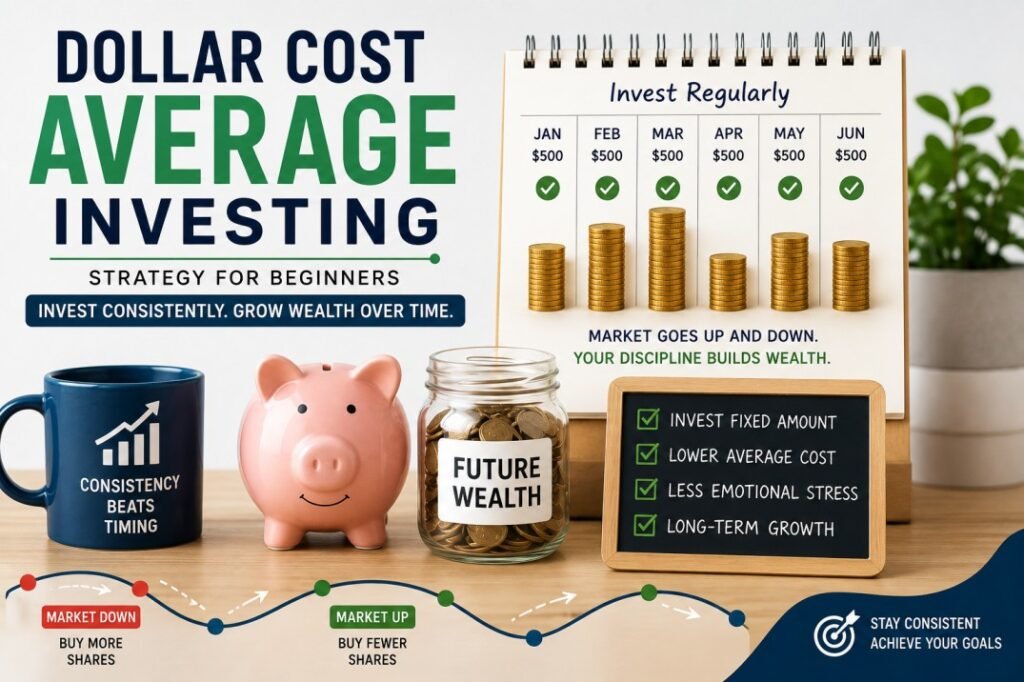
Dollar Cost Average Investing is an investment strategy where you invest the same amount of money at regular intervals, regardless of market conditions.
Instead of investing a large amount all at once, your money enters the market gradually.
For example:
Suppose you decide to invest $500 every month into an S&P 500 index fund.
You continue investing:
- January: $500
- February: $500
- March: $500
- April: $500
Even if the market experiences significant ups and downs during these months, you continue following your plan.
The focus is not on predicting market movements but on building wealth through consistency.
The Core Principle Behind Dollar Cost Average Investing
The strategy works because the same investment amount purchases different numbers of shares depending on market prices.
When prices decline:
- Your fixed investment buys more shares.
When prices rise:
- Your investment buys fewer shares.
Over time, this can result in a lower average purchase price than making random investment decisions based on emotions.
It’s important to understand that Dollar Cost Average Investing doesn’t always produce a lower average cost than every alternative. However, it provides a systematic approach that many investors find easier to follow over the long term.
How Dollar Cost Average Investing Works
Let’s look at a simple example.
Suppose an investor contributes $500 every month to the same investment.
| Month | Share Price | Monthly Investment | Shares Purchased |
|---|---|---|---|
| January | $50 | $500 | 10.00 |
| February | $40 | $500 | 12.50 |
| March | $25 | $500 | 20.00 |
| April | $35 | $500 | 14.29 |
| May | $45 | $500 | 11.11 |
| June | $55 | $500 | 9.09 |
Total invested: $3,000
Total shares purchased: 76.99 shares
Average purchase price: Approximately $38.97 per share
Notice how the investor purchased significantly more shares during March, when prices were at their lowest. This happens automatically without trying to predict market bottoms.
A Real-Life Example
Imagine two friends, Sarah and Michael.
Sarah checks financial news every day. She wants to invest but keeps waiting for the “perfect” opportunity. Every time the market rises, she thinks prices are too high. When the market falls, she worries it will fall even more.
Months pass without investing.
Michael chooses a different approach.
He sets up an automatic investment of $300 every month into a diversified index fund. Sometimes he buys when prices are high, and sometimes when prices are low. He doesn’t worry about daily market movements because his plan remains the same.
Years later, Michael has consistently accumulated investments while Sarah is still trying to decide when to start.
This example highlights one of the biggest strengths of Dollar Cost Average Investing: it helps investors overcome procrastination and emotional decision-making.
Why Many Beginners Prefer Dollar Cost Average Investing
Investing can trigger powerful emotions. Watching markets fluctuate every day often leads beginners to make decisions based on fear or excitement instead of long-term goals.
Dollar Cost Average Investing creates a structured process that reduces the need to constantly evaluate market conditions.
Some reasons beginners appreciate this approach include:
Lower Emotional Stress
Investors no longer feel pressured to predict short-term market movements.
Simple to Automate
Many brokerage platforms allow automatic recurring investments, making it easier to stay disciplined.
Works Well With Regular Income
People who receive paychecks every two weeks or monthly can align investments with their income schedule.
Builds Consistent Habits
Successful investing often depends more on consistency than perfection. Dollar Cost Average Investing encourages regular saving and investing over many years.
Common Investments Used with Dollar Cost Average Investing
The strategy is flexible and can be applied across many investment types.
Popular options include:
Index Funds
Broad market index funds are commonly used because they provide diversification across many companies.
Exchange-Traded Funds (ETFs)
ETFs can also be purchased regularly through many brokerage accounts.
Mutual Funds
Many mutual funds allow automatic monthly investment plans, making Dollar Cost Average Investing convenient.
Individual Stocks
Some investors also use the strategy for individual companies. However, concentrating investments in a single stock generally involves higher risk than investing in diversified funds.
Does Dollar Cost Average Investing Eliminate Risk?
No.
This is one of the biggest misconceptions among new investors.
Dollar Cost Average Investing helps manage timing risk, but it does not eliminate the risks associated with investing.
Investments can still:
- Lose value
- Experience prolonged market declines
- Be affected by economic recessions
- Face company-specific risks (for individual stocks)
For this reason, investors should focus not only on how they invest but also on what they invest in.
Diversification, appropriate asset allocation, and investing according to your financial goals remain essential.
The Importance of Staying Consistent
The greatest benefit of Dollar Cost Average Investing isn’t simply buying shares at different prices—it’s encouraging investors to remain committed during all market conditions.
History has shown that financial markets experience periods of growth, corrections, and recoveries. Investors who continue investing through these cycles often avoid the costly mistake of trying to time every market move.
Consistency doesn’t guarantee higher returns, but it can help build disciplined investing habits that support long-term financial goals.
Benefits of Dollar Cost Average Investing
Dollar Cost Average Investing has become one of the most popular strategies for beginner investors because it emphasizes consistency over prediction. While it cannot eliminate investment risk, it offers several advantages that can make long-term investing more manageable.
1. Reduces the Pressure of Market Timing
One of the biggest challenges for investors is deciding when to invest.
Even professional fund managers cannot consistently predict market highs and lows. Waiting for the “perfect” time often leads to missed opportunities.
With Dollar Cost Average Investing, you invest according to a schedule rather than trying to forecast the market.
Example:
Instead of waiting six months hoping for lower prices, an investor contributes $500 every month. If prices rise during that period, at least part of their money has already been invested.
2. Encourages Long-Term Discipline
Successful investing is often more about behavior than intelligence.
Many investors underperform because they:
- Panic during market downturns
- Stop investing after losses
- Buy only after markets have already risen significantly
Dollar Cost Average Investing creates a routine that helps investors stay focused on their long-term goals instead of reacting to short-term market news.
3. Reduces Emotional Decision-Making
Market volatility can trigger fear when prices fall and excitement when prices rise.
These emotions often lead investors to:
- Sell during market declines
- Buy after strong rallies
- Constantly change investment strategies
A predetermined investment schedule removes much of this emotional decision-making.
Instead of asking, “Should I invest this month?” the answer is already built into your plan.
4. Makes Investing Affordable
Not everyone has thousands of dollars available to invest at once.
Dollar Cost Average Investing allows people to start with smaller amounts.
For example:
- $100 per month
- $250 every paycheck
- $500 each month
Many brokerage platforms in the United States also support fractional shares, allowing investors to buy portions of expensive stocks or ETFs.
5. Buys More Shares During Market Declines
This is one of the most attractive features of the strategy.
When prices fall:
- Your fixed investment buys more shares.
When prices rise:
- Your investment buys fewer shares.
This happens automatically without requiring investors to predict market movements.
6. Fits Naturally With Regular Income
Most people receive income on a recurring schedule.
Dollar Cost Average Investing aligns well with:
- Weekly paychecks
- Bi-weekly salaries
- Monthly income
- Business income distributions
Investing shortly after receiving income can help establish a consistent saving habit before spending the money elsewhere.
7. Works Well for Retirement Accounts
Many retirement plans already use a Dollar Cost Average Investing approach.
Examples include:
- 401(k) plans
- 403(b) plans
- Traditional IRAs
- Roth IRAs
Employees often contribute automatically from each paycheck, helping them invest consistently over many years.
8. Helps New Investors Build Confidence
Beginners are often afraid of making a costly investing mistake.
Dollar Cost Average Investing lowers the psychological pressure because investors are not committing all of their money at one price.
Instead, they gradually gain experience while continuing to invest.
Risks and Limitations of Dollar Cost Average Investing
Although Dollar Cost Average Investing has many advantages, it is not perfect. Understanding its limitations is just as important as understanding its benefits.
1. It Does Not Guarantee Higher Returns
A common misconception is that Dollar Cost Average Investing always produces better returns.
That is not true.
If markets rise steadily over a long period, investing a lump sum at the beginning may generate higher returns because more money is invested earlier.
Dollar Cost Average Investing focuses on reducing timing risk—not maximizing returns in every market.
2. Investment Losses Are Still Possible
Buying at different prices does not eliminate investment risk.
If the underlying investment performs poorly, your portfolio can still lose value.
This is why choosing diversified, high-quality investments is just as important as selecting an investment strategy.
3. Longer Cash Holding Period
Instead of investing all available funds immediately, part of your money remains uninvested while waiting for future investment dates.
During a strong bull market, this cash may miss potential gains.
4. Requires Patience
Dollar Cost Average Investing is not designed for quick profits.
Its benefits become more meaningful over years rather than weeks or months.
Investors expecting rapid returns may become disappointed if they don’t understand its long-term nature.
5. Transaction Costs Can Matter
Although many U.S. brokerages now offer commission-free trading, some investment accounts may still charge fees.
Frequent investments could increase costs if commissions or transaction fees apply.
Before setting up an automatic investment plan, review your brokerage’s fee schedule.
Dollar Cost Averaging vs Lump Sum Investing
One of the most common questions beginners ask is:
Should I invest all my money at once or spread it out over time?
The answer depends on your financial situation, risk tolerance, and comfort level with market fluctuations.
Comparison Table
| Feature | Dollar Cost Average Investing | Lump Sum Investing |
|---|---|---|
| Investment Method | Fixed amount invested regularly | Entire amount invested immediately |
| Market Timing Risk | Lower | Higher |
| Emotional Pressure | Lower | Higher |
| Suitable for Beginners | Yes | Can be challenging |
| Best for Regular Income | Excellent | Less practical |
| Potential Return in Rising Markets | May be lower | Often higher |
| Risk of Investing Before a Market Decline | Reduced | Higher |
| Investment Discipline | Encourages consistency | Requires confidence and planning |
| Automation | Easy | Usually one-time investment |
When Dollar Cost Average Investing May Be Better
This strategy may be suitable if you:
- Receive income regularly.
- Feel uncomfortable investing a large amount all at once.
- Prefer reducing the impact of short-term market swings.
- Are new to investing.
- Want a disciplined, automated investing approach.
For detailed information about Investing in an S&P 500 Fund: The Ultimate Beginner
When Lump Sum Investing May Be Better
Lump sum investing may be worth considering if you:
- Receive a large inheritance or bonus.
- Already have cash available for investing.
- Have a long investment horizon.
- Are comfortable with market volatility.
- Understand that markets historically have tended to rise over long periods, although future performance is never guaranteed.
For detailed information about Capital Group American Funds
Which Strategy Is Better?
There is no universal answer.
Research has shown that because markets have historically trended upward over long periods, lump sum investing has often outperformed Dollar Cost Average Investing when a large amount of money is available from the start.
However, many investors prefer Dollar Cost Average Investing because it reduces emotional stress and the fear of investing just before a market decline.
Ultimately, the best strategy is the one you can follow consistently while staying invested for the long term.
Pros and Cons of Dollar Cost Average Investing
| Pros | Cons |
|---|---|
| Reduces emotional investing | Does not eliminate investment risk |
| Lowers timing risk | May underperform lump sum investing in rising markets |
| Easy to automate | Requires patience and consistency |
| Suitable for beginners | Cash may remain uninvested for some time |
| Fits regular income | Frequent purchases may create small transaction costs in some accounts |
| Encourages disciplined investing | No guarantee of profits |
Who Should Consider Dollar Cost Average Investing?
This strategy may be a good fit for:
First-Time Investors
Beginners often find it easier to invest smaller amounts regularly rather than committing a large sum all at once.
Long-Term Investors
People investing for goals that are many years away—such as retirement, children’s education, or building long-term wealth—may benefit from the consistency this strategy encourages.
Salaried Employees
Employees receiving regular paychecks can align automatic investments with each payday.
Retirement Savers
Investors contributing to retirement accounts such as a 401(k) or IRA often use Dollar Cost Average Investing without even realizing it through payroll deductions.
Investors Who Prefer Automation
Those who don’t want to monitor the stock market daily can automate contributions and stay focused on their long-term plan.
Who May Want to Consider Other Approaches?
Dollar Cost Average Investing may not always be the best choice for everyone.
For example:
Investors With a Large Lump Sum
If you already have a substantial amount available to invest and have a long investment horizon, lump sum investing may provide greater exposure to potential market growth. However, it also exposes the entire amount to immediate market fluctuations.
Experienced Investors With a Defined Strategy
Some experienced investors use different approaches based on their broader portfolio management strategy, asset allocation, or rebalancing plans.
Short-Term Investors
If your investment goal is only a few months away, market volatility can have a greater impact. In such cases, lower-risk options may be more appropriate depending on your financial objectives.
Can You Combine Both Strategies?
Yes.
Many investors use a hybrid approach.
For example:
- Invest part of a large cash amount immediately.
- Spread the remaining amount over several months using Dollar Cost Average Investing.
This approach allows investors to gain market exposure while reducing the emotional impact of investing everything at once.
There is no single strategy that works for everyone. Your decision should reflect your financial goals, investment timeline, risk tolerance, and overall financial plan.
For detailed information about Ave Maria Funds Review 2026
Practical Examples of Dollar Cost Average Investing
Understanding a strategy is one thing-seeing it in action makes it much easier to appreciate its value. The following examples show how Dollar Cost Average Investing works in different real-life situations.
Example 1: Investing Through Market Volatility
Suppose Emma decides to invest $500 every month in an S&P 500 index fund.
Here’s how her investments look over six months.
| Month | Investment | Share Price | Shares Purchased |
|---|---|---|---|
| January | $500 | $50 | 10.00 |
| February | $500 | $45 | 11.11 |
| March | $500 | $35 | 14.29 |
| April | $500 | $40 | 12.50 |
| May | $500 | $48 | 10.42 |
| June | $500 | $55 | 9.09 |
Total Invested: $3,000
Because prices fell in February and March, Emma automatically bought more shares during those months. She didn’t have to predict the market decline or make emotional decisions.
This illustrates one of the core strengths of Dollar Cost Average Investing: it turns market volatility into an opportunity to accumulate more shares when prices are lower.
Example 2: Investing During a Bull Market
Now imagine the market rises steadily throughout the year.
| Month | Share Price |
|---|---|
| January | $50 |
| February | $52 |
| March | $55 |
| April | $58 |
| May | $61 |
| June | $64 |
Emma still invests the same $500 each month.
In this scenario, she purchases fewer shares over time because prices continue to increase.
If she had invested the entire $3,000 in January, her investment might have benefited more from the rising market.
This example highlights an important point:
Dollar Cost Average Investing prioritizes consistency and reducing timing risk-not maximizing returns in every market environment.
Example 3: Investing During a Market Correction
Many beginners become nervous when markets decline sharply.
Imagine the stock market falls 20% over several months.
An investor using Dollar Cost Average Investing continues making regular investments instead of stopping.
Although it can feel uncomfortable to buy during a downturn, those purchases are made at lower prices. If the market eventually recovers, the shares purchased during the decline may contribute positively to long-term growth.
Of course, market recoveries are never guaranteed, and investment values can fluctuate over time. This example simply illustrates why long-term investors often remain disciplined during periods of volatility.
For detailed information about Best Charles Schwab Money Market Funds
How to Start Dollar Cost Average Investing
One of the biggest advantages of this strategy is its simplicity.
You don’t need advanced investing knowledge or constant market analysis to get started.
Step 1: Define Your Financial Goal
Before investing, identify why you’re investing in the first place.
Common goals include:
- Retirement
- Building long-term wealth
- Buying a home
- College savings
- Financial independence
Your goal helps determine your investment horizon and risk tolerance.
Step 2: Build an Emergency Fund First
Before investing in the stock market, it’s generally wise to have an emergency fund for unexpected expenses.
Many financial experts recommend keeping several months’ worth of essential living expenses in a readily accessible account, though the right amount depends on your personal circumstances.
Having emergency savings may reduce the likelihood of selling investments during a market downturn to cover unexpected costs.
Step 3: Choose an Appropriate Investment Account
U.S. investors commonly use accounts such as:
- Employer-sponsored 401(k) plans
- Traditional IRA
- Roth IRA
- Taxable brokerage account
- Health Savings Account (HSA), if eligible
The most suitable account depends on your financial goals, tax situation, and eligibility requirements. Consider reviewing the latest IRS rules or consulting a qualified tax professional if you have questions.
Step 4: Select Your Investments Carefully
Dollar Cost Average Investing can be used with many different investments.
Examples include:
- Broad market index funds
- Exchange-Traded Funds (ETFs)
- Mutual funds
- Diversified stock portfolios
Rather than chasing recent winners, focus on investments that align with your long-term objectives and risk tolerance.
Remember to verify current details such as expense ratios, fund objectives, holdings, and historical performance from the fund provider’s official website before investing.
Step 5: Decide How Much to Invest
Choose an amount that comfortably fits within your monthly budget.
For example:
- $100 per month
- $250 every two weeks
- $500 monthly
- 10% of every paycheck
The amount is less important than your ability to invest consistently over time.
Step 6: Automate Your Investments
Automation is one of the easiest ways to stay disciplined.
Many brokerage firms allow recurring investments on a weekly, bi-weekly, or monthly schedule.
Automatic investing can help remove the temptation to delay contributions based on short-term market news.
Step 7: Review Periodically-Not Daily
Checking your portfolio every day can lead to emotional decision-making.
Instead, consider reviewing your investments periodically-such as quarterly or annually-to ensure they still align with your financial goals.
Frequent monitoring doesn’t necessarily improve long-term investment outcomes.
Common Mistakes Beginners Should Avoid
Even a simple investment strategy can become less effective if investors make avoidable mistakes.
Here are some common pitfalls.
1. Trying to Time the Market
Many investors pause their regular investments because they expect prices to fall further.
Unfortunately, consistently predicting market movements is extremely difficult.
Skipping investments while waiting for “the perfect moment” can result in missed opportunities.
2. Stopping Investments During Market Declines
Market downturns often cause fear.
Some investors stop investing precisely when prices are lower.
While no one knows how long a downturn will last, abandoning a long-term plan because of short-term volatility can undermine the discipline that Dollar Cost Average Investing is designed to build.
3. Investing More Than You Can Afford
Consistency matters more than investing an amount that strains your finances.
If your investment contributions leave you unable to cover essential expenses, you may be forced to sell investments at an unfavorable time.
Choose an investment amount you can realistically maintain.
4. Ignoring Diversification
Dollar Cost Average Investing is a strategy—not an investment itself.
Investing regularly in a poorly diversified portfolio still exposes you to unnecessary risk.
Consider spreading investments across different companies, industries, or asset classes where appropriate.
5. Chasing Popular Stocks
Social media trends and headlines can tempt investors to abandon their long-term plan.
Instead of constantly switching investments, stay focused on your overall financial objectives.
Remember that past performance does not guarantee future results.
6. Forgetting to Increase Contributions
As your income grows, your investments may not keep pace if you continue contributing the same amount year after year.
For example:
- Start with $200 per month.
- Increase to $250 after a salary raise.
- Increase again as your financial situation improves.
Gradually increasing contributions can have a meaningful impact over the long term.
7. Expecting Quick Results
Dollar Cost Average Investing is not a get-rich-quick strategy.
Its strength lies in consistency over many years.
Investors who expect significant gains within a few months may become discouraged and abandon their plan too early.
For detailed information about Best REIT Stocks to Buy in the USA
Best Practices for Long-Term Success
The following habits can help you make the most of Dollar Cost Average Investing.
Invest Consistently
The strategy works best when you follow your schedule through both rising and falling markets.
Focus on Long-Term Goals
Daily market movements are less important than your long-term investment horizon.
Keep your attention on your financial objectives rather than short-term headlines.
Reinvest Dividends When Appropriate
If your investments pay dividends, reinvesting them may help increase the number of shares you own over time through compounding.
Whether dividend reinvestment is appropriate depends on your financial goals and cash flow needs.
Review Your Portfolio Periodically
Markets change, and so do personal financial goals.
Review your portfolio periodically to ensure your investments remain aligned with your objectives, but avoid making frequent changes based solely on market noise.
Continue Learning
Investment knowledge develops over time.
Reading educational resources, understanding basic portfolio concepts, and staying informed about personal finance can help you make more confident decisions.
For detailed information about Best Vanguard Mutual Funds
Frequently Asked Questions (FAQs)
1. What is Dollar Cost Average Investing?
Dollar Cost Average Investing is a strategy where you invest a fixed amount of money at regular intervals, regardless of market prices. This approach promotes consistency and reduces the need to predict market movements.
2. Is Dollar Cost Average Investing good for beginners?
Yes. It is often considered beginner-friendly because it encourages disciplined investing, reduces emotional decision-making, and works well with regular income.
3. Does Dollar Cost Average Investing guarantee profits?
No.
No investment strategy can guarantee profits or protect against losses. Investment returns depend on market performance and the specific investments you choose.
4. Can I use Dollar Cost Average Investing with ETFs?
Yes.
Many investors use this strategy with ETFs, index funds, mutual funds, and even diversified stock portfolios.
5. How often should I invest?
Many investors contribute:
- Weekly
- Every two weeks
- Monthly
The best schedule is one you can maintain consistently over the long term.
6. Is Dollar Cost Average Investing better than lump sum investing?
It depends.
Historically, lump sum investing has often produced higher returns in rising markets because more money is invested sooner. However, Dollar Cost Average Investing can reduce timing risk and may be easier for investors who receive regular income or prefer a more gradual approach.
7. What happens if the market keeps falling?
Your regular contributions continue purchasing shares at lower prices.
While this can lower your average cost per share over time, there is no guarantee that the market will recover quickly—or at all. Long-term investors should ensure their investment strategy matches their goals and risk tolerance.
8. Can I stop Dollar Cost Average Investing?
Yes.
You can adjust, pause, or stop your investment plan whenever your financial circumstances change. However, making changes based solely on short-term market movements may interfere with a disciplined long-term strategy.
9. How much money do I need to start?
Many brokerage platforms allow investors to begin with relatively small amounts, sometimes as little as $25 or $50 per recurring investment. Minimum investment requirements vary by broker and investment product.
10. Is Dollar Cost Average Investing suitable for retirement planning?
For many people, yes.
Regular contributions to retirement accounts such as a 401(k) or IRA often follow a Dollar Cost Average Investing approach through automatic payroll deductions. Whether this strategy is appropriate for you depends on your financial goals, time horizon, and overall retirement plan.
For detailed information about Best Fidelity Index Funds for Beginners
Conclusion
For many beginners, the hardest part of investing is not choosing a stock or fund—it’s getting started and staying consistent. Dollar Cost Average Investing offers a simple, disciplined approach that removes much of the stress associated with trying to predict market movements.
By investing a fixed amount at regular intervals, you naturally buy more shares when prices are lower and fewer when prices are higher. Over time, this approach can help smooth out your average purchase price while encouraging a long-term investing mindset. Although it does not eliminate market risk or guarantee positive returns, it can reduce the emotional pressure that often leads investors to make poor timing decisions.
Whether you’re investing through a 401(k), IRA, taxable brokerage account, or building a diversified ETF or index fund portfolio, Dollar Cost Average Investing can be an effective strategy for steadily working toward your financial goals.
It’s also important to remember that this strategy is only one part of a successful investment plan. Your long-term results will also depend on factors such as:
- Choosing diversified investments
- Maintaining an appropriate asset allocation
- Keeping investment costs low
- Staying invested through market cycles
- Reviewing your portfolio periodically
- Aligning your investments with your financial goals and risk tolerance
For investors with regular income, automating investments can make consistency almost effortless. For those who receive a large lump sum, it may be worth comparing Dollar Cost Average Investing with lump sum investing based on personal circumstances, investment horizon, and comfort with market volatility.
Above all, avoid making investment decisions based on fear, excitement, or short-term market headlines. A thoughtful, long-term strategy combined with patience and discipline is often more valuable than trying to predict the next market move.
For detailed and updated information about educational resources on investing, diversification, and long-term planning
Key Takeaways
- Dollar Cost Average Investing involves investing a fixed amount on a regular schedule.
- The strategy reduces the need to time the market.
- It helps investors develop disciplined, long-term investing habits.
- Investors automatically purchase more shares when prices are lower and fewer when prices are higher.
- It works well for retirement accounts, ETFs, mutual funds, index funds, and diversified portfolios.
- The strategy does not eliminate investment risk or guarantee profits.
- Lump sum investing may outperform during steadily rising markets, but Dollar Cost Average Investing can reduce emotional investing and timing risk.
- Diversification, patience, and consistency remain essential for long-term investing success.
- Review your investment plan periodically and verify current fund information, fees, and tax rules using official sources before investing.
Author’s Note: I’ve been investing in mutual funds and stocks since 2018 and have practical experience in business and personal finance. While I’m not a licensed financial advisor or investment professional, I write educational content based on years of hands-on investing experience, business knowledge, extensive research, and reliable sources. My goal through TheInvestorStory.com is to simplify investing, personal finance, business, and financial concepts so readers can make more informed financial decisions.
Disclaimer: The content provided is for educational and informational purposes only and should not be considered financial, investment, insurance, or legal advice.



Pingback: Fidelity Investments Roth IRA for Beginners: Complete 2026 Guide
Pingback: BlackRock Mutual Funds for Beginners: Complete Investing Guide